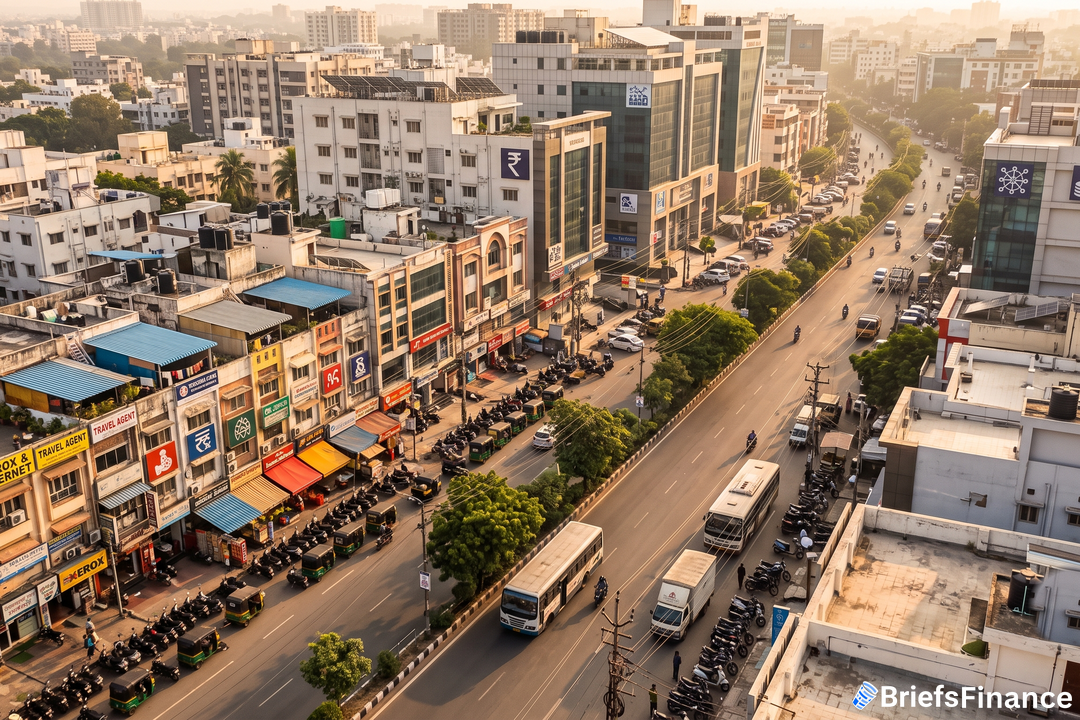
The Data That This Index Provides
India's statistics ministry released a trial version of the Index of Services Production. The statement highlighted strong performance in accommodation and food services, retail trade, administrative and support activities, and real estate sectors. Only two sub-sectors - air transport and railway transport - recorded declines over the previous year.
The ISP covers 19 distinct sub-sectors and is designed to offer policymakers a rapid view of service activities, representing more than half of India's total economic output.
The ministry noted that the monthly ISP for each category - using 2024-25 as the base year - is currently experimental and only encompasses the formal sector.
Why This Index Matters
Introducing a monthly services index addresses a missing component in India's economic data framework. While the Index of Industrial Production (IIP) has long provided monthly readings for manufacturing, mining, and electricity, services - the largest contributor to GDP - lacked a comparable high-frequency indicator. The trial data for April showed broad-based strength, underscoring the sector's resilience.
Get the market news that matters in a five-minute read with Market Briefs, our free daily newsletter
The ISP's release addresses a long-standing need for more frequent monitoring of the services economy. For years, analysts had to rely on quarterly GDP data or indirect proxies to gauge the health of sectors such as information technology, finance, and retail. The monthly index, even in its experimental form, gives a much earlier signal of trends.
The launch of the ISP reflects a broader effort by the Indian government to improve the timeliness and granularity of economic data. Previously, policymakers had to rely on quarterly GDP releases or proxy indicators like GST collections and bank credit to assess services activity. With monthly data now available, analysts can more quickly identify shifts in consumer spending, tourism, and business services.
The index's limited formal-sector coverage, however, means it currently excludes millions of workers in unorganized retail, street vending, and small hospitality businesses. Expanding the index to include these areas remains a key priority.
The services sector's dominance in India's economy makes timely data crucial for policy decisions. Unlike the industrial sector, which has long benefited from monthly IIP reports, services lacked such frequency, forcing reliance on quarterly GDP figures. The experimental ISP, even in its limited formal-sector scope, provides an early glimpse into trends across retail, hospitality, and real estate. As the index undergoes user testing, its eventual expansion to include informal services - a major employment source - could transform economic planning in India.
The government expects that after a period of user testing and validation, the index can be expanded to cover informal services, which still employ a large share of India's workforce. Such an expansion would make the ISP a truly comprehensive tool for economic planning.
What Policymakers Said
At a press conference in New Delhi, Chief Economic Advisor V Anantha Nageswaran said the new trial data will help "put the services sector on the same footing as industrial production data." Nageswaran added, "Unveiling the series will make sure the data set is tested and validated by users before it can be transformed into an index."
Join Market Briefs, our free daily newsletter, for a quick daily rundown of the markets