Free NewsletterPro Login
S&P 500 6,287 +0.42%
DOW 44,521 -0.18%
NASDAQ 21,103 +0.71%
S&P 500 +12.4%
Briefs Finance Fund +24.8%
JOIN THE FUND →

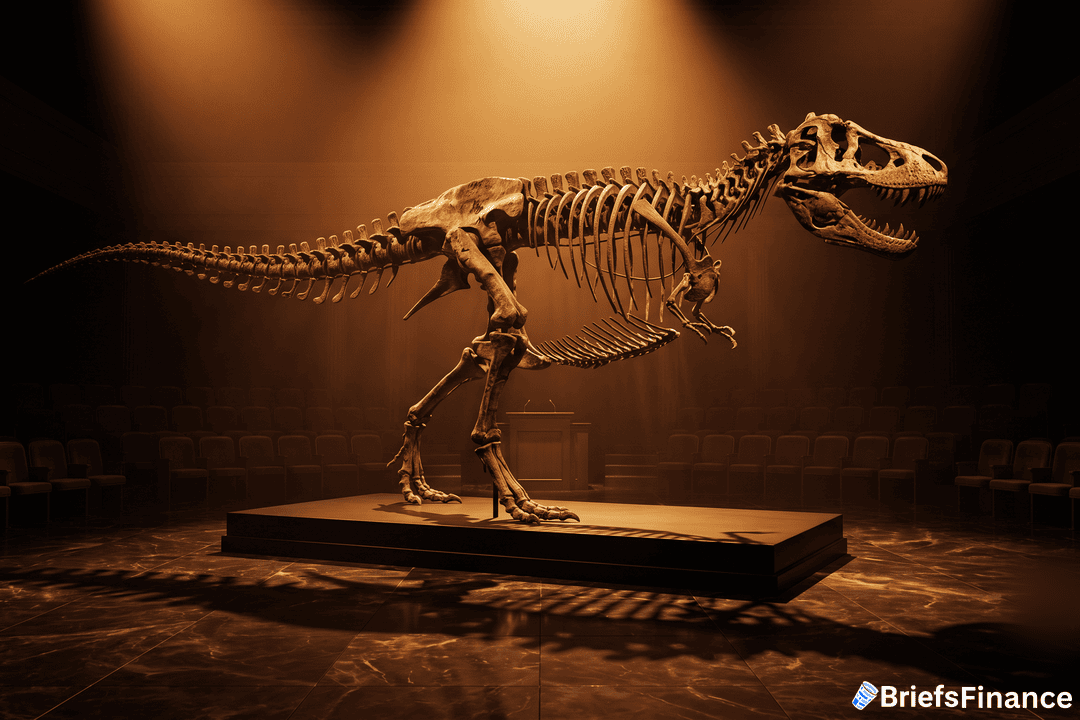
Gus the T. Rex Sets New Auction Record at $50.1 Million

Published Jul 14, 2026
[tts_player]
Share:
Summary:
  • A Tyrannosaurus rex skeleton named Gus sold for $50.1 million at a Sotheby's auction, setting a new record for a dinosaur fossil.
  • The bidding lasted only 10 minutes, surpassing the previous record of $44.6 million for a stegosaurus called Apex in 2022.
  • The buyer's identity was not disclosed, reigniting debate over whether scientifically important fossils should remain in public hands.

A 10-Minute Auction That Made History

The previous record was set in 2022, when financier Ken Griffin paid $44.6 million for a stegosaurus named Apex. Before that, the top price for a T. Rex was $31.8 million for a specimen called Stan in 2020.

Sotheby's stated that Gus is one of the biggest and most wholly preserved dinosaur skeletons ever found. By bone count, the skeleton is 61% complete, and by bone mass, it reaches up to 80%. For comparison, Stan was roughly 65% complete based on bone count.

In a press release, Cassandra Hatton, who oversees Sotheby's science and natural history department, said, "Tyrannosaurus Rex is the most iconic pre-historic species in the fossil record, and Gus stands firmly among the greatest examples ever found."

Why Wealthy Collectors Are Racing for Dinosaurs

Over the past few years, wealthy collectors have shown growing fascination with dinosaur fossils, viewing them as unique investments that combine emotional appeal with the chance for substantial financial gains.

Get the market news that matters in a five-minute read with Market Briefs, our free daily newsletter

The buyer of Gus was not immediately clear. But the pattern is clear. Private collectors are willing to spend tens of millions for a skeleton. Some of them find ways to share their fossils with the public.

As an example, Todd Graves, the founder of the Raising Cane's Chicken Fingers fast-food chain, loaned a triceratops skull he owned to the Louisiana Art & Science Museum. Separately, Ken Griffin's dinosaur specimen Apex, a stegosaurus, is currently housed at New York's American Museum of Natural History under a loan agreement.

These loan arrangements let wealthy investors own a piece of natural history while keeping it where people can see it. But not everyone is happy about that compromise.

The Scientists vs. the Private Owners

Ahead of Tuesday's sale, the Society of Vertebrate Paleontology issued a statement reaffirming its stance that fossils of scientific importance ought to remain in the custody of public research institutions. "While spectacular dinosaur fossils capture the imaginations of people around the world, SVP emphasizes that specimens of this scientific importance represent far more than rare collectibles," the statement read.

That position has not slowed the market.

Gus's record-breaking price reflects a broader surge in the market for high-end fossils. With every new auction, the price threshold climbs, drawing greater interest from both billionaires and museums.

The auction's outcome further highlights the persistent tension between private ownership and scientific access. Many researchers worry that wealthy buyers may restrict access to important specimens for study and public education, even as some owners agree to loan their fossils to institutions.

The bottom line: The record sale shows that for the ultra-wealthy, the kind of rarity represented by a T. Rex like Gus is hard to beat.

Join Market Briefs, our free daily newsletter, for a quick daily rundown of the markets
Disclosure

Recent News

1 2 3 35

Get Market Briefs delivered to your inbox every morning for free!

No fluff. No noise. No politics. Just finance news you can read in 5 minutes.

Blogs

June 29, 2026
Portfolio Diversification: Why Putting All Your Eggs in One Basket Destroys Wealth
  • Real diversification means spreading investments across all 11 economic sectors plus bonds, alternatives, and cash so no single bet can sink the portfolio.
  • Different sectors perform at different times, so a diversified portfolio captures upswings while smoothing the brutal drawdowns that wipe out concentrated bets.
  • Total market index funds offer the simplest path to diversification, and annual rebalancing is what keeps the structure working over time.
Read More
June 29, 2026
Non Taxable Income: What It Is and Why It Matters
  • Non taxable income is money you receive that you don't owe income tax on.
  • The tax code treats workers, investors, and business owners very differently, and investors often come out ahead.
  • Learning how income is taxed is a quiet superpower for keeping more of what you earn.
Read More
June 29, 2026
Semiconductor Stocks: A Simple Guide for Investors
  • Semiconductor stocks are companies that design and make computer chips, the brains inside nearly every modern device.
  • The AI boom has turned chips into one of the market's most important and most watched groups.
  • They offer big growth potential, but come with high valuations and a notoriously cyclical history.
Read More
June 25, 2026
How Stocks Work: A Simple Guide for Beginners
  • A stock is a slice of ownership in a company - buy one, and you own a piece of the business.
  • You make money two ways: the share price rising over time, and dividends paid to shareholders.
  • The simplest path for most beginners is buying into the whole market through a low-cost index fund.
Read More
June 25, 2026
Stop Loss vs Stop Limit: What's the Difference?
  • A stop loss order sells your stock once it hits a trigger price, prioritizing getting you out.
  • A stop limit order only sells within a price range you set, prioritizing price over a guaranteed exit.
  • The trade-off: a stop loss almost always executes; a stop limit might not if the price moves too fast.
Read More
June 25, 2026
Energy Stocks: A Simple Guide for Investors
  • Energy stocks are companies that produce and supply the power the world runs on, from oil and gas to newer sources.
  • They make up one of the 11 sectors of the market and tend to move with energy prices and big-picture shifts.
  • Like any sector, the key is diversification and understanding the forces driving demand.
Read More
June 18, 2026
What Is a Stop Loss Order? A Simple Guide
  • A stop loss order automatically sells a stock once it falls to a price you set.
  • It's a tool to cap losses or lock in gains without watching the market all day.
  • It works best for active strategies, and can backfire if used carelessly on long-term holdings.
Read More
June 18, 2026
Best S&P 500 Index Fund: How to Choose One
  • The best S&P 500 index fund for most investors is simply the cheapest, most established one that tracks the index well.
  • Funds like VOO, IVV, and SPY all hold the same 500 companies, so the biggest difference is the fee.
  • Pick one, automate your buys, and let time do the heavy lifting.
Read More
June 17, 2026
What Are Penny Stocks? Risks and Rewards Explained
  • Penny stocks are very low-priced shares of very small companies, often trading for just a few dollars or less.
  • They promise huge gains but carry huge risks: low liquidity, high failure rates, and wild price swings.
  • Most investors are better served by quality companies and funds than by chasing cheap shares.
Read More
June 17, 2026
Best Stocks for Beginners With Little Money
  • The best stocks for beginners with little money usually aren't individual stocks at all - they're low-cost index funds.
  • You can start with $100 or less and use small, regular investments to build wealth over time.
  • Focus on diversification and consistency, not on picking the next big winner.
Read More
1 2 3 24
Share via
Copy link











