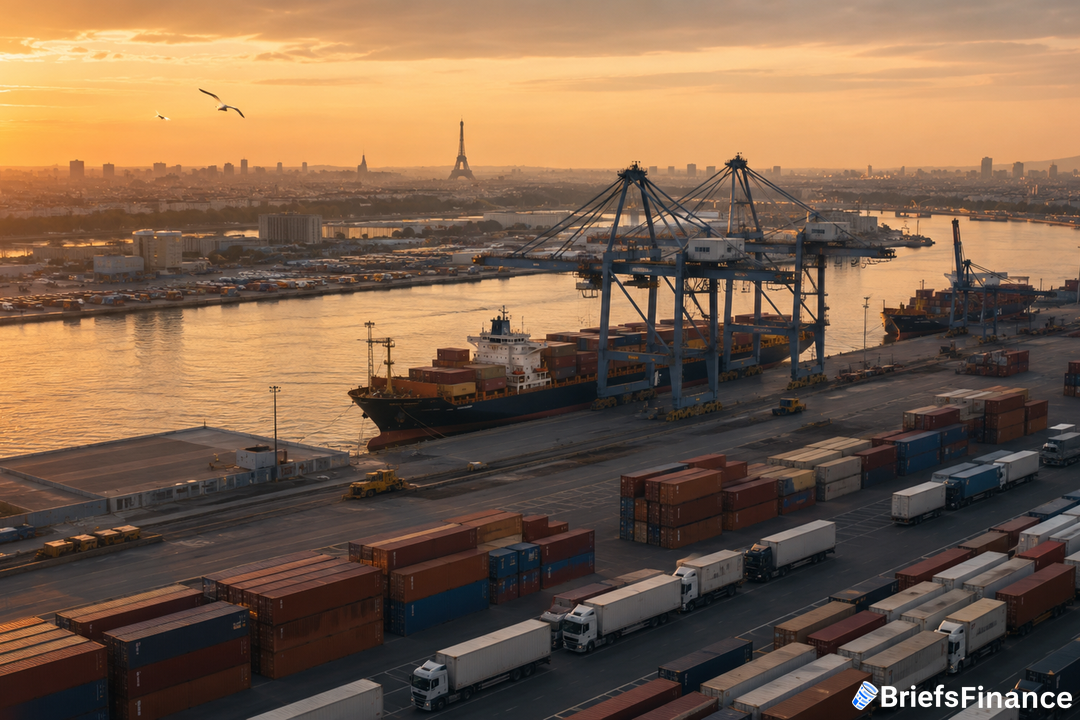
The French economy contracted in the first three months of 2026, but new central bank data shows a 0.2% growth rate for the second quarter, meaning the country is avoiding a recession.
The Bank of France's monthly business survey and hard data show stronger activity across industry, services, and construction. That marks a sharp reversal from the stagnation estimate.
The central bank revised its second-quarter GDP prediction upward from zero expansion to 0.2%. June saw a pickup in industrial activity, and both services and construction rebounded compared to May.
The central bank's chief economist, Xavier Debrun, said, "The improved second quarter would give a mechanical boost to the full-year number."
Companies continue to raise the prices they set for clients, though the rate of increase has decelerated from May. The monthly uncertainty indicator fell somewhat, back to where it stood prior to the Iran conflict.
Get the market news that matters in a five-minute read with Market Briefs, our free daily newsletter
The Deficit Squeeze
The French government had already cut its official 2026 growth forecast from 0.9% down to 0.7%. That made it harder to hit its deficit target of 5% of economic output. Finance Minister Roland Lescure acknowledged that hitting the goal of a modest decrease in the 2026 gap to 5% is now "difficult." The Bank of France's own full-year forecast sits at just 0.5%.
Debrun said, "There is a positive upside risk for the central bank's full-year forecasts, though it's not enormous."
Background and Context
France's economy shrank by 0.1% in the first quarter of 2026, driven by geopolitical turmoil and weak consumer demand. The Iran conflict had disrupted shipping routes and pushed up energy costs, dragging down industrial output. While the second-quarter uptick is modest, it lifts full-year prospects and eases fears of a technical recession - defined as two consecutive quarters of contraction.
However, the government's fiscal squeeze remains severe. With official growth now seen at 0.7% and the Bank of France even more cautious at 0.5%, meeting the 5% deficit target will require either higher tax revenues or deeper spending cuts. Social programs and defense commitments add further pressure.
The Iran conflict's effect on global supply chains has been particularly damaging for French manufacturers, who rely heavily on imported raw materials and energy. Although the uncertainty indicator has dropped back to pre-war levels, energy prices remain elevated, and some shipping routes have yet to fully normalize. This continuing drag on production costs and consumer confidence means the recovery in the second quarter may be fragile, and any renewed escalation could quickly reverse the gains seen in June.
Economic Outlook
The government's fiscal position remains under pressure. With the official growth forecast cut to 0.7%, achieving the 5% deficit target requires either stronger revenue or spending cuts. The Bank of France's more conservative estimate of 0.5% growth suggests further belt-tightening may be needed. Meanwhile, the easing of the uncertainty indicator to pre-Iran-war levels offers a glimmer of stability, though the conflict's lingering effects on energy prices and trade routes continue to pose risks.
Join Market Briefs, our free daily newsletter, for a quick daily rundown of the markets