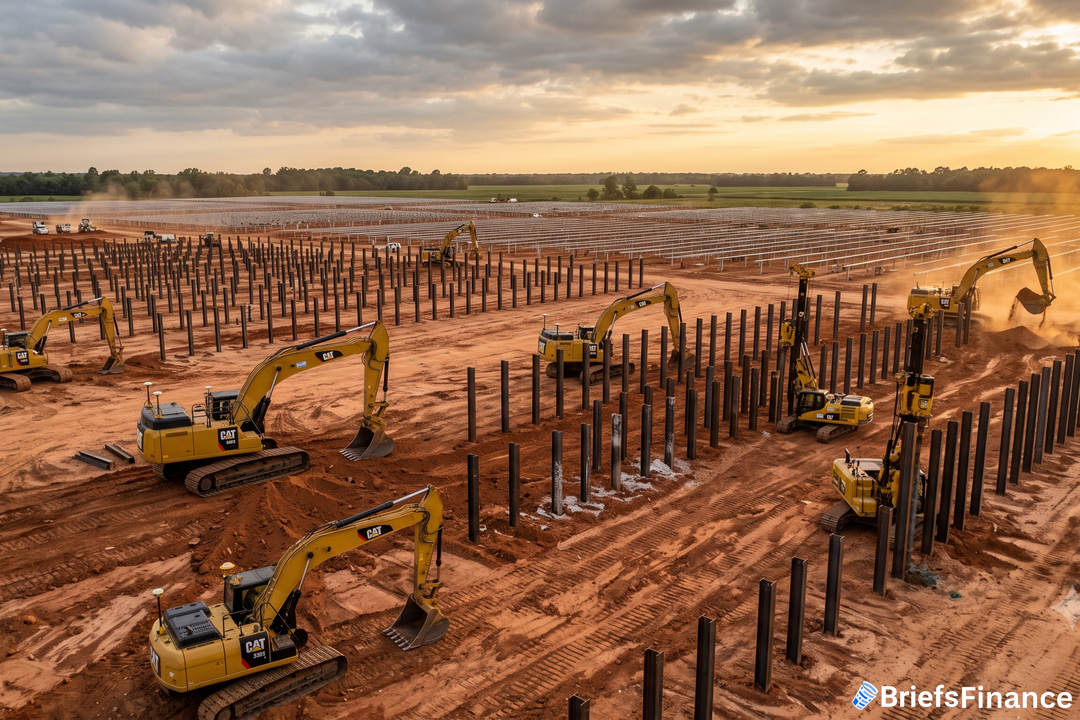
The construction industry needs to hire 349,000 net new workers in 2026. But the people aren't there. So at a solar farm in Louisiana, ten 72‑ton robots are doing the work of three to four times as many human crew members, driving steel beams into the ground from dawn until dusk.
"The pressure is on to build out the grid at a pace we've never seen before," said Noah Ready‑Campbell, co‑founder and CEO of Built Robotics.
The Robots at Work
Each autonomous machine is a standard Caterpillar excavator retrofitted with Built Robotics' software and sensors. The robots grab 200‑pound steel piles, position them, and hammer them into the earth.
Get your free investing masterclass bonus when you join Market Briefs, our free daily newsletter
The solar farm will supply power to Meta's Hyperion data center in Richland Parish, Louisiana, a computing facility that spans 3,650 acres. That data center is expected to need 2 gigawatts of electricity initially. The solar farm is being built by Blattner Energy, a renewable‑energy contractor that has worked with Built Robotics on seven previous projects.
"Nobody really wants to go back to that," Ready‑Campbell said, referring to the physically exhausting job of manually handling the heavy beams. He added that each worker effectively has to "deadlift half the weight of this beam" during installation.
Why Automation Is Taking Over
The construction industry is facing a severe labor shortage. Ready‑Campbell described projects where immigration enforcement picked up workers, and calls the shortage a "huge, huge problem." Meanwhile, the AI boom has put new pressure on the power grid, forcing developers to look for power behind the meter because they can't get enough electricity from the grid.
Built Robotics was founded in 2016 and has completed more than 40 project deployments. The company modifies heavy equipment made by Caterpillar, adding autonomous‑driving hardware and an AI model that runs on the robots. Ready‑Campbell said the model is tuned to be conservative: "If it sees anything that it thinks might be a human, it'll just stop the robot."
For now, the robots are focused on solar farm construction, a relatively new type of building where decision makers are "also a little more open‑minded," Ready‑Campbell noted.
Worth Noting
The robots don't get tired, don't need breaks, and don't complain about the Louisiana heat. "Because the robots don't care," Ready‑Campbell said. As the industry struggles to close its labor gap, these machines are expected to take on more hazardous and remote site conditions, freeing humans for less dangerous roles.
Subscribe to Market Briefs, our free daily newsletter, and claim your bonus investing masterclass