Free NewsletterPro Login
S&P 500 6,287 +0.42%
DOW 44,521 -0.18%
NASDAQ 21,103 +0.71%
S&P 500 +12.4%
Briefs Finance Fund +24.8%
JOIN THE FUND →

Toyota Benefits from Hybrid Boom as GM Faces Sales Drop in Q2 2026

Published Jul 1, 2026
[tts_player]
Share:
Summary:
  • Toyota's U.S. sales rose 1.1% in Q2, fueled by a roughly 20% jump in electrified vehicle sales.
  • Hyundai's hybrid sales surged 67% in the first half of 2026, helping overall Q2 sales climb 4%.
  • General Motors' total Q2 sales fell 4.2%, with EV sales plunging 33% amid high gas prices and falling EV demand.

Rising fuel costs and waning interest in fully electric cars have divided the U.S. auto market. Automakers with strong hybrid lineups gained ground, while those without them lost. The result is a two-tier market where winning and losing depend on the mix of vehicles sold.

The diverging fortunes of automakers reflect a fundamental shift in consumer preferences. With gas prices surging over 20% from 2025 levels, buyers increasingly opt for hybrids that combine fuel efficiency with the convenience of gasoline refueling, rather than committing to fully electric vehicles that depend on charging infrastructure. This trend has bolstered companies with strong hybrid lineups like Toyota and Hyundai, while punishing those like GM that focused heavily on all-electric models.

Hybrids Boom While EV Demand Cools

AAA reports that gasoline costs have risen over 20% compared to the same timeframe in 2025. That pushed many buyers toward fuel-efficient hybrids. Randy Parker, CEO of Hyundai and Genesis North America, said, "Hybrids are definitely our growth engine right now. Hybrids are really, really taking off right now as consumers, I think, are prioritizing fuel efficiency and lower operating costs due to high gas prices."

Get your free investing masterclass bonus when you join Market Briefs, our free daily newsletter

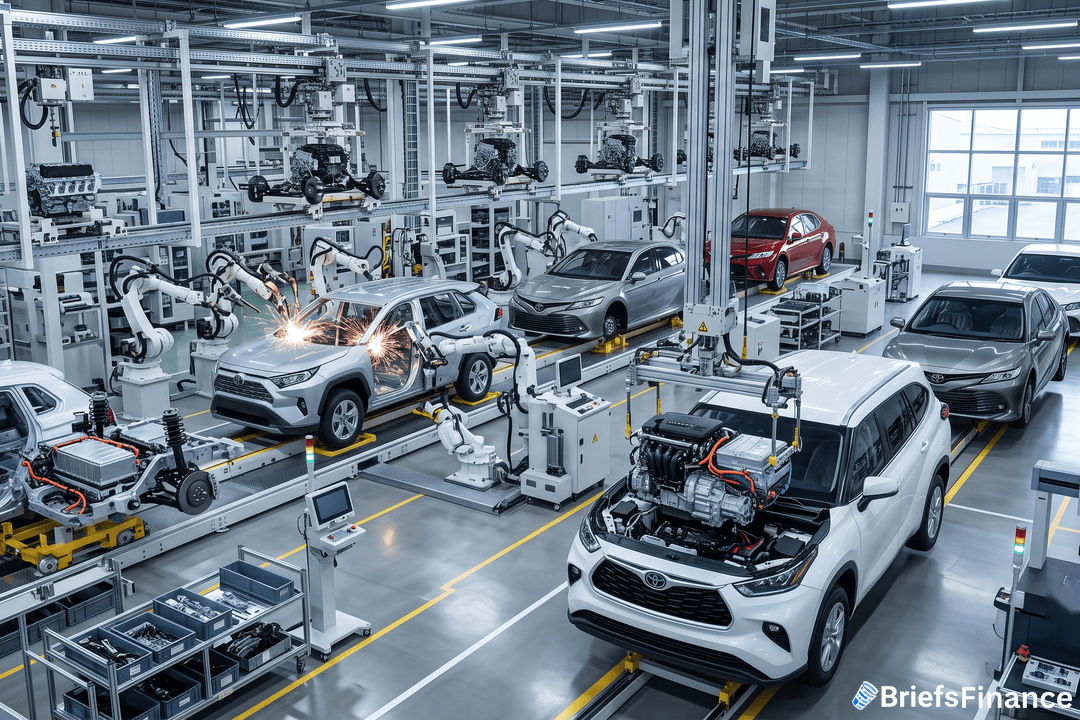
Kia posted a roughly 3% overall sales gain, with hybrid sales skyrocketing 152% in Q2. Honda reported an 8.4% overall sales increase, driven by record electrified sales. Toyota, the global hybrid leader, posted a 1.1% sales gain, with its electrified vehicles up about 20%.

Even automakers with limited hybrid offerings saw sales rise. Stellantis reported a 5.9% increase. Nissan gained 9.6%. Tiago Castro, Nissan's senior sales and marketing officer for the Americas, remarked, "At a time when customers are focused on maximizing the value of every dollar they spend, our lineup is delivering with strong quality, capability and the right mix of products."

GM Slips as Toyota Gains Ground

General Motors, America's best-selling automaker, sells numerous electric vehicles but has just a single hybrid model - the low-volume Corvette. That strategy backfired in Q2. GM's overall sales fell 4.2%.

EV sales dropped 33% compared to last year. All four GM brands declined: Cadillac down 19.2%, Buick down 7.5%, Chevrolet down 3.9%, and GMC down 0.3%. The Chevrolet Silverado pickup saw a 7.7% sales drop, and its electric version plunged 25.9%.

The GMC Sierra, however, managed a 5% increase, including double-digit increases for its electric and light-duty 1500 models.

GM President Duncan Aldred defended the company's position, saying, "Our business is performing well, and customer demand is resilient, especially for our trucks and SUVs. The depth, breadth and appeal of our vehicle portfolio allows us to lead the market in sales, while maintaining discipline on inventory, pricing and incentives to deliver strong margins."

But analysts see trouble. Cox Automotive's Charlie Chesbrough, an economist and director of industry insights, stated during a media event, "At these rates, and what we're seeing right now in the selling rates, GM may be looking over their shoulder here when we get to the year's end, that Toyota could potentially overtake them as the top selling manufacturer here in the U.S. market." Cox expects Ford's Q2 sales to fall 11.5% and Tesla's to drop more than 20%, because EV demand surged last year in anticipation that the Trump administration would eliminate the up to $7,500 tax credit for EV buyers. Cox Automotive predicted last week that full-year U.S. auto sales would fall 2.9% to 15.8 million vehicles, with retail sales dropping 3.4% and a June adjusted selling rate of 16.1 million.

Subscribe to Market Briefs, our free daily newsletter, and claim your bonus investing masterclass

Disclosure

Recent News

1 2 3 31

Get Market Briefs delivered to your inbox every morning for free!

No fluff. No noise. No politics. Just finance news you can read in 5 minutes.

Blogs

June 29, 2026
Portfolio Diversification: Why Putting All Your Eggs in One Basket Destroys Wealth
  • Real diversification means spreading investments across all 11 economic sectors plus bonds, alternatives, and cash so no single bet can sink the portfolio.
  • Different sectors perform at different times, so a diversified portfolio captures upswings while smoothing the brutal drawdowns that wipe out concentrated bets.
  • Total market index funds offer the simplest path to diversification, and annual rebalancing is what keeps the structure working over time.
Read More
June 29, 2026
Non Taxable Income: What It Is and Why It Matters
  • Non taxable income is money you receive that you don't owe income tax on.
  • The tax code treats workers, investors, and business owners very differently, and investors often come out ahead.
  • Learning how income is taxed is a quiet superpower for keeping more of what you earn.
Read More
June 29, 2026
Semiconductor Stocks: A Simple Guide for Investors
  • Semiconductor stocks are companies that design and make computer chips, the brains inside nearly every modern device.
  • The AI boom has turned chips into one of the market's most important and most watched groups.
  • They offer big growth potential, but come with high valuations and a notoriously cyclical history.
Read More
June 25, 2026
How Stocks Work: A Simple Guide for Beginners
  • A stock is a slice of ownership in a company - buy one, and you own a piece of the business.
  • You make money two ways: the share price rising over time, and dividends paid to shareholders.
  • The simplest path for most beginners is buying into the whole market through a low-cost index fund.
Read More
June 25, 2026
Stop Loss vs Stop Limit: What's the Difference?
  • A stop loss order sells your stock once it hits a trigger price, prioritizing getting you out.
  • A stop limit order only sells within a price range you set, prioritizing price over a guaranteed exit.
  • The trade-off: a stop loss almost always executes; a stop limit might not if the price moves too fast.
Read More
June 25, 2026
Energy Stocks: A Simple Guide for Investors
  • Energy stocks are companies that produce and supply the power the world runs on, from oil and gas to newer sources.
  • They make up one of the 11 sectors of the market and tend to move with energy prices and big-picture shifts.
  • Like any sector, the key is diversification and understanding the forces driving demand.
Read More
June 18, 2026
What Is a Stop Loss Order? A Simple Guide
  • A stop loss order automatically sells a stock once it falls to a price you set.
  • It's a tool to cap losses or lock in gains without watching the market all day.
  • It works best for active strategies, and can backfire if used carelessly on long-term holdings.
Read More
June 18, 2026
Best S&P 500 Index Fund: How to Choose One
  • The best S&P 500 index fund for most investors is simply the cheapest, most established one that tracks the index well.
  • Funds like VOO, IVV, and SPY all hold the same 500 companies, so the biggest difference is the fee.
  • Pick one, automate your buys, and let time do the heavy lifting.
Read More
June 17, 2026
What Are Penny Stocks? Risks and Rewards Explained
  • Penny stocks are very low-priced shares of very small companies, often trading for just a few dollars or less.
  • They promise huge gains but carry huge risks: low liquidity, high failure rates, and wild price swings.
  • Most investors are better served by quality companies and funds than by chasing cheap shares.
Read More
June 17, 2026
Best Stocks for Beginners With Little Money
  • The best stocks for beginners with little money usually aren't individual stocks at all - they're low-cost index funds.
  • You can start with $100 or less and use small, regular investments to build wealth over time.
  • Focus on diversification and consistency, not on picking the next big winner.
Read More
1 2 3 24
Share via
Copy link










