Free NewsletterPro Login
S&P 500 6,287 +0.42%
DOW 44,521 -0.18%
NASDAQ 21,103 +0.71%
S&P 500 +12.4%
Briefs Finance Fund +24.8%
JOIN THE FUND →

Meteorologists Say This El Niño Could Be One of the Strongest Measured Since 1950

Published Jul 11, 2026
[tts_player]
Share:
Summary:
  • Meteorologists expect this El Niño to be among the most intense since 1950, with ocean surface temperatures running 1°C above normal in the central and eastern equatorial Pacific.
  • There is a 97% probability the event will persist through early spring 2027, with no chance of a La Niña developing.
  • Early impacts include a sharp drop in Indian hydroelectric output and a reduced Atlantic hurricane forecast due to increased wind shear.

According to meteorologists, this El Niño may become one of the strongest since record-keeping started in 1950. But they also warn that even record-breaking events don't always produce the same results everywhere. "Even the strongest El Niño events do not lead to the typical impact everywhere," the U.S. Climate Prediction Center (CPC) says. The key word is probability - this event tilts the odds in favor of certain extreme weather.

What El Niño Means for Traders and Markets

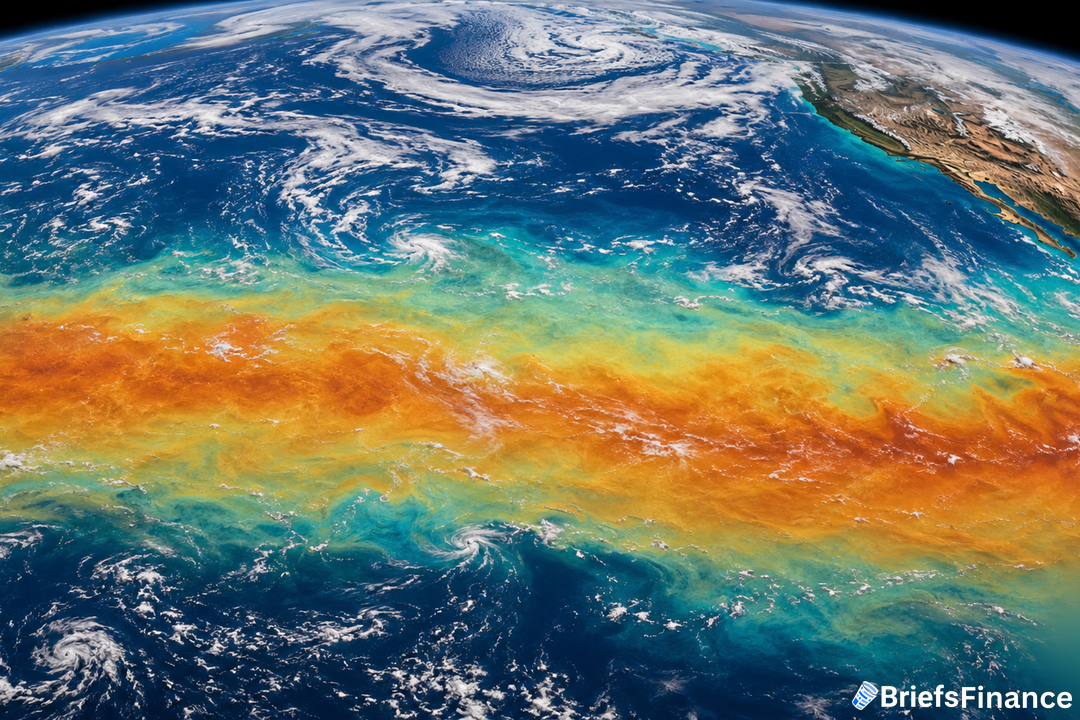
El Niño is a natural warming of ocean surface temperatures in the central and eastern Pacific. Right now, that warming covers a huge area and is running 1°C above normal. In the past week, some parts of the eastern Pacific were 2.7°C warmer than normal.

Forecasters at the CPC estimate an 81% likelihood that this El Niño will be classified as "very strong." It has already emerged last month and continues to build. That matters because financial traders, government agencies, and market analysts closely monitor El Niño due to its ability to cause flooding, drought, cold spells, and changes in hurricane patterns.

Get the market news that matters in a five-minute read with Market Briefs, our free daily newsletter

El Niño's typical effects include heavy rainfall and flooding along the western coast of South America, while parts of Southeast Asia and Australia often experience drier conditions, threatening agricultural yields. These contrasting impacts can disrupt supply chains for commodities such as coffee, cocoa, and sugar, adding to market uncertainty. Traders also watch for shifts in energy demand, as extreme temperatures can strain power grids and alter natural gas consumption patterns.

Impacts Already Showing Up

In the quarter ended June 2026, dam output in India decreased by roughly 7%, while coal, nuclear, and renewable sources stepped up production to satisfy all‑time‑high electricity demand fueled by extreme heat. India's depleted reservoirs - blamed on El Niño - have strained the power grid during peak summer consumption.

The 30-year average for the Atlantic basin is 14 named storms. By strengthening wind shear across the Caribbean, El Niño disrupts the formation of tropical storms and hurricanes.

These early disruptions illustrate how El Niño's reach extends beyond weather. The reduced Atlantic hurricane forecast could lower the risk of supply disruptions for oil and gas operations in the Gulf of Mexico, while the strain on India's hydroelectric dams forces greater reliance on coal and renewables. Meanwhile, the threat to agricultural yields in Southeast Asia and South America keeps commodity traders on edge, as coffee, cocoa, and sugar prices may swing with changing rainfall patterns.

What Forecasters Are Saying

That means the warming will persist for many months. The CPC's message is that stronger events tilt the odds, but they never guarantee a specific outcome.

Join Market Briefs, our free daily newsletter, for a quick daily rundown of the markets
Disclosure

Recent News

1 2 3 33

Get Market Briefs delivered to your inbox every morning for free!

No fluff. No noise. No politics. Just finance news you can read in 5 minutes.

Blogs

June 29, 2026
Portfolio Diversification: Why Putting All Your Eggs in One Basket Destroys Wealth
  • Real diversification means spreading investments across all 11 economic sectors plus bonds, alternatives, and cash so no single bet can sink the portfolio.
  • Different sectors perform at different times, so a diversified portfolio captures upswings while smoothing the brutal drawdowns that wipe out concentrated bets.
  • Total market index funds offer the simplest path to diversification, and annual rebalancing is what keeps the structure working over time.
Read More
June 29, 2026
Non Taxable Income: What It Is and Why It Matters
  • Non taxable income is money you receive that you don't owe income tax on.
  • The tax code treats workers, investors, and business owners very differently, and investors often come out ahead.
  • Learning how income is taxed is a quiet superpower for keeping more of what you earn.
Read More
June 29, 2026
Semiconductor Stocks: A Simple Guide for Investors
  • Semiconductor stocks are companies that design and make computer chips, the brains inside nearly every modern device.
  • The AI boom has turned chips into one of the market's most important and most watched groups.
  • They offer big growth potential, but come with high valuations and a notoriously cyclical history.
Read More
June 25, 2026
How Stocks Work: A Simple Guide for Beginners
  • A stock is a slice of ownership in a company - buy one, and you own a piece of the business.
  • You make money two ways: the share price rising over time, and dividends paid to shareholders.
  • The simplest path for most beginners is buying into the whole market through a low-cost index fund.
Read More
June 25, 2026
Stop Loss vs Stop Limit: What's the Difference?
  • A stop loss order sells your stock once it hits a trigger price, prioritizing getting you out.
  • A stop limit order only sells within a price range you set, prioritizing price over a guaranteed exit.
  • The trade-off: a stop loss almost always executes; a stop limit might not if the price moves too fast.
Read More
June 25, 2026
Energy Stocks: A Simple Guide for Investors
  • Energy stocks are companies that produce and supply the power the world runs on, from oil and gas to newer sources.
  • They make up one of the 11 sectors of the market and tend to move with energy prices and big-picture shifts.
  • Like any sector, the key is diversification and understanding the forces driving demand.
Read More
June 18, 2026
What Is a Stop Loss Order? A Simple Guide
  • A stop loss order automatically sells a stock once it falls to a price you set.
  • It's a tool to cap losses or lock in gains without watching the market all day.
  • It works best for active strategies, and can backfire if used carelessly on long-term holdings.
Read More
June 18, 2026
Best S&P 500 Index Fund: How to Choose One
  • The best S&P 500 index fund for most investors is simply the cheapest, most established one that tracks the index well.
  • Funds like VOO, IVV, and SPY all hold the same 500 companies, so the biggest difference is the fee.
  • Pick one, automate your buys, and let time do the heavy lifting.
Read More
June 17, 2026
What Are Penny Stocks? Risks and Rewards Explained
  • Penny stocks are very low-priced shares of very small companies, often trading for just a few dollars or less.
  • They promise huge gains but carry huge risks: low liquidity, high failure rates, and wild price swings.
  • Most investors are better served by quality companies and funds than by chasing cheap shares.
Read More
June 17, 2026
Best Stocks for Beginners With Little Money
  • The best stocks for beginners with little money usually aren't individual stocks at all - they're low-cost index funds.
  • You can start with $100 or less and use small, regular investments to build wealth over time.
  • Focus on diversification and consistency, not on picking the next big winner.
Read More
1 2 3 24
Share via
Copy link











