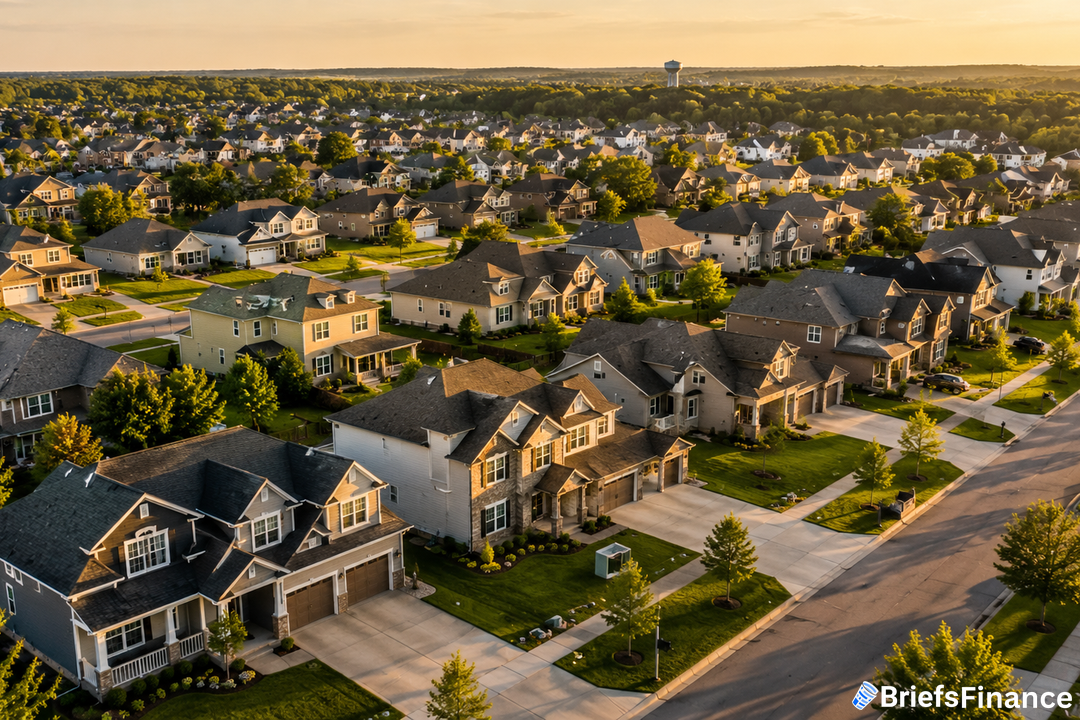
Home prices are setting fresh records, but the climb is almost imperceptible. Annual growth has stayed below 1% for nine consecutive months. That contradiction - new highs with barely any speed - defines today's housing market.
A Slow Climb to New Highs
Elevated mortgage rates and affordability pressures continue to suppress buyer activity, especially among first-time purchasers. This persistent constraint keeps price growth subdued even as inventory remains historically tight.
Luxury vs. Starter: A Tale of Two Markets
Growth is uneven across home types. Starter and mid-tier properties have lagged behind luxury homes, as wealthier buyers benefit from financial gains accumulated through rising home values and stock market returns. In Dallas, luxury home prices jumped 9.2% year-over-year. Starter homes in Dallas rose just 3.1%.
Get your free investing masterclass bonus when you join Market Briefs, our free daily newsletter
Nationally, the strongest annual increase in the starter-home segment was in St. Louis, at 8.6%. But first-time buyers still face tough conditions. Elevated mortgage rates and scarce inventory keep affordability out of reach for many.
"Housing market divergence is not just a regional story - it's also a story of market segments," said Mark Fleming, chief economist for First American Data & Analytics.
The gap between luxury and starter homes underscores an uneven market. While wealthier buyers leverage stock market gains and home equity, first-time buyers face a daunting combination of elevated mortgage rates and limited inventory.
The housing market's current dynamics stem from persistent inventory shortages. Tight supply persists because homeowners with low-rate mortgages are reluctant to sell and take on a higher-rate loan - though that specific reason is not stated in the report. What is clear is that the imbalance between limited inventory and modest demand has led to the unusual situation of record prices but minimal annual growth.
Regional Winners and Losers
Some metro areas are outperforming others. Pittsburgh rose 2.6%, Cambridge, Massachusetts, gained 1.9%, New Brunswick, New Jersey, was up 1.7%, and Anaheim, California, rose 1.6%. Orlando dropped 2.2%, Las Vegas fell 2.1%, Tampa declined 2.0%, and Oakland lost 1.7%.
These gaps reflect local supply and demand dynamics. Some markets still see strong buyer interest, while others are experiencing price declines.
The Bottom Line
In summary, the housing market appears stuck in a period of stagnation. Annual price growth has fallen significantly from the rapid increases seen during the pandemic, yet low inventory prevents any substantial drop in home values. For mortgage professionals, this means first-time buyers continue to face affordability challenges, while borrowers with substantial equity or high incomes will likely remain the primary drivers of activity in the near term.
"National house prices are making history in slow motion," Fleming stated. "While annual house price growth remains below 1 percent, the price level reached a new historical peak this month."
Subscribe to Market Briefs, our free daily newsletter, and claim your bonus investing masterclass