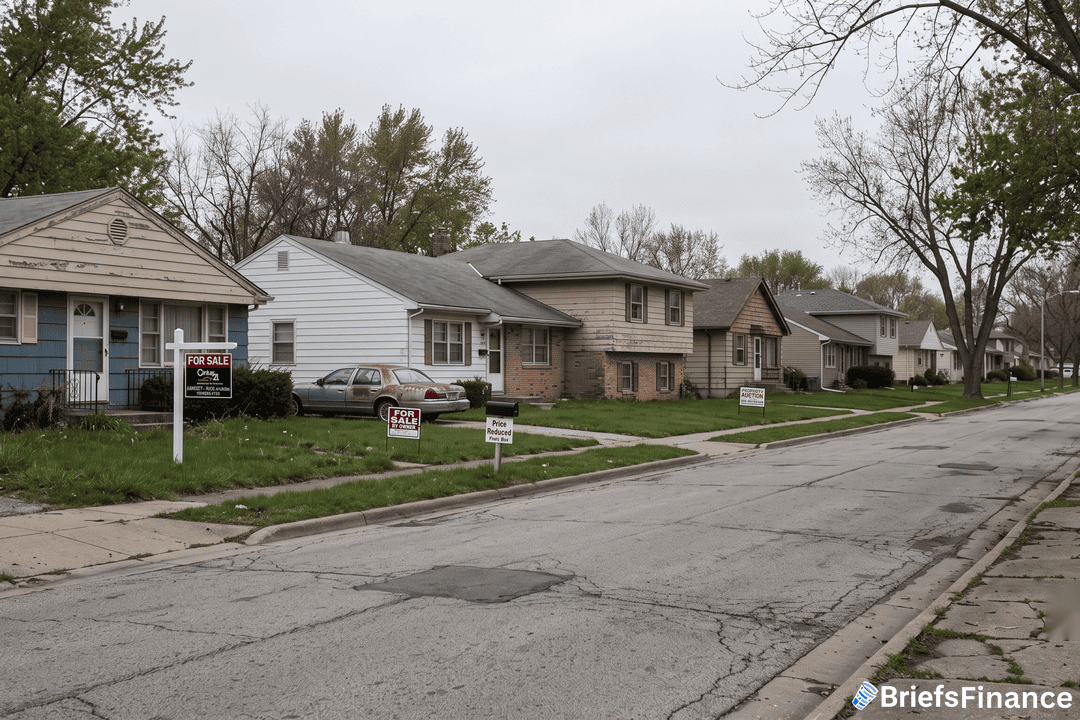
Home prices are barely moving higher, but inflation is eating those gains.
Nominal Gains Mask Real Losses
The national home price index reached 332.68 in April, up 0.77% from March. That month-over-month gain was slightly faster than March's 0.74% rise, but still tiny. "April's figures confirm that U.S. home prices remain essentially flat, with the S&P Cotality Case-Shiller National Home Price Index up a scant 0.8% year over year, just above March's 0.7% pace," said Nicholas Godec, who leads S&P Dow Jones Indices' fixed income tradables and commodities division.
The difficulty is that inflation, which was 3.8% in April, far exceeds that modest increase. The average 30-year mortgage rate in April was 6.3%, keeping affordability tight. "After dipping below 6% earlier this year, 30-year mortgage rates climbed back to 6.3% in April, keeping financing costs elevated," Godec added.
Regional Divide Widens
Geographic differences are stark. The 10-city composite index rose 1.8% year over year to 367.60, while the 20-city composite gained 1.1% to 324.43. But those averages hide big gaps.
Get your free investing masterclass bonus when you join Market Briefs, our free daily newsletter
"Geographic dispersion remains pronounced. "Midwest and Northeast markets are still leading moderate growth, while many Sun Belt and Western metros see ongoing declines"," Godec said.
Data from HousingWire for the week ending June 26, 2026 shows that among major U.S. metros, Chicago (up 7.3%), Atlanta (up 3.2%), and Miami (up 3.1%) posted the highest annual growth in median list prices.
Among the top-20 markets analyzed in the Case-Shiller index, Chicago posted the strongest annual gain at +6.5%, while Seattle was weakest at -2.3%. Completing the list of the top three markets for year-over-year home price growth in April were New York (+3.8%) and Cleveland (+3.2%), while at the bottom were Denver (-1.85%) and Tampa (-1.77%). The gap between the strongest market (Chicago +6.5%) and the weakest (Seattle -2.3%) was nearly nine percentage points.
Broader Economic Context
With mortgage rates still elevated near 6.3%, would-be buyers face a dual drag: rising borrowing costs and declining real home values. Even though nominal prices are barely positive, the erosion of purchasing power means that for most Americans, homes are becoming less affordable in real terms. The persistent regional divergence further complicates the market, as some areas continue to see price growth while others experience declines. This split reflects varying supply dynamics and population shifts, with higher-cost coastal markets losing steam while more affordable interior metros hold up better.
Impact on Homebuyers
"Housing affordability continues to remain a key headwind impacting consumers and holding back home price growth," Godec said. "In this higher-rate environment, home price growth remains constrained, with housing largely treading water in nominal terms and falling in real terms."
Subscribe to Market Briefs, our free daily newsletter, and claim your bonus investing masterclass