Free NewsletterPro Login
S&P 500 6,287 +0.42%
DOW 44,521 -0.18%
NASDAQ 21,103 +0.71%
S&P 500 +12.4%
Briefs Finance Fund +24.8%
JOIN THE FUND →

Poll: Majority of American Growers Cannot Afford Full Fertilizer This Season

Published Jul 5, 2026
[tts_player]
Share:
Summary:
  • A survey by the American Farm Bureau Federation found that roughly 70% of U.S. farmers cannot afford all the fertilizer they need this season.
  • Intel indicates major harm to the South Pars petrochemical facility in Iran and the Ras Laffan LNG infrastructure that supplies Qatari fertilizer manufacturers.
  • Even under the best-case “Quick Reopening” scenario, analysts project urea prices to peak at $782 per short ton - 66% above the pre-crisis price of $470.

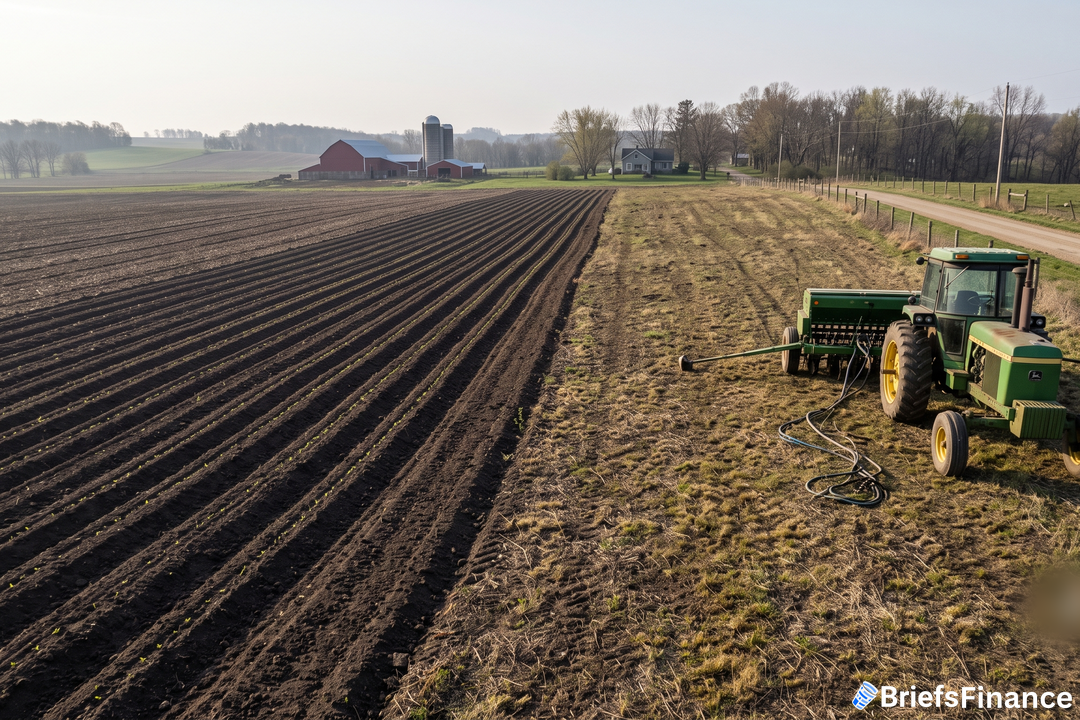
A recent poll conducted by the American Farm Bureau Federation reveals that approximately 7 in 10 American growers cannot purchase sufficient fertilizer for the current season because of climbing input expenses linked to the conflict in Iran and a pre-existing tough agricultural climate. The poll took place between April 3 and April 11, drawing responses from over 5,700 farmers.

The Regional Breakdown of Fertilizer Shortages

Faith Parum, an economist at the American Farm Bureau Federation, reported the results. She noted that farmers in the Southern region are hurting the most.

"Farmers in the Southern region reported the greatest difficulty securing fertilizer, with 78% unable to afford all needed inputs this season," Parum said. "Producers in the Northeast and West also reported significant challenges, with 69% and 66%, respectively, unable to afford all required fertilizer, compared to 48% in the Midwest."

The cost issue becomes even starker when looking at specific crops. Over four-fifths of growers of rice, cotton, and peanuts stated they lack funds for complete fertilizer application, underscoring the fragility of these crop systems to price spikes. Across the board, more than 50% of all commodity producers say they are unable to cover their full fertilizer requirements this season.

Get your free investing masterclass bonus when you join Market Briefs, our free daily newsletter

Price Projections: How High Can Fertilizer Go?

According to intelligence, the South Pars petrochemical facility in Iran and the Ras Laffan LNG infrastructure supplying Qatari fertilizer plants have suffered severe damage, putting urea production out of commission. A team of analysts from North Dakota State University created three scenarios to show where prices could land.

Under the "Contested Transit" scenario - where a ceasefire holds but the Strait of Hormuz only partially reopens - urea is projected to peak at $784 per short ton in July 2026, a 67% increase. DAP is projected to peak at $866 per short ton in October, up 39%.

If the ceasefire collapses and the Strait remains closed through fall 2026 - the "Extended Conflict" scenario - prices go much higher. Urea would reach $996 per short ton in October, a 112% jump. DAP would hit $945 per short ton in November, up 52%.

Even the best-case scenario, called "Quick Reopening," in which all parties collaborate completely and the waterway resumes normal function by July, still results in prices far above typical levels. Urea would peak at $782 per short ton, 66% above the pre-crisis price of $470. The NDSU team warned that "if this damage assessment is accurate, the pre‑crisis pricing environment is unlikely to return before 2028."

What Farmers Are Doing - and What It Means for Food Supply

"When producers cannot afford full fertilizer application rates, they may reduce nutrient use or shift acreage decisions," Parum said. "Both of which increase the risk of lower yields and reduced production potential in the 2026 crop year."

Corn and soybean growers in the Midwest placed fertilizer preorders at a greater frequency than their Southern counterparts cultivating cotton and rice. Within the Midwest, 67% of survey participants indicated they had purchased fertilizer in advance. Despite these higher prebooking rates, almost a third of Midwestern farmers still began the season without all the nutrients secured.

Farmers elsewhere tend to buy fertilizer nearer to the time of application. In the South, only 19% had prebooked fertilizer for this year's crop, while Western farmers reported 31% and Northeastern growers 30%.

Subscribe to Market Briefs, our free daily newsletter, and claim your bonus investing masterclass

Disclosure

Recent News

1 2 3 32

Get Market Briefs delivered to your inbox every morning for free!

No fluff. No noise. No politics. Just finance news you can read in 5 minutes.

Blogs

June 29, 2026
Portfolio Diversification: Why Putting All Your Eggs in One Basket Destroys Wealth
  • Real diversification means spreading investments across all 11 economic sectors plus bonds, alternatives, and cash so no single bet can sink the portfolio.
  • Different sectors perform at different times, so a diversified portfolio captures upswings while smoothing the brutal drawdowns that wipe out concentrated bets.
  • Total market index funds offer the simplest path to diversification, and annual rebalancing is what keeps the structure working over time.
Read More
June 29, 2026
Non Taxable Income: What It Is and Why It Matters
  • Non taxable income is money you receive that you don't owe income tax on.
  • The tax code treats workers, investors, and business owners very differently, and investors often come out ahead.
  • Learning how income is taxed is a quiet superpower for keeping more of what you earn.
Read More
June 29, 2026
Semiconductor Stocks: A Simple Guide for Investors
  • Semiconductor stocks are companies that design and make computer chips, the brains inside nearly every modern device.
  • The AI boom has turned chips into one of the market's most important and most watched groups.
  • They offer big growth potential, but come with high valuations and a notoriously cyclical history.
Read More
June 25, 2026
How Stocks Work: A Simple Guide for Beginners
  • A stock is a slice of ownership in a company - buy one, and you own a piece of the business.
  • You make money two ways: the share price rising over time, and dividends paid to shareholders.
  • The simplest path for most beginners is buying into the whole market through a low-cost index fund.
Read More
June 25, 2026
Stop Loss vs Stop Limit: What's the Difference?
  • A stop loss order sells your stock once it hits a trigger price, prioritizing getting you out.
  • A stop limit order only sells within a price range you set, prioritizing price over a guaranteed exit.
  • The trade-off: a stop loss almost always executes; a stop limit might not if the price moves too fast.
Read More
June 25, 2026
Energy Stocks: A Simple Guide for Investors
  • Energy stocks are companies that produce and supply the power the world runs on, from oil and gas to newer sources.
  • They make up one of the 11 sectors of the market and tend to move with energy prices and big-picture shifts.
  • Like any sector, the key is diversification and understanding the forces driving demand.
Read More
June 18, 2026
What Is a Stop Loss Order? A Simple Guide
  • A stop loss order automatically sells a stock once it falls to a price you set.
  • It's a tool to cap losses or lock in gains without watching the market all day.
  • It works best for active strategies, and can backfire if used carelessly on long-term holdings.
Read More
June 18, 2026
Best S&P 500 Index Fund: How to Choose One
  • The best S&P 500 index fund for most investors is simply the cheapest, most established one that tracks the index well.
  • Funds like VOO, IVV, and SPY all hold the same 500 companies, so the biggest difference is the fee.
  • Pick one, automate your buys, and let time do the heavy lifting.
Read More
June 17, 2026
What Are Penny Stocks? Risks and Rewards Explained
  • Penny stocks are very low-priced shares of very small companies, often trading for just a few dollars or less.
  • They promise huge gains but carry huge risks: low liquidity, high failure rates, and wild price swings.
  • Most investors are better served by quality companies and funds than by chasing cheap shares.
Read More
June 17, 2026
Best Stocks for Beginners With Little Money
  • The best stocks for beginners with little money usually aren't individual stocks at all - they're low-cost index funds.
  • You can start with $100 or less and use small, regular investments to build wealth over time.
  • Focus on diversification and consistency, not on picking the next big winner.
Read More
1 2 3 24
Share via
Copy link










