Free NewsletterPro Login
S&P 500 6,287 +0.42%
DOW 44,521 -0.18%
NASDAQ 21,103 +0.71%
S&P 500 +12.4%
Briefs Finance Fund +24.8%
JOIN THE FUND →
BREAKING
×

UK FCA to Simplify Stablecoin Capital Rules Before 2027 Crypto Regime

Published Jun 29, 2026
[tts_player]
Share:
Summary:
  • The Financial Conduct Authority will make stablecoin capital requirements simpler ahead of the UK's new cryptocurrency regulations in 2027.
  • All crypto firms must apply for FCA authorization between September 2026 and February 2027 to keep operating in the UK.
  • The Bank of England set a £40 billion ($53 billion) cap on each systemic sterling stablecoin, removing earlier individual holding limits.

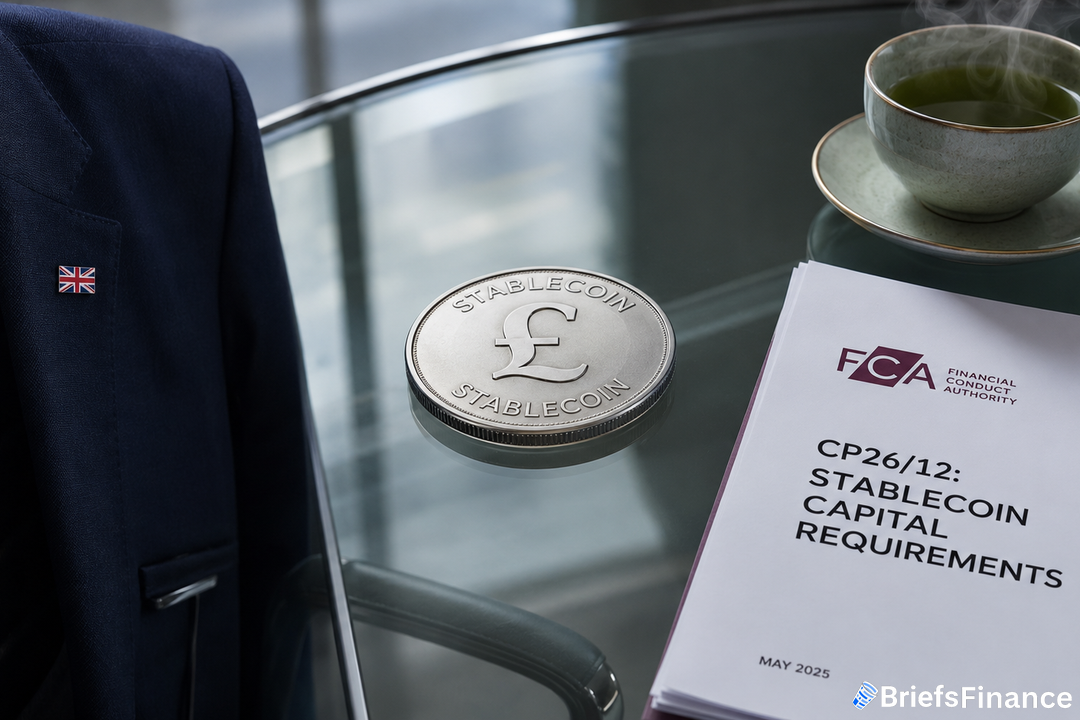
Ahead of the 2027 introduction of the UK's crypto regulatory framework, the Financial Conduct Authority is easing stablecoin capital rules and, for the first time, bringing digital assets under its regulatory oversight. According to a statement released today, under the updated regime, all crypto firms will need to fulfill financial resilience standards such as capital and stress tests, and the FCA is relaxing certain earlier proposals after industry feedback. These adjustments involve lowering the capital needed for issuing stablecoins and simplifying the categories within the risk framework.

"Consumers have been exposed to real harm from unregulated activity and we believe the regime that we're putting in place addresses that directly," stated David Geale, who serves as the FCA's executive director for payments and digital finance. "We published something that applies the same core principles we use across financial services so where we see the same risk, we are looking for the same regulatory outcomes."

Stablecoins are digital tokens whose value is tied to a fiat currency, intended to facilitate quicker and more cost-effective payments, especially for international transactions. Adoption is accelerating, fueled partly by last year's pioneering GENIUS Act from US President Donald Trump, which has begun drawing in traditional financial institutions. Consequently, the FCA will expand its oversight past just anti-money laundering, aiming to position Britain as a worldwide crypto center.

"It's not a competition, it's a global opportunity and we work closely with our partners," stated Matthew Long, the FCA's director of payments and digital assets. The final policy was published about one week following the Bank of England's removal of individual holding restrictions for systemic sterling stablecoins, imposing instead a £40 billion ($53 billion) cap per coin on total issuance. As part of a wider push to update money for a digital age, the central bank stated its aim is to make sterling stablecoins more commercially feasible and simpler to administer while safeguarding users.

According to the FCA, it worked alongside the UK Treasury and the Bank of England, and also examined the submissions from crypto firms made during the consultation period. The Bank of England has already detailed how it and the FCA will oversee sterling-pegged stablecoins.

"Firms have been asking us for regulatory clarity and we've delivered it," Geale said.

The UK's push to regulate stablecoins is part of a broader effort to create a safe environment for digital asset innovation without stifling growth. By simplifying capital requirements, the FCA aims to lower compliance costs for issuers while still ensuring they can absorb losses during market stress. The dual oversight model - with the Bank of England focusing on systemic risks and the FCA on conduct and resilience - mirrors the approach used for traditional payment systems. Industry participants have welcomed the clarity, though some smaller firms have expressed concern about the cost of meeting the new authorization deadline.

Disclosure

Recent News

1 2 3 29

Get Market Briefs delivered to your inbox every morning for free!

No fluff. No noise. No politics. Just finance news you can read in 5 minutes.

Blogs

June 29, 2026
Portfolio Diversification: Why Putting All Your Eggs in One Basket Destroys Wealth
  • Real diversification means spreading investments across all 11 economic sectors plus bonds, alternatives, and cash so no single bet can sink the portfolio.
  • Different sectors perform at different times, so a diversified portfolio captures upswings while smoothing the brutal drawdowns that wipe out concentrated bets.
  • Total market index funds offer the simplest path to diversification, and annual rebalancing is what keeps the structure working over time.
Read More
June 29, 2026
Non Taxable Income: What It Is and Why It Matters
  • Non taxable income is money you receive that you don't owe income tax on.
  • The tax code treats workers, investors, and business owners very differently, and investors often come out ahead.
  • Learning how income is taxed is a quiet superpower for keeping more of what you earn.
Read More
June 29, 2026
Semiconductor Stocks: A Simple Guide for Investors
  • Semiconductor stocks are companies that design and make computer chips, the brains inside nearly every modern device.
  • The AI boom has turned chips into one of the market's most important and most watched groups.
  • They offer big growth potential, but come with high valuations and a notoriously cyclical history.
Read More
June 25, 2026
How Stocks Work: A Simple Guide for Beginners
  • A stock is a slice of ownership in a company - buy one, and you own a piece of the business.
  • You make money two ways: the share price rising over time, and dividends paid to shareholders.
  • The simplest path for most beginners is buying into the whole market through a low-cost index fund.
Read More
June 25, 2026
Stop Loss vs Stop Limit: What's the Difference?
  • A stop loss order sells your stock once it hits a trigger price, prioritizing getting you out.
  • A stop limit order only sells within a price range you set, prioritizing price over a guaranteed exit.
  • The trade-off: a stop loss almost always executes; a stop limit might not if the price moves too fast.
Read More
June 25, 2026
Energy Stocks: A Simple Guide for Investors
  • Energy stocks are companies that produce and supply the power the world runs on, from oil and gas to newer sources.
  • They make up one of the 11 sectors of the market and tend to move with energy prices and big-picture shifts.
  • Like any sector, the key is diversification and understanding the forces driving demand.
Read More
June 18, 2026
What Is a Stop Loss Order? A Simple Guide
  • A stop loss order automatically sells a stock once it falls to a price you set.
  • It's a tool to cap losses or lock in gains without watching the market all day.
  • It works best for active strategies, and can backfire if used carelessly on long-term holdings.
Read More
June 18, 2026
Best S&P 500 Index Fund: How to Choose One
  • The best S&P 500 index fund for most investors is simply the cheapest, most established one that tracks the index well.
  • Funds like VOO, IVV, and SPY all hold the same 500 companies, so the biggest difference is the fee.
  • Pick one, automate your buys, and let time do the heavy lifting.
Read More
June 17, 2026
What Are Penny Stocks? Risks and Rewards Explained
  • Penny stocks are very low-priced shares of very small companies, often trading for just a few dollars or less.
  • They promise huge gains but carry huge risks: low liquidity, high failure rates, and wild price swings.
  • Most investors are better served by quality companies and funds than by chasing cheap shares.
Read More
June 17, 2026
Best Stocks for Beginners With Little Money
  • The best stocks for beginners with little money usually aren't individual stocks at all - they're low-cost index funds.
  • You can start with $100 or less and use small, regular investments to build wealth over time.
  • Focus on diversification and consistency, not on picking the next big winner.
Read More
1 2 3 24
Share via
Copy link










