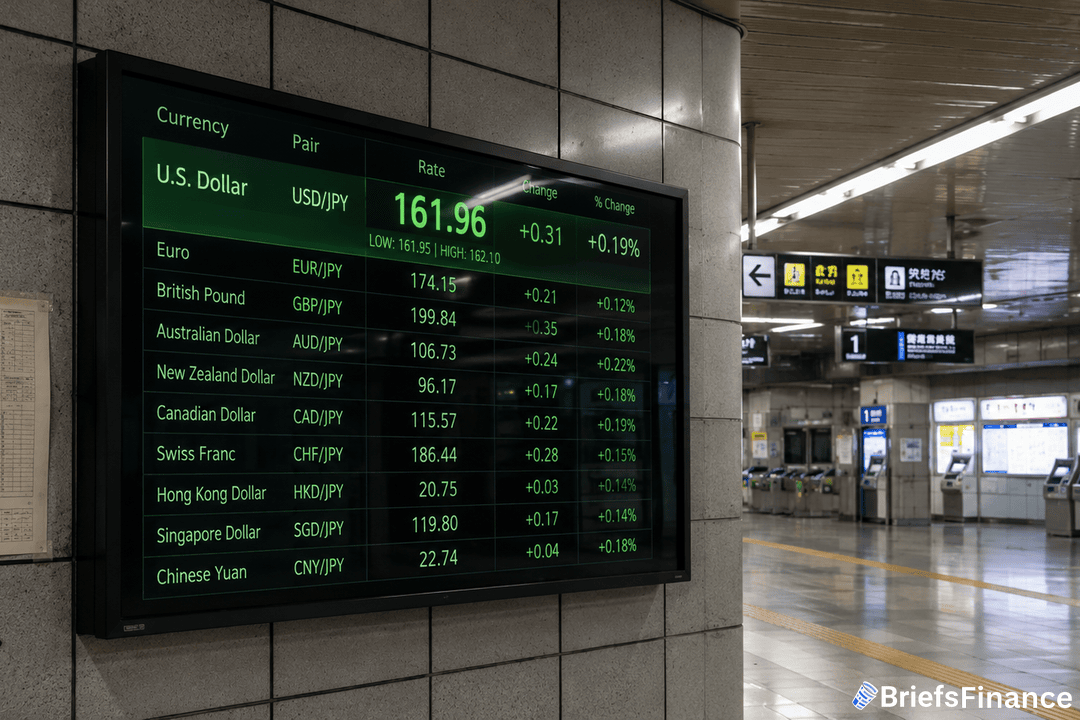
On Monday in New York, the yen fell as much as 0.1% to 161.96 per dollar, surpassing the 161.95 level seen in July 2024 when Japan previously attempted to support the currency. That level had not been seen since 1986, when the yen was in the midst of a prolonged appreciation following a US-engineered currency accord.
The yen's ongoing weakness persists despite the Bank of Japan's policy shift, which saw it abandon negative rates in 2024 and raise its key rate to 1% on June 16 - the highest since 1995. However, this move had little effect as market participants anticipate the Federal Reserve will maintain a hawkish stance. Meanwhile, Japan's government is poised to urge "appropriate" monetary policy in its basic guidelines, likely to discourage further rate increases.
"Doubtless, the Bank of Japan is watching things closely," Shaun Osborne, Scotiabank's head of currency strategy, said after the yen crept past the key level on Monday.
Get your free investing masterclass bonus when you join Market Briefs, our free daily newsletter
The huge amount spent underscores not only how much is at stake for Japan, but also the difficulty involved in pushing back against the tide in the $9.5 trillion-a-day global foreign exchange market.
Japanese Finance Minister Satsuki Katayama reiterated on June 19 that authorities were ready to take "bold action" to damp excessive speculative moves in the foreign exchange market. In her remarks, Katayama noted that the US and Japan have grown more coordinated on foreign exchange matters following talks with Treasury Secretary Scott Bessent, and that both nations committed to implementing forceful measures regarding currencies as necessary. Japan's market interventions in 2022 - its first yen-buying operations since 1998 - and again in 2024 provided only short-lived stability, with the currency soon weakening further. The most recent round of intervention began on April 28, when officials stepped in repeatedly to prop up the yen.
Andrew Hazlett, a currency trader at Monex Inc., stated, "Intervention is right around the corner if we don't see a quick correction." However, Hazlett added, intervention is "only a temporary fix if they do not address the interest-rate differential."
Exporters are seeing higher profits from the weak yen, which has also pushed the nation's stock market to new highs. However, the cost of imports is rising sharply, especially for oil and gas that are dollar-denominated. This inflation is squeezing households, driving up costs for basic goods and utilities, and threatening the approval ratings of Prime Minister Sanae Takaichi's administration.
The main driver is often attributed to interest-rate gaps - both current and anticipated - with Japan's low rates encouraging investors to sell yen for foreign assets. Long-term factors like an aging, shrinking population and high public debt also drag on growth and limit the scope for significant rate increases.
Subscribe to Market Briefs, our free daily newsletter, and claim your bonus investing masterclass