Free NewsletterPro Login
S&P 500 6,287 +0.42%
DOW 44,521 -0.18%
NASDAQ 21,103 +0.71%

Warning: Undefined variable $funds in /var/www/briefs.co/htdocs/wp-content/plugins/oxygen/component-framework/components/classes/code-block.class.php(133) : eval()'d code on line 491

Warning: foreach() argument must be of type array|object, null given in /var/www/briefs.co/htdocs/wp-content/plugins/oxygen/component-framework/components/classes/code-block.class.php(133) : eval()'d code on line 491
/* the link was here */

Heat Compresses Champagne Growing Season, Picking Earlier

Published Aug 15, 2026
[tts_player]
Share:
Summary:
  • Picking is running about two weeks ahead of the recent average.
  • Warmer weather is forcing winemakers to balance acidity and flavor.
  • The industry is adapting with English vineyards and new techniques.

A Shifting Harvest Calendar

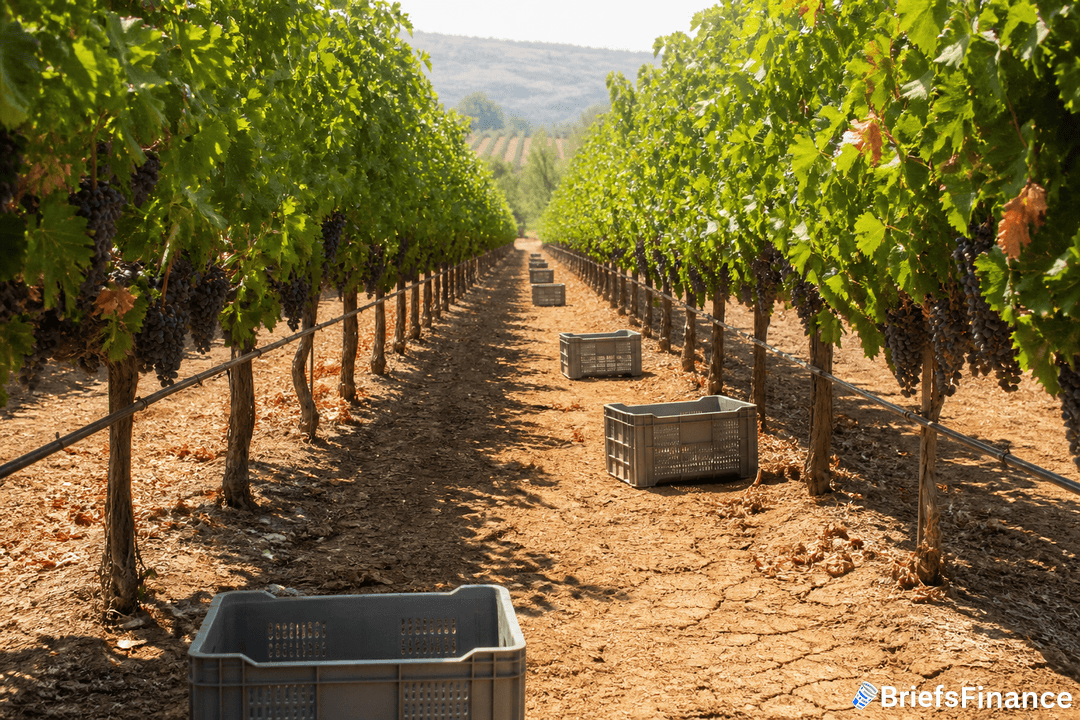
Champagne's harvest is underway, with most growers in the vines from Aug. 20 to 25. That is roughly two weeks earlier than the norm in recent years. In the years before 2000, growers usually harvested in September or October. The sparkling wine generated $6.6 billion in brand sales last year.

Warmer springs and summers have sped up grape maturation, boosting sugar levels and narrowing the window for picking. In a region whose identity is tied to those grapes, the earlier calendar is not just a logistics change; it is a visible sign that the area's growing season has been transformed. Much of Champagne's craft depends on a long, slow season, so the harvest-date shift forces growers to adjust their expectations.

The Flavor Balancing Act

Growers face a trade-off: pick early to preserve acidity, or wait for "phenolic ripeness," the point at which tannins and other compounds are fully developed to produce the desired taste and mouthfeel.

"For great wine grapes, you want the maturation process to be slow. This is true with most fruit," said Linda Johnson-Bell, founder of the Wine & Climate Change Institute.

A compressed season is easier to convince in red wines, whose alcohol levels have risen in recent years because of high-sugar fruit. Yet for Champagne, where the product's identity depends on balance, the challenge becomes even more serious.

When climate change shifts the harvest, a steady investing habit can protect your future with the free Always Be Buying eBook.

The extra sugar can translate into higher alcohol, which is easier to tolerate in red wines but harder in Champagne. That is why timing matters so much. If growers wait too long, they risk losing the acidity that gives the wine its lift; if they pick too early, they miss the flavor depth that comes with full ripeness.

Johnson-Bell said the region has been preparing for decades: "The Champenois will do absolutely everything to safeguard that product, they've been onto these issues for decades."

Industry Pressures

The harvest shift comes as demand weakens. The Comité Champagne trade group said shipments dropped 9.2% in 2023. High inventory and tariffs add to the strain. One industry analyst said, "Quality seems promising, and the industry could do with lower inventory."

That combination of climate pressure and market softness is testing one of the sought-after world's rare wine regions.

New Ground in England

Warmer weather is also changing the map for sparkling wine. Taittinger has purchased vineyard land in Kent for English sparkling wine. Balfour Winery's wine director, Fergus Sklias, said the change has been dramatic. "It's quite astonishing to see the forward shift in the harvest."

Elias added that the grapes are already usable. "If I really wanted to, I could pick these vines and make a passable wine with them," he said. He says the England growing season remains long enough, and he is excited about the possibilities.

Adaptation and Outlook

Some producers in southern France are also having a strong year. Jean-Claude Mas, founder of Domaines Paul Mas, said, "In 30 years I've never seen a year like this. I was so stressed, but this year it looks like we could have a really good harvest."

For investors, the story is less about a single heat wave and more about how the industry adapts. Champagne houses are experimenting with different varieties, reploughing, and looking north. The taste of Champagne may change, but producers are determined to protect the brand.

Just as great wine needs a slow build, your money grows with consistency, so get the free Always Be Buying eBook.

Disclosure

Recent News

1 2 3 55

Get Market Briefs delivered to your inbox every morning for free!

No fluff. No noise. No politics. Just finance news you can read in 5 minutes.

Blogs

June 29, 2026
Portfolio Diversification: Why Putting All Your Eggs in One Basket Destroys Wealth
  • Real diversification means spreading investments across all 11 economic sectors plus bonds, alternatives, and cash so no single bet can sink the portfolio.
  • Different sectors perform at different times, so a diversified portfolio captures upswings while smoothing the brutal drawdowns that wipe out concentrated bets.
  • Total market index funds offer the simplest path to diversification, and annual rebalancing is what keeps the structure working over time.
Read More
June 29, 2026
Non Taxable Income: What It Is and Why It Matters
  • Non taxable income is money you receive that you don't owe income tax on.
  • The tax code treats workers, investors, and business owners very differently, and investors often come out ahead.
  • Learning how income is taxed is a quiet superpower for keeping more of what you earn.
Read More
June 29, 2026
Semiconductor Stocks: A Simple Guide for Investors
  • Semiconductor stocks are companies that design and make computer chips, the brains inside nearly every modern device.
  • The AI boom has turned chips into one of the market's most important and most watched groups.
  • They offer big growth potential, but come with high valuations and a notoriously cyclical history.
Read More
June 25, 2026
How Stocks Work: A Simple Guide for Beginners
  • A stock is a slice of ownership in a company - buy one, and you own a piece of the business.
  • You make money two ways: the share price rising over time, and dividends paid to shareholders.
  • The simplest path for most beginners is buying into the whole market through a low-cost index fund.
Read More
June 25, 2026
Stop Loss vs Stop Limit: What's the Difference?
  • A stop loss order sells your stock once it hits a trigger price, prioritizing getting you out.
  • A stop limit order only sells within a price range you set, prioritizing price over a guaranteed exit.
  • The trade-off: a stop loss almost always executes; a stop limit might not if the price moves too fast.
Read More
June 25, 2026
Energy Stocks: A Simple Guide for Investors
  • Energy stocks are companies that produce and supply the power the world runs on, from oil and gas to newer sources.
  • They make up one of the 11 sectors of the market and tend to move with energy prices and big-picture shifts.
  • Like any sector, the key is diversification and understanding the forces driving demand.
Read More
June 18, 2026
What Is a Stop Loss Order? A Simple Guide
  • A stop loss order automatically sells a stock once it falls to a price you set.
  • It's a tool to cap losses or lock in gains without watching the market all day.
  • It works best for active strategies, and can backfire if used carelessly on long-term holdings.
Read More
June 18, 2026
Best S&P 500 Index Fund: How to Choose One
  • The best S&P 500 index fund for most investors is simply the cheapest, most established one that tracks the index well.
  • Funds like VOO, IVV, and SPY all hold the same 500 companies, so the biggest difference is the fee.
  • Pick one, automate your buys, and let time do the heavy lifting.
Read More
June 17, 2026
What Are Penny Stocks? Risks and Rewards Explained
  • Penny stocks are very low-priced shares of very small companies, often trading for just a few dollars or less.
  • They promise huge gains but carry huge risks: low liquidity, high failure rates, and wild price swings.
  • Most investors are better served by quality companies and funds than by chasing cheap shares.
Read More
June 17, 2026
Best Stocks for Beginners With Little Money
  • The best stocks for beginners with little money usually aren't individual stocks at all - they're low-cost index funds.
  • You can start with $100 or less and use small, regular investments to build wealth over time.
  • Focus on diversification and consistency, not on picking the next big winner.
Read More
1 2 3 24
Share via
Copy link










