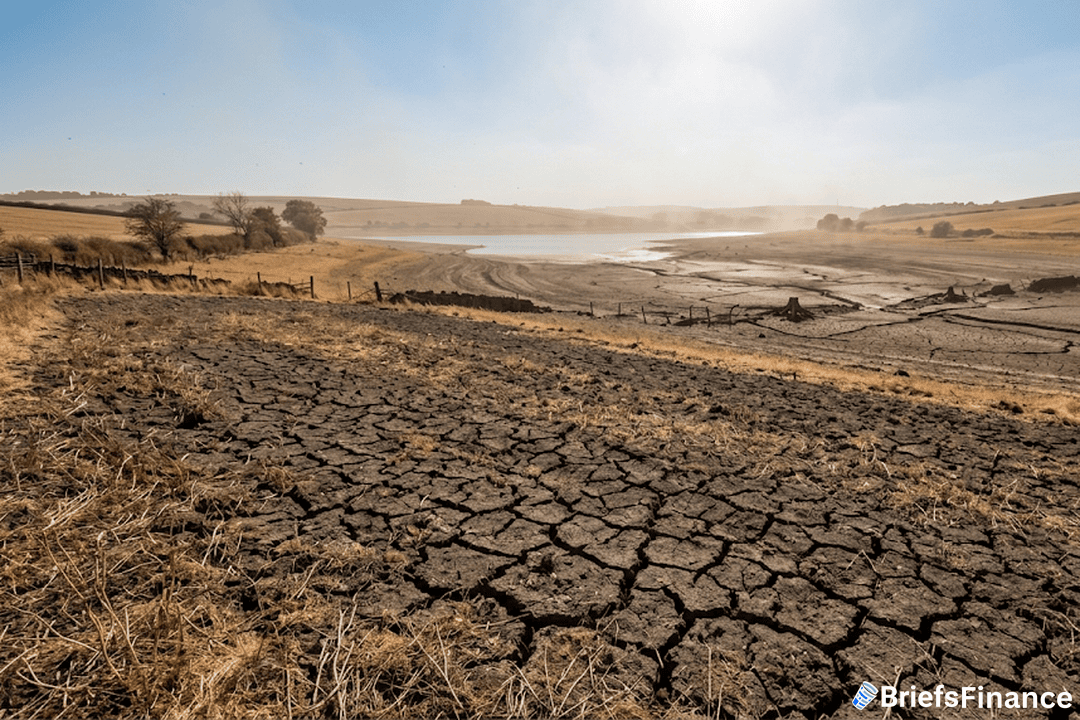
A Dry Country Is Now an Official Drought
A burst Thames Water pipe forced Chessington World of Adventures Resort to shut down on Monday.
That is not the kind of headline you expect from a resort, but it is exactly what happens when dry ground starts pulling at underground pipes.
England is now dealing with that problem on a national scale, and the official status carries weight for farmers, water companies, and anyone who pays a utility bill.
The Environment Agency has declared that roughly three-quarters of the country is now in drought conditions.
Reservoirs are holding about 12% below the typical long-term level, and the month of July broke records for dryness across England.
The forecast for the rest of August offers little relief.
This is also Europe's fifth heat wave of the year, so the heat keeps building on itself.
Reservoir-fed canals are the worst hit.
The four earlier heat waves already drained a lot of their water, the Environment Agency said.
Officials have upgraded Yorkshire and northeast England to a "prolonged dry weather" stage.
No part of the country has normal water conditions anymore.
What the Drought Is Doing to Farms
The farm economy is where the drought shows up first.
Get the free Always Be Buying eBook and learn the simple system for building wealth on any income
Farmers are bringing in their crops earlier than they have in two decades, and not because the season is going well.
Wheat, spring barley, oats, and grassland are all producing less than normal, which matters because these are the starting points for bread, beer, and animal feed.
Water restrictions are adding to the pressure.
Over 300 growers in East Anglia have been asked by the Environment Agency to reduce their river and stream water withdrawals by half.
More than 1,500 restrictions on water abstractions for farming and other purposes are already in place.
The effects are moving up the food chain.
With grass growing poorly, some cattle are now eating the winter forage that was saved for colder months.
That is a short-term fix with a longer-term cost.
It can push milk output down, and when feed runs short, the price of milk and meat tends to feel it.
What the Water Shortage Means for Infrastructure
The water problem is bigger than farms.
The UK has 16 water companies, and eight of them now have hosepipe bans; five reservoirs are exceptionally low.
For households in those regions, that means the garden hose is off limits.
The strain on infrastructure is already showing.
The shifting, dry ground is putting more strain on underground pipes, and more of them are bursting.
Wildfires are part of the same picture.
In the New Forest National Park in Hampshire, firefighters worked overnight after a van fire spread.
Some river and canal navigation routes have closed because there is not enough water.
More could close if this month does not bring real rain, the Environment Agency warns.
The bottom line: a drought like this does not stay on the farm.
It moves from the fields to the supermarket shelf to the bill in the mail.
When most of a country is short on water, the cost of food and the cost of fixing pipes tend to point in the same direction.
If the dry weather keeps pushing harvests earlier and yields lower, the next numbers to move could show up in the price of bread, milk, and meat.
Download the free Always Be Buying eBook and start putting your money to work today