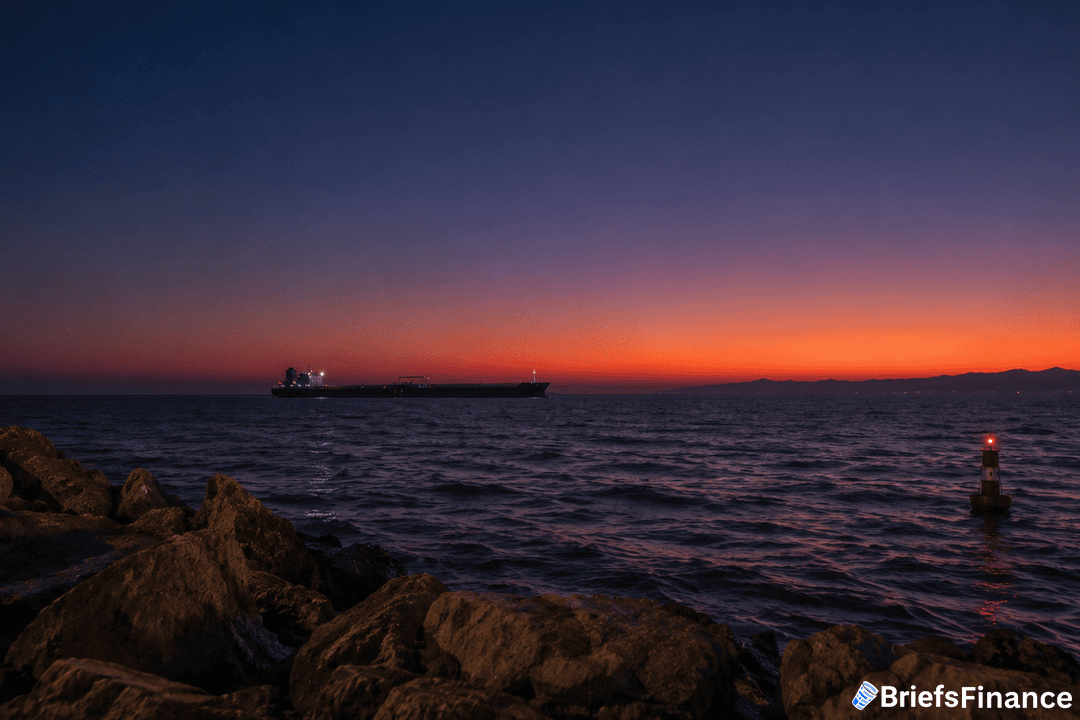
When the Iran conflict erupted earlier this year, one of the biggest fears in energy markets was that the Strait of Hormuz would effectively shut down. That narrow waterway handles about a fifth of the world's oil supply, according to the US Energy Information Administration. A full closure would have been catastrophic.
It did not happen. And a new report from the International Energy Agency shows just how the UAE pulled it off.
Geopolitics moves markets fast, and Market Briefs translates it into what matters for your portfolio every morning - plus a free 45-minute investing masterclass when you join.
The country's oil exports hit about 4.3 million barrels per day in early June. That is a massive recovery from the 1.9 million bpd it was managing back in March, when hostilities were at their worst. The UAE is now operating at roughly 85% of its pre-war export capacity.
And here is the key detail: this recovery happened before the US and Iran signed their interim peace agreement. The UAE did not wait for a diplomatic solution. It built its own.
The backbone of the strategy was a pipeline network connecting Abu Dhabi's oil fields to the port of Fujairah on the UAE's eastern coast. That route completely bypasses the Strait of Hormuz, letting crude reach open ocean without ever entering the contested waterway.
The country also tapped a 42-million-barrel underground storage facility at Mandous, near Fujairah, which gave it a strategic buffer when surface-level logistics got complicated.
But not every shipment avoided the strait. Some tankers kept moving through Hormuz during the conflict. They just did it quietly. The IEA report notes that vessels moved through the waterway while keeping their tracking systems dark.
State-owned ADNOC played a central role. The company used its own fleet of smaller tankers to ferry crude and gas cargoes through the Gulf, navigating around both Iranian naval forces and US military vessels in the area.
At the height of the crisis, some analysts warned that oil could spike to $200 a barrel if Hormuz was fully shut down. That worst-case scenario never arrived. Brent crude briefly crossed the $100 mark during the conflict, but prices have since settled back closer to pre-war levels.
Several factors helped keep the market from overheating. Oil continued moving through Hormuz, even if some of it was invisible to tracking systems. US crude exports hit record levels, adding supply to global markets. China's appetite for crude also softened faster than forecast, which helped ease the supply-demand math.
The recovery is not just a short-term fix. The UAE currently produces about 3.7 million barrels per day and has laid out plans to push capacity to 5 million bpd by 2027. That kind of output would put the UAE among the most powerful voices inside OPEC.
Still, the Gulf is not back to normal. Some vessels still switch off their transponders for parts of the Hormuz journey. Security concerns have not fully faded, even with the interim peace deal in place.
For investors, the takeaway is straightforward. The UAE proved that major Gulf producers can adapt to serious geopolitical disruptions. The risk of a prolonged supply crisis has not disappeared, but the playbook for managing it is now a lot clearer. That matters for anyone watching oil prices, energy stocks, or the inflation outlook. A supply shock that once seemed inevitable turned out to be manageable, and the market is pricing that in.
For a clear read on how global risk hits oil, stocks, and your money, join the 350,000+ investors reading Market Briefs - five minutes a day, with a free investing course included.