Free NewsletterPro Login
S&P 500 6,287 +0.42%
DOW 44,521 -0.18%
NASDAQ 21,103 +0.71%
S&P 500 +12.4%
Briefs Finance Fund +24.8%
JOIN THE FUND →

SpaceX Launches Biggest Starship Yet, Two Days After Filing IPO

Published May 25, 2026
[tts_player]
Share:
Summary:
  • SpaceX successfully launched its third-generation Starship V3 from Starbase, Texas on Friday, May 22, the 12th test flight of the program.
  • The launch came two days after CEO Elon Musk said SpaceX is going public, with an SEC filing this week showing the company has spent more than $15 billion on Starship development.
  • Starship is central to NASA's Artemis plan, which targets a crewed lunar landing as soon as 2028.

SpaceX just sent the biggest rocket ever built into the sky. Two days earlier, it filed paperwork to take the whole company public.

Those two events are not unrelated, and the timing tells you everything about how the company plans to sell itself.

Starship V3's Test Flight

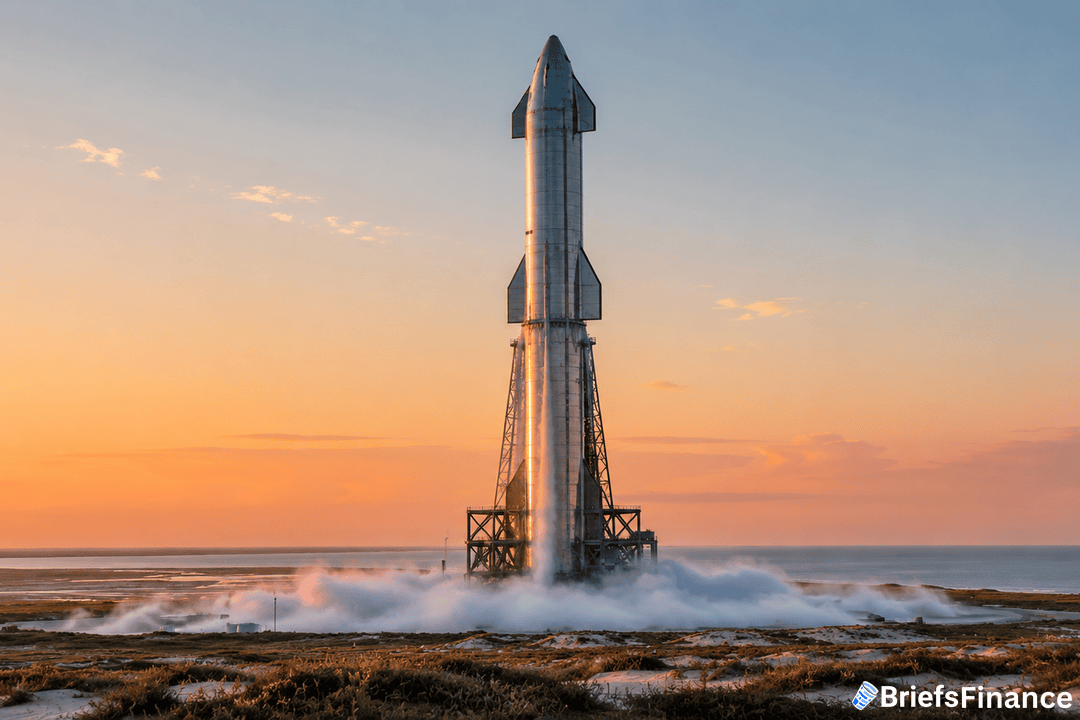
Starship V3 lifted off from Starbase, Texas on Friday. It carried 20 dummy Starlink satellites and flew halfway around the planet before splashing into the Indian Ocean and erupting in flames on impact.

That part was planned. SpaceX wasn't trying to recover anything on this run, and the booster also crashed into the Gulf of Mexico, which was also planned.

The 407-foot V3 is taller, heavier, and more powerful than earlier Starship models. Musk called it "an epic" launch.

The ship lost one engine during the flight but completed most of its planned objectives. The booster failed its return burn, which was less clean - but with nothing being recovered on this run, the failure was internal data, not a public setback.

If you want a five-minute daily read on the IPOs, deals, and tech moves driving markets, Market Briefs is delivered every weekday morning - and a free investing masterclass comes with sign-up.

The IPO Sits Behind It

This is the 12th test flight of Starship. It's the first since SpaceX confirmed plans to go public at a reported $1.75 trillion valuation, which would make it one of the largest listings in U.S. history.

In an SEC filing this week, SpaceX disclosed it has invested more than $15 billion in Starship development. That number matters now, because public investors will want to see what they're buying.

Think of this launch as a pre-IPO demo. It's a chance to show the most expensive rocket program in the company isn't just a money pit, it actually flies.

The other half of the IPO pitch is Starlink. The satellite internet business is the actual cash engine inside SpaceX, and its $11.4 billion in 2025 sales is what makes the rest of the math work.

NASA's Moon Plan

NASA is paying SpaceX billions of dollars to deliver lunar landers for the Artemis program. Jeff Bezos' Blue Origin is also building a lander with NASA money.

Whichever company is ready first - and safer - gets to land astronauts back on the moon. The first crewed landing under Artemis IV could happen as soon as 2028.

Blue Origin's Blue Moon lander hasn't flown yet, while Starship just notched another working test flight. That gap is one of the more concrete arguments for SpaceX's valuation, since it suggests the company is closest to closing on contracts that span the next decade.

What To Watch

The IPO is the bigger event for investors. SpaceX has been the most valuable private company in the U.S. for years, and a listing would reset benchmarks across the space and defense sectors.

A successful launch days before the filing details get scrutinized is exactly the kind of headline a banker wants on the table.

Join Market Briefs here for the daily morning recap - and we'll throw in a 45-minute investing course as a bonus.

Disclosure

Recent News

1 2 3 34

Get Market Briefs delivered to your inbox every morning for free!

No fluff. No noise. No politics. Just finance news you can read in 5 minutes.

Blogs

June 29, 2026
Portfolio Diversification: Why Putting All Your Eggs in One Basket Destroys Wealth
  • Real diversification means spreading investments across all 11 economic sectors plus bonds, alternatives, and cash so no single bet can sink the portfolio.
  • Different sectors perform at different times, so a diversified portfolio captures upswings while smoothing the brutal drawdowns that wipe out concentrated bets.
  • Total market index funds offer the simplest path to diversification, and annual rebalancing is what keeps the structure working over time.
Read More
June 29, 2026
Non Taxable Income: What It Is and Why It Matters
  • Non taxable income is money you receive that you don't owe income tax on.
  • The tax code treats workers, investors, and business owners very differently, and investors often come out ahead.
  • Learning how income is taxed is a quiet superpower for keeping more of what you earn.
Read More
June 29, 2026
Semiconductor Stocks: A Simple Guide for Investors
  • Semiconductor stocks are companies that design and make computer chips, the brains inside nearly every modern device.
  • The AI boom has turned chips into one of the market's most important and most watched groups.
  • They offer big growth potential, but come with high valuations and a notoriously cyclical history.
Read More
June 25, 2026
How Stocks Work: A Simple Guide for Beginners
  • A stock is a slice of ownership in a company - buy one, and you own a piece of the business.
  • You make money two ways: the share price rising over time, and dividends paid to shareholders.
  • The simplest path for most beginners is buying into the whole market through a low-cost index fund.
Read More
June 25, 2026
Stop Loss vs Stop Limit: What's the Difference?
  • A stop loss order sells your stock once it hits a trigger price, prioritizing getting you out.
  • A stop limit order only sells within a price range you set, prioritizing price over a guaranteed exit.
  • The trade-off: a stop loss almost always executes; a stop limit might not if the price moves too fast.
Read More
June 25, 2026
Energy Stocks: A Simple Guide for Investors
  • Energy stocks are companies that produce and supply the power the world runs on, from oil and gas to newer sources.
  • They make up one of the 11 sectors of the market and tend to move with energy prices and big-picture shifts.
  • Like any sector, the key is diversification and understanding the forces driving demand.
Read More
June 18, 2026
What Is a Stop Loss Order? A Simple Guide
  • A stop loss order automatically sells a stock once it falls to a price you set.
  • It's a tool to cap losses or lock in gains without watching the market all day.
  • It works best for active strategies, and can backfire if used carelessly on long-term holdings.
Read More
June 18, 2026
Best S&P 500 Index Fund: How to Choose One
  • The best S&P 500 index fund for most investors is simply the cheapest, most established one that tracks the index well.
  • Funds like VOO, IVV, and SPY all hold the same 500 companies, so the biggest difference is the fee.
  • Pick one, automate your buys, and let time do the heavy lifting.
Read More
June 17, 2026
What Are Penny Stocks? Risks and Rewards Explained
  • Penny stocks are very low-priced shares of very small companies, often trading for just a few dollars or less.
  • They promise huge gains but carry huge risks: low liquidity, high failure rates, and wild price swings.
  • Most investors are better served by quality companies and funds than by chasing cheap shares.
Read More
June 17, 2026
Best Stocks for Beginners With Little Money
  • The best stocks for beginners with little money usually aren't individual stocks at all - they're low-cost index funds.
  • You can start with $100 or less and use small, regular investments to build wealth over time.
  • Focus on diversification and consistency, not on picking the next big winner.
Read More
1 2 3 24
Share via
Copy link










