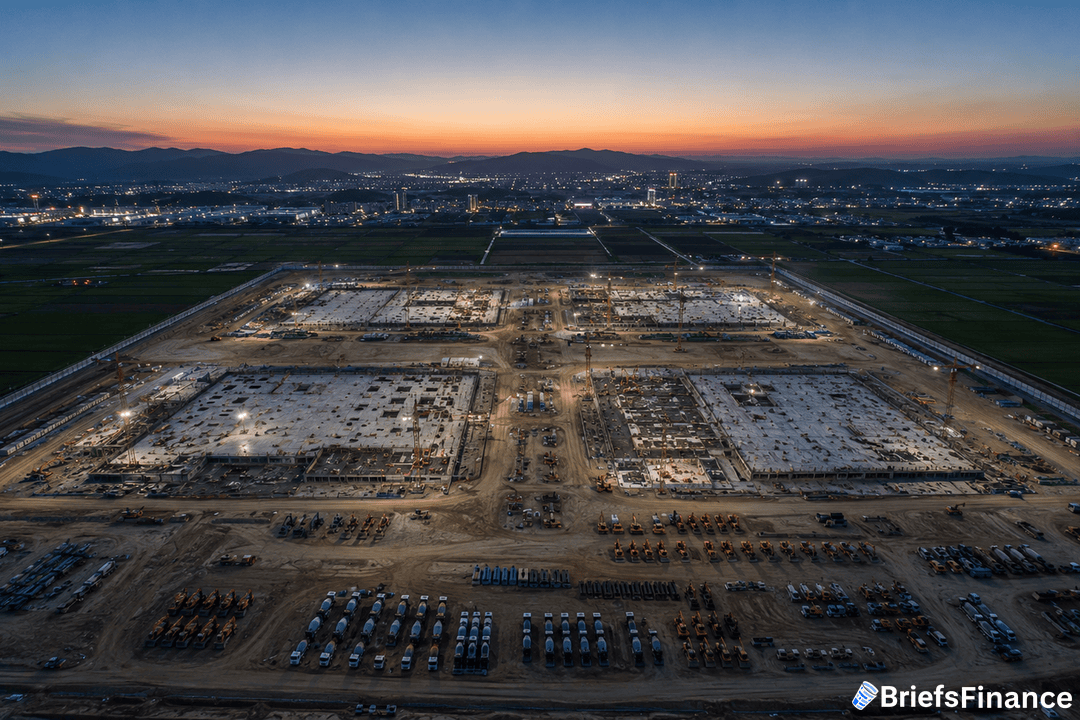
The world can't get enough memory chips for AI. South Korea's government and its biggest chip makers just promised to spend over $900 billion to fix that. But building factories takes years, and demand might drop before they are ready.
The Plan: Four New Memory Fabs and Data Centers
South Korean President Jae Myung Lee announced a national investment plan led by Samsung and SK Hynix. The two companies are the world's largest memory chip makers.
A separate $52 billion high-bandwidth memory (HBM) packaging hub will go up in the central region.
SK Telecom will spearhead the construction of 15 gigawatts of AI data center capacity nationwide.
Other companies including GS and Naver will also build data centers. They plan to spend $356 billion (550 trillion won) through 2035.
Separately, Samsung issued a press release detailing its intention to spend 2,655 trillion won (~$1.7 trillion) over ten years, setting aside 425 trillion won for the Honam region in the southwest, which will host a new semiconductor fab in Gwangju and an AI data center in Haenam.
President Lee said: "Semiconductors, physical AI, and AI data centers are the triple axis for South Korea's next industrial era." He added, "We must secure overwhelming production capacity in advance."
For context, Reuters reports that U.S. technology behemoths Alphabet, Amazon, Meta, and Microsoft together are projected to invest $650 billion in AI infrastructure in just this year.
Why Now: The "RAMageddon"
A critical global shortfall of memory chips, driven by the rapid expansion of AI infrastructure, has emerged - a situation some refer to as "RAMageddon." So the government wants to spread investment to the southwestern region.
Samsung, SK Hynix, and U.S.-based Micron are all benefiting from unprecedented demand stemming from this shortfall.
What to Watch
Executing these grand plans is far from certain. The semiconductor and AI sectors operate on their own timelines, not aligned with political or customer demand schedules. Constructing fabs requires years, and there is a real danger that by the time production starts, the demand that triggered the investment may have faded, resulting in oversupply and price collapses.
President Lee said: "The government's role is to invest its capabilities so that companies can invest without losses and with better prospects."
For now, the global AI chip supply chain - particularly participants eager for memory products - will be closely monitoring whether South Korea can deliver on these promises.