Free NewsletterPro Login

Metals Just Had Their Worst Day in Months

A stylized illustration of a cylindrical cup with blue arrows and lines indicating a swirling or rotational motion inside the cup.
Published Mar 19, 2026
Share:
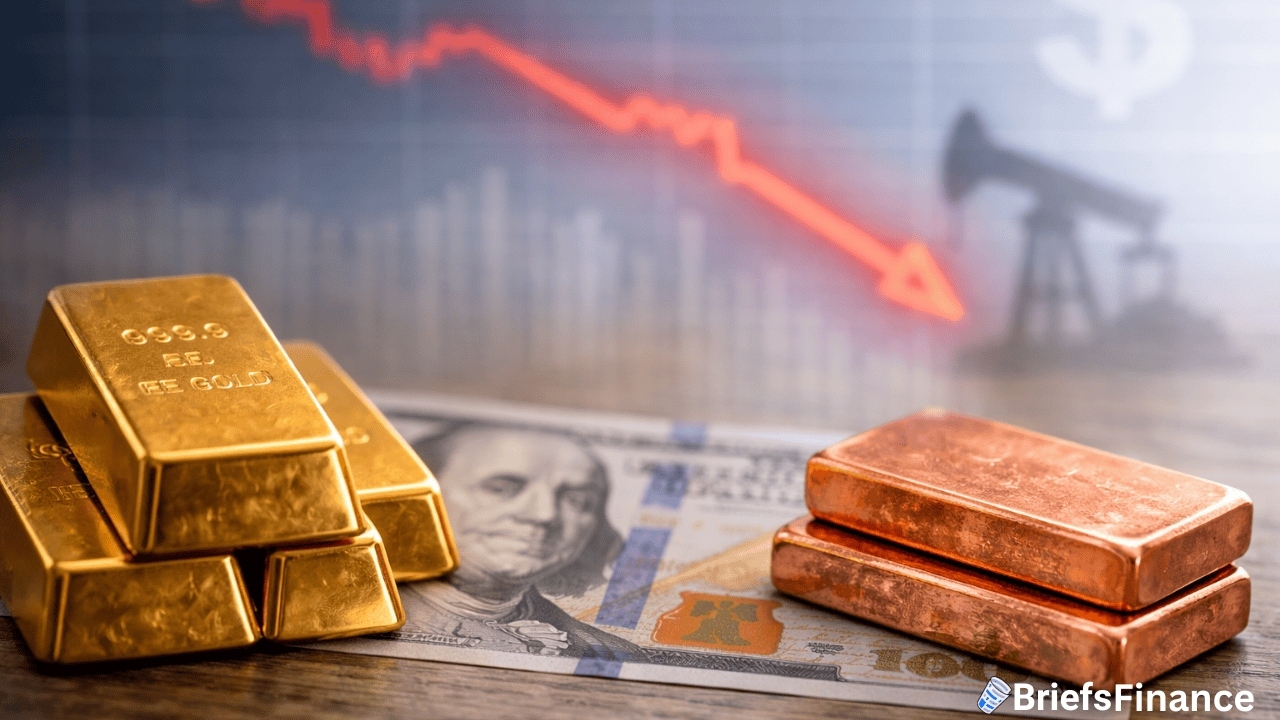
Gold bars, copper ingots, and a US $100 bill in the foreground; a downward trending red stock chart and oil pump silhouette in the background illustrate how metals fell during the market’s worst day.
Summary:
  • Gold dropped nearly 5%, silver lost over 6%, and copper gave back all of its 2026 gains in a single session on Thursday.
  • The Iran conflict is pushing oil prices high enough that investors are now pricing in a real chance of recession.
  • The word "stagflation" is making the rounds on Wall Street - but the Fed and several analysts think that fear is overblown.

The Safe Haven That Wasn't

Gold is supposed to go up when the world gets scary.

Instead, it's been sliding ever since the first missiles hit Iran - and Thursday's drop was the ugliest yet. The metal lost close to 5% in a single session, dragging silver down more than 6% with it.

Here's why the playbook broke: oil is repricing everything. Rising energy costs are pushing inflation expectations higher, which is pulling interest rates up with them.

The 10-year Treasury - the benchmark rate that influences everything from mortgages to corporate borrowing - briefly topped 4.3% on Thursday.

That's a problem for gold. It doesn't pay interest, so when rates climb, investors have less reason to hold it.

A stronger U.S. dollar - another side effect of higher rates - makes it even less appealing.

"The risks to inflation taking away the Fed rate cuts that were priced in, and seeing interest rate increases across the world, and real rates rising, that has been the drag on gold," said Peter Boockvar, CIO at One Point BFG Wealth Partners.

Copper Is Sending a Different Warning

Gold falling on rate fears is one thing. Copper falling is a whole different signal.

Copper shows up in basically every corner of the economy that involves building or making things - construction, electronics, plumbing, you name it.

When its price drops, it usually means the market is betting that demand for real stuff is about to slow down.

And that's exactly what happened.

Copper lost roughly 2% on Thursday, erasing its entire 2026 rally in one session. Over in London, copper has shed close to a tenth of its value in March alone.

The fear is straightforward: if oil stays this expensive for long enough, consumers and businesses start pulling back.

That's when an energy shock turns into a spending shock - and eventually a recession.

"On the industrial metal side, people are now really worried about the recession risks," Boockvar said.

Aluminum got hit even harder - its worst single session in nearly four years - with trading volumes in London hitting all-time highs.

Options-related hedging made the move worse, with dealers unwinding massive positions that had been built during the early days of the conflict.

The Stagflation Debate

When you combine rising prices with slowing growth, you get stagflation - the worst of both worlds for investors. And some on Wall Street are starting to position for exactly that.

But the people who actually set interest rates aren't buying it.

Fed Chair Jerome Powell said Wednesday that he'd "reserve the term stagflation for a much more serious set of circumstances."

Ed Yardeni, head of Yardeni Research, made a similar case in a note this week.

He pointed to 2022 as proof - when Russia went into Ukraine, oil spiked and prices ran hot, but the economy never tipped into a downturn.

His argument: modern energy shocks don't cause the kind of lasting damage they did during the 1970s oil embargo.

Not everyone agrees. Bernard Dahdah at Natixis said the broader outlook "is looking bleak" and that central banks may have no choice but to hike rates to fight inflation - which would only pile more pressure on metals.

What to Watch

The longer this war drags on, the more these recession fears will build. Boockvar thinks industrial metals need a ceasefire to find a floor.

Gold might have a different path.

If government debt and deficits keep growing - partly because of military spending - gold tends to benefit as a hedge against currency weakness.

Goldman Sachs' asset allocation team wrote Thursday that gold should find support in a stagflation scenario, especially if real interest rates start falling.

Wars end - but deficits can stick around a lot longer.
Disclosure

Get Market Briefs delivered to your inbox every morning for free!

No fluff. No noise. No politics. Just finance news you can read in 5 minutes.

Blogs

May 30, 2026
Financial Literacy Books That Actually Build Wealth
  • The best financial literacy books don't just teach budgeting, they shift how you think about money.
  • Two classics stand out: The Intelligent Investor for valuing investments, and Rich Dad Poor Dad for the owner's mindset.
  • Reading is only step one. The real wealth comes from acting on what you learn.
Read More
May 30, 2026
What Is a Roth Conversion? A Simple Guide
  • A Roth conversion moves money from a traditional retirement account into a Roth account.
  • You pay taxes on the money now, in exchange for tax-free growth and withdrawals later.
  • It can pay off if you expect higher taxes or more income in the future, but the timing and tax hit matter a lot.
Read More
May 30, 2026
Trailing Stop Loss: How to Protect Your Gains
  • A trailing stop loss is an order that automatically sells a stock if it falls a set percentage from its recent high.
  • As the stock rises, the sell point rises with it, locking in gains while capping losses.
  • It's most useful for active strategies like momentum investing, not for long-term buy-and-hold.
Read More
May 30, 2026
5 Types of Wealth: Why Money Is Only One of Them
  • Real wealth is more than a bank balance. It spans your finances, health, mind, purpose, and freedom.
  • Money is powerful, but it amplifies the life you already have rather than fixing a broken one.
  • True financial wealth means your cash flow covers your expenses, so your money works while you live.
Read More
May 30, 2026
How to Invest in Private Equity: A Beginner's Guide
  • Private equity means investing in companies that aren't listed on the stock market.
  • Traditional private equity is built for experienced, high-net-worth investors with large amounts to invest.
  • New rules have opened more accessible paths, like startup crowdfunding and real estate deals, often starting around $100.
Read More
May 30, 2026
What Is a Call Option? A Simple Guide With Examples
  • A call option gives you the right to buy a stock at a set price by a set date.
  • Investors buy calls when they expect a stock to rise, using less money than buying the shares outright.
  • The most you can lose buying a call is the premium, but time works against you, so it's an advanced tool.
Read More
May 30, 2026
EBITDA Formula: How to Calculate It Step by Step
  • EBITDA stands for Earnings Before Interest, Taxes, Depreciation, and Amortization, a measure of a company's core profit.
  • The formula adds those four items back to net income to show what the underlying business earns.
  • Investors use EBITDA to compare companies and to judge how many times earnings a stock is selling for.
Read More
May 30, 2026
What Is a Stock Option? A Plain-English Guide
  • A stock option is a contract giving you the right, but not the obligation, to buy or sell a stock at a set price by a set date.
  • There are two types: calls (the right to buy) and puts (the right to sell).
  • Options are powerful but risky, so they suit investors who already have the basics down.
Read More
May 30, 2026
Put Option: What It Is and How It Works
  • A put option gives you the right to sell a stock at a set price by a set date.
  • Investors use puts to bet a stock will fall, or as insurance to protect shares they own.
  • The most you can lose buying a put is the premium you paid, which makes it a defined-risk tool.
Read More
May 30, 2026
Operating Margin: What It Is and How to Calculate It
  • Operating margin shows how much profit a company keeps from its core business after paying its running costs.
  • The formula is operating income divided by revenue, shown as a percent.
  • A strong, steady operating margin signals a well-run business that controls its costs.
Read More
1 2 3 22
Share via
Copy link










