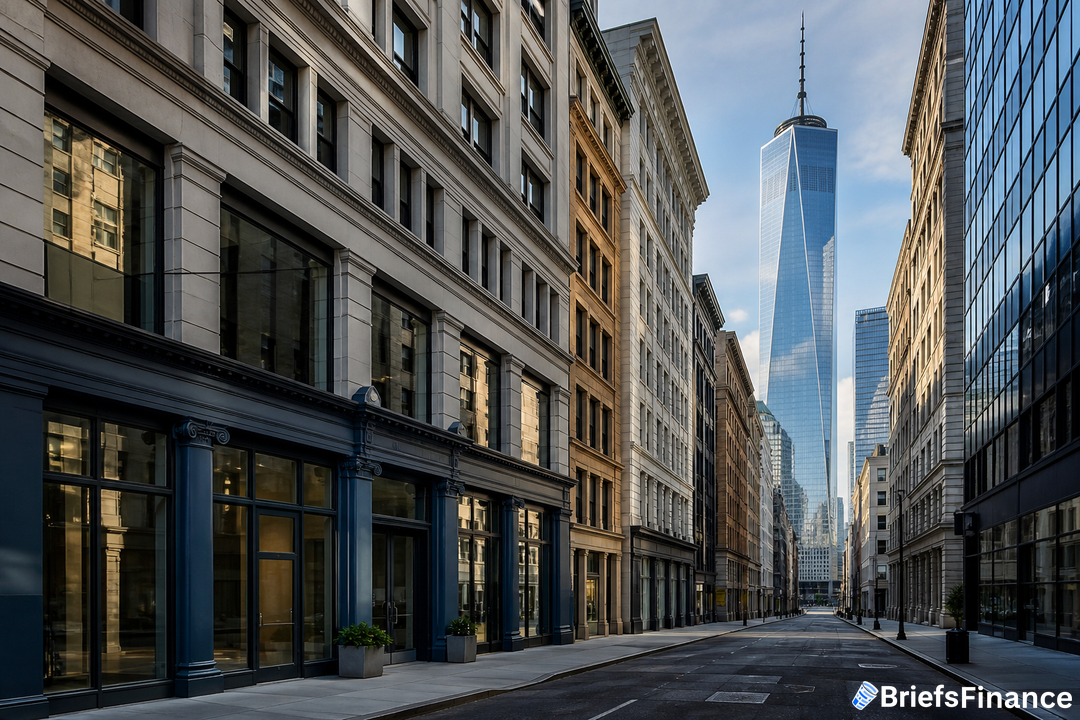
Demand Returns Downtown
If you want a nice office without Midtown sticker shock, Lower Manhattan is back on the shortlist. From January through June, companies signed for roughly 4 million square feet below Canal Street, excluding renewals. That's more than double the same period a year earlier and the best first-half showing since 2019, according to Cushman & Wakefield.
The momentum is a welcome turn for the Wall Street and Financial District area, which has faced a long road back in the 25 years since 9/11. In the pandemic era, firms gravitated to buildings clustered around Midtown's big transit hubs, squeezing vacancies and lifting rents there. Downtown stood out for offering more options, lower costs, and less competition.
"There's strong relocation activity, with more companies choosing to move to the district," said Jessica Lappin, president of the Alliance for Downtown New York. "You're getting great space that's accessible for your employees at a lower price point."
Big Names and AI Fill the Trade Center
Early this year, American Express Co. selected 2 World Trade Center for its headquarters, which enabled Silverstein Properties to begin building the final major office tower slated for the 9/11 site. Ground broke in July. Lappin called it "a huge piece of the puzzle, and it's a wonderful investment in the neighborhood and the city," adding, "People are very excited and inspired."
AI and tech outfits are grabbing a sizable chunk of the new space. At 1 World Trade Center, the startup Mercor, which operates an AI marketplace for labor, along with the legal-and-compliance firm Norm Ai, each agreed to take space. Meta Platforms Inc.-backed Scale AI shifted from Chelsea to a much larger footprint at 1 World Trade that can support about 500 people.
Amid shifting headlines, steady investors focus on value and long-term resilience. Join Briefs Finance CEO Jaspreet Singh on September 29th for a FREE live investor workshop, How to Profit From A Dollar That's Losing its Value, where he shows how we're spotting investment opportunities as the dollar falls. Save your spot.
Opened in 2014 as the site's first new office tower, 1 World Trade Center took time to lease up all 71 office floors. Co-developer the Durst Organization says occupancy now stands at 97%. "We have recently done some deals with law firms, financial services, and tech continues to be a strong demand," said Eric Engelhardt, Durst's senior vice president of commercial leasing. "And for the last six months, for the first time for a long time, we actually have competing offers for the same space."
Rents, Records, and Midtown's Pull
According to CBRE, Downtown's average asking rent in July was up 8% year over year, reaching $61.91 per square foot, the highest since 2020. That beat Midtown's 4% gain and Midtown South's 2%. Even so, Downtown remains the value play compared with Midtown at $85.77 and Midtown South at $86.34. Across Manhattan, vacancies are tightening, and only 2.2% of space is available in trophy towers, per CBRE.
Midtown is still the center of gravity for the recovery. That swath - covering Hudson Yards and Park Avenue - now posts Manhattan's lowest vacancy rate, and several recent marquee deals have pushed rents to new highs. 57th St. According to brokerage Jones Lang LaSalle Inc., that topped the mark established only weeks earlier when AI infrastructure company Nscale signed a $320-a-square-foot deal at One Vanderbilt, SL Green Realty Corp.'s tower next to Grand Central. The pipeline of brand-new premium offices is thin.
AI demand is also steering where leases land. Since 2025, about 62% of AI leasing has gone to Midtown South, Cushman & Wakefield said. July's headliner was Anthropic PBC, which took the whole 16-story property at 330 Hudson St. - a 462,513-square-foot commitment that CBRE labeled Manhattan's biggest deal that month.
What It Means for Your Money
Two tracks are clear. Trophy space is scarce and setting eye-popping highs like $327.50 per square foot at 9 W. 57th St., while Downtown's average sits at $61.91 even after an 8% jump. That gap explains why value seekers are zeroing in on Lower Manhattan.
Meanwhile, conversions are quietly tightening supply as obsolete offices, including former Goldman Sachs Group Inc. space at 55 Broad St., are turned into housing. If you watch REITs or funds with New York exposure, keep an eye on the spillover effect: when top-tier Midtown options are limited and pricey, neighborhoods that pencil out can see a meaningful lift in leasing and pricing power.
Opportunities evolve, but a thoughtful plan helps protect and grow savings. Our CEO Jaspreet Singh is hosting a FREE live investor workshop, How to Profit From A Dollar That's Losing its Value, on September 29th. Sign up free to join him live.