Free NewsletterPro Login
S&P 500 6,287 +0.42%
DOW 44,521 -0.18%
NASDAQ 21,103 +0.71%
S&P 500 +12.4%
Briefs Finance Fund +24.8%
JOIN THE FUND →
BREAKING
×

Lobbying Groups Urge Rejection Of Pentagon Stock Buyback Ban

Published Jun 29, 2026
[tts_player]
Share:
Summary:
  • A proposed ban would block some Pentagon contractors from buying back their own stock starting in fiscal year 2027.
  • Over 1,300 amendments have been proposed to the House Rules Committee, including the buyback ban.
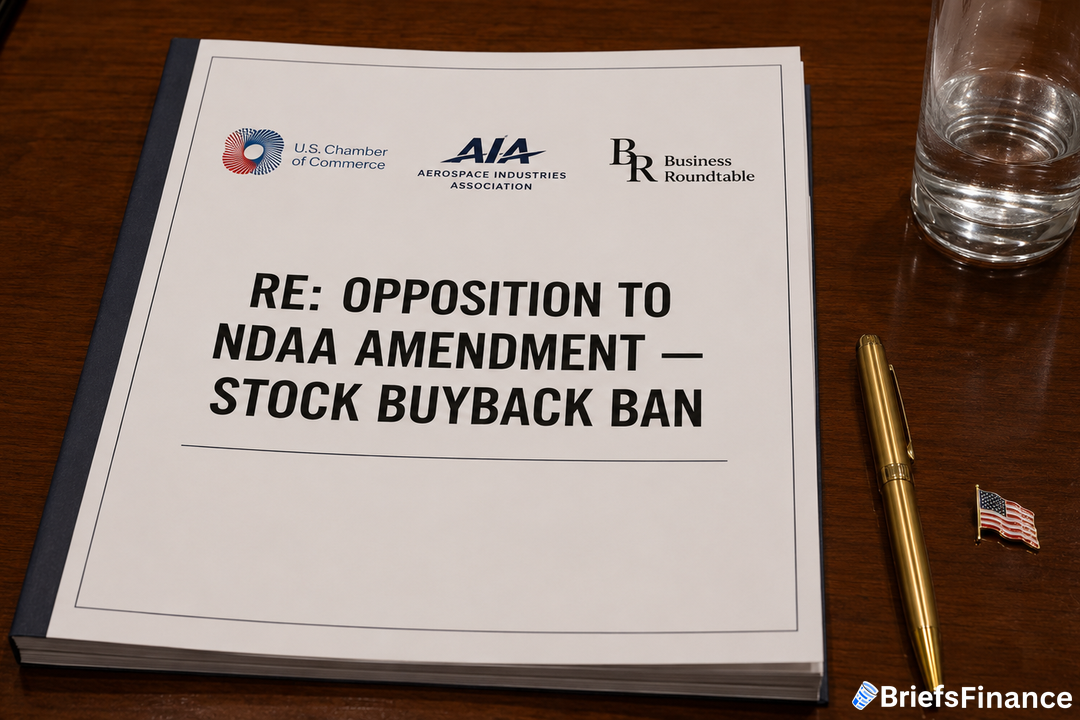
  • Three industry groups - the Chamber of Commerce, Aerospace Industries Association, and Business Roundtable - are urging the committee to reject the amendment.

Defense contractors want to keep buying back their own stock. A group of lawmakers wants them to deliver before they pay themselves.

The Proposed Ban

Two Democratic representatives, Chris Deluzio of Pennsylvania and John Garamendi of California, introduced an amendment to the National Defense Authorization Act. Under the proposal, the Pentagon would be prohibited from contracting with any company that buys back its shares. The Defense Department could grant exceptions at its own discretion. A comparable provision appears in the Senate's fiscal 2027 defense authorization bill.

In an interview with CNBC, Senator Elizabeth Warren, a Massachusetts Democrat spearheading the effort, stated that the measure aims to "bring a small amount of discipline to these defense contractors who have been running wild for years." Supporters argue that the rule is meant to ensure that contractors fulfill their obligations before rewarding themselves. Longtime detractors of defense procurement contend that firms are overcharging the government through budget overruns and late deliveries.

The ban would affect major contractors including Boeing, Lockheed Martin, and Northrop Grumman.

Industry Pushback

The letter says the ban "raises serious concerns about an unprecedented expansion of the federal government's role in restricting lawful corporate governance and capital allocation decisions made by businesses." It also warns that "prohibiting covered defense contractors from engaging in otherwise lawful dividends, share repurchases, and other capital distributions unless they obtain a waiver from the DoD establishes a troubling precedent in which Washington effectively dictates how businesses manage capital allocation decisions that have traditionally remained the responsibility of corporate leadership and shareholders."

The letter adds that "creating a framework that prohibits companies from engaging in ordinary capital allocation decisions unless they obtain a government waiver sends the opposite signal and risks discouraging precisely the type of innovative and non‑traditional market participants policymakers are actively trying to attract."

What to Watch

The House is expected to vote on the National Defense Authorization Act later this week. The Rules Committee will decide whether to include the buyback ban amendment in the final bill.

The outcome will show whether lawmakers side with defense contractors or the push for more discipline.

Background on the Debate

Stock buybacks have become a flashpoint in debates over corporate spending, with critics arguing that companies prioritize shareholder returns over investment in innovation, workers, and contract performance. The defense industry, which relies heavily on government contracts, has faced particular scrutiny as delays and cost overruns on major programs like the F-35 fighter jet and the KC-46 tanker have drawn congressional ire. The proposed amendment is part of a broader effort to tie contractor profitability to meeting deadlines and budget targets, echoing previous attempts to limit buybacks at firms that miss milestones or exceed cost estimates.

Disclosure

Recent News

1 2 3 29

Get Market Briefs delivered to your inbox every morning for free!

No fluff. No noise. No politics. Just finance news you can read in 5 minutes.

Blogs

June 29, 2026
Portfolio Diversification: Why Putting All Your Eggs in One Basket Destroys Wealth
  • Real diversification means spreading investments across all 11 economic sectors plus bonds, alternatives, and cash so no single bet can sink the portfolio.
  • Different sectors perform at different times, so a diversified portfolio captures upswings while smoothing the brutal drawdowns that wipe out concentrated bets.
  • Total market index funds offer the simplest path to diversification, and annual rebalancing is what keeps the structure working over time.
Read More
June 29, 2026
Non Taxable Income: What It Is and Why It Matters
  • Non taxable income is money you receive that you don't owe income tax on.
  • The tax code treats workers, investors, and business owners very differently, and investors often come out ahead.
  • Learning how income is taxed is a quiet superpower for keeping more of what you earn.
Read More
June 29, 2026
Semiconductor Stocks: A Simple Guide for Investors
  • Semiconductor stocks are companies that design and make computer chips, the brains inside nearly every modern device.
  • The AI boom has turned chips into one of the market's most important and most watched groups.
  • They offer big growth potential, but come with high valuations and a notoriously cyclical history.
Read More
June 25, 2026
How Stocks Work: A Simple Guide for Beginners
  • A stock is a slice of ownership in a company - buy one, and you own a piece of the business.
  • You make money two ways: the share price rising over time, and dividends paid to shareholders.
  • The simplest path for most beginners is buying into the whole market through a low-cost index fund.
Read More
June 25, 2026
Stop Loss vs Stop Limit: What's the Difference?
  • A stop loss order sells your stock once it hits a trigger price, prioritizing getting you out.
  • A stop limit order only sells within a price range you set, prioritizing price over a guaranteed exit.
  • The trade-off: a stop loss almost always executes; a stop limit might not if the price moves too fast.
Read More
June 25, 2026
Energy Stocks: A Simple Guide for Investors
  • Energy stocks are companies that produce and supply the power the world runs on, from oil and gas to newer sources.
  • They make up one of the 11 sectors of the market and tend to move with energy prices and big-picture shifts.
  • Like any sector, the key is diversification and understanding the forces driving demand.
Read More
June 18, 2026
What Is a Stop Loss Order? A Simple Guide
  • A stop loss order automatically sells a stock once it falls to a price you set.
  • It's a tool to cap losses or lock in gains without watching the market all day.
  • It works best for active strategies, and can backfire if used carelessly on long-term holdings.
Read More
June 18, 2026
Best S&P 500 Index Fund: How to Choose One
  • The best S&P 500 index fund for most investors is simply the cheapest, most established one that tracks the index well.
  • Funds like VOO, IVV, and SPY all hold the same 500 companies, so the biggest difference is the fee.
  • Pick one, automate your buys, and let time do the heavy lifting.
Read More
June 17, 2026
What Are Penny Stocks? Risks and Rewards Explained
  • Penny stocks are very low-priced shares of very small companies, often trading for just a few dollars or less.
  • They promise huge gains but carry huge risks: low liquidity, high failure rates, and wild price swings.
  • Most investors are better served by quality companies and funds than by chasing cheap shares.
Read More
June 17, 2026
Best Stocks for Beginners With Little Money
  • The best stocks for beginners with little money usually aren't individual stocks at all - they're low-cost index funds.
  • You can start with $100 or less and use small, regular investments to build wealth over time.
  • Focus on diversification and consistency, not on picking the next big winner.
Read More
1 2 3 24
Share via
Copy link










