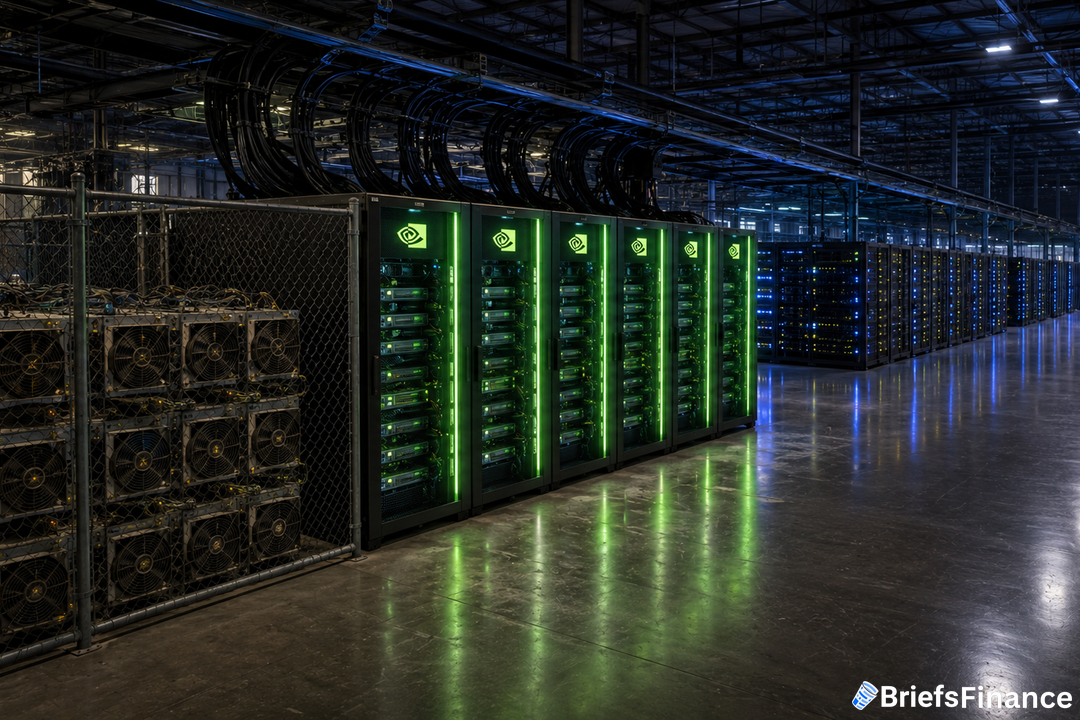
Bitcoin mining profits are shrinking as energy costs rise. So IREN changed its game. It started renting out its computer chips for AI cloud services. Those moves secured major partnerships with Microsoft and Nvidia, ultimately earning the company a place in the Russell 1000.
IREN was founded in 2019 as Iris Energy, a Bitcoin miner. Facing increasing electricity expenses and declining profitability from mining, the company pivoted to AI.
"IREN changed its game. It started renting out its computer chips for AI cloud services," a company spokesperson said. Back in November 2025, IREN inked a five-year GPU cloud deal with Microsoft valued at about $9.7 billion, leveraging Nvidia GB300 chips at its 750-megawatt Childress, Texas facility, which is expected to generate roughly $1.94 billion in annualized run-rate revenue.
Get your free investing masterclass bonus when you join Market Briefs, our free daily newsletter
In a separate arrangement, Nvidia obtained a five-year option to purchase up to 30 million IREN shares (worth about $2.1 billion), while the two firms jointly develop up to 5 gigawatts of AI infrastructure.
BitMine Immersion Technologies takes a different approach. BitMine holds approximately 5.67 million ETH, representing about 4.7% of all ETH in circulation, and carries no debt. Market analysts project that its addition to the index could drive up to $2.15 billion in passive investment inflows.
BitMine, chaired by Tom Lee, joined the Russell 1000 on the same date as IREN. Other crypto-adjacent firms already in the index include Michael Saylor's Strategy, Coinbase, and Robinhood.
Being added to the Russell 1000 brings passive investment from index funds that track the index.
The inclusion of both IREN and BitMine in the Russell 1000 underscores the increasing convergence of cryptocurrency mining and traditional finance. For IREN, the transition from pure mining to AI cloud services has not only attracted major tech partners but also positioned it for index membership, which typically leads to automatic buying from passive funds tracking the index. BitMine, meanwhile, stands out as a debt-free holder of a significant percentage of Ethereum, making it a unique crypto play.
The Russell 1000 index is reconstituted annually based on market capitalization rankings as of the end of May. Inclusion in the index typically leads to increased liquidity and institutional interest, as passive funds and ETFs that track the index must buy the newly added stocks. This mechanism often provides a short-term price boost, although market conditions and investor sentiment can cause fluctuations, as seen with IREN's dip on the day the article was published.
Subscribe to Market Briefs, our free daily newsletter, and claim your bonus investing masterclass