Free NewsletterPro Login
S&P 500 6,287 +0.42%
DOW 44,521 -0.18%
NASDAQ 21,103 +0.71%
S&P 500 +12.4%
Briefs Finance Fund +24.8%
JOIN THE FUND →

Casey's Sets Sights on Adding 400 Stores in Three-Year Push

Published Jun 30, 2026
[tts_player]
Share:
Summary:
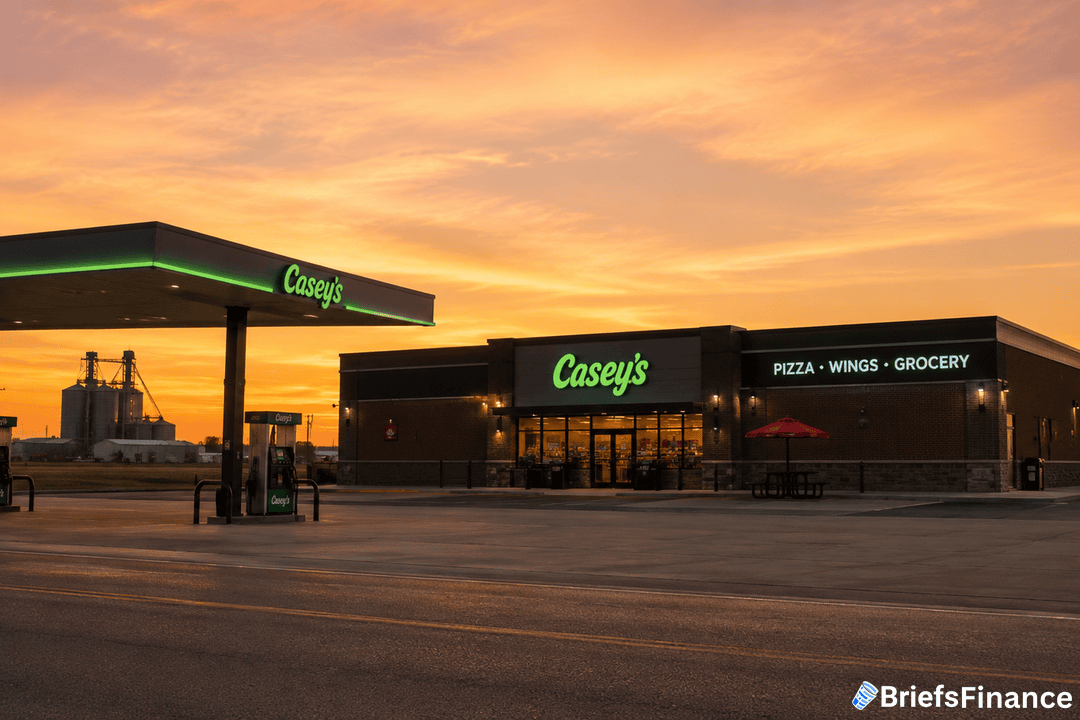
  • Casey's General Stores will add at least 400 new locations over the next three years.
  • The company's stock has gained more than 53% in the past year, trading at $780.24.
  • Casey's ranks as the third-largest convenience store retailer in the U.S. and the fifth-largest pizza chain.

Growth Plans and Past Success

In the previous three-year cycle, Casey's added more than 500 stores and joined the S&P 500 index. According to CEO Darren Rebelez, Casey's is emerging from what he called "the best three-year cycle" in its history after beating its prior targets.

"We made a commitment to grow our EBITDA by 8% to 10%, which is top-quintile growth for the S&P 500," Rebelez told FOX Business. "We'll do that through growing our prepared foods business, growing our store base and running our business more efficiently."

The company currently operates more than 2,900 convenience stores. Casey's uses both new builds and acquisitions to expand. Ena Williams, chief operations officer, said in a statement, "Our growth strategy is expanding Casey's Country in a disciplined way. We've shown that we can grow through both new stores and acquisitions."

Food Business Driving Growth

Casey's is famous for its pizza. But the company is now leaning hard into another prepared food item: chicken wings. Currently, some 850 locations offer wings, including bone-in and boneless varieties, along with five sauces, three dry rubs, and freshly made ranch. In Des Moines, where the wings have been on the menu for over a year, same-store sales have risen about 20% year-over-year.

"We're famous for our pizza, we still have a long runway for growth there with innovation and new items that we've introduced more recently," Rebelez said. "But now we have the wings platform."

Rebelez said Casey's does not see other convenience stores as competition for prepared foods. "We're really competing with the restaurant business," he said.

"We sell fuel, we sell grocery and general merchandise, and we have prepared food, so we can compete in either space," Rebelez added.

Technology and Efficiency

The company is also investing in AI, predictive tools, and digital platforms like the Casey's app and Casey's Rewards to boost efficiency and enhance the customer experience.

What to Watch

The company will expand into new markets while deepening its wings and pizza presence in existing ones.

Background on Casey's Market Position

Founded more than five decades ago, Casey's has grown from a small-town Iowa operation into a national powerhouse with a footprint spanning 16 states. Its combination of fuel, grocery, and prepared food - especially pizza - has allowed it to capture customers who might otherwise visit quick-service restaurants. With a market capitalization exceeding $30 billion and a spot in the S&P 500, the company's aggressive expansion plan underscores its confidence in both organic growth and future acquisitions. The new store target of 400 over three years represents a slightly slower pace than the previous cycle's 500, but management believes the enhanced focus on food innovation and digital tools will lift profitability.

Disclosure

Recent News

1 2 3 29

Get Market Briefs delivered to your inbox every morning for free!

No fluff. No noise. No politics. Just finance news you can read in 5 minutes.

Blogs

June 29, 2026
Portfolio Diversification: Why Putting All Your Eggs in One Basket Destroys Wealth
  • Real diversification means spreading investments across all 11 economic sectors plus bonds, alternatives, and cash so no single bet can sink the portfolio.
  • Different sectors perform at different times, so a diversified portfolio captures upswings while smoothing the brutal drawdowns that wipe out concentrated bets.
  • Total market index funds offer the simplest path to diversification, and annual rebalancing is what keeps the structure working over time.
Read More
June 29, 2026
Non Taxable Income: What It Is and Why It Matters
  • Non taxable income is money you receive that you don't owe income tax on.
  • The tax code treats workers, investors, and business owners very differently, and investors often come out ahead.
  • Learning how income is taxed is a quiet superpower for keeping more of what you earn.
Read More
June 29, 2026
Semiconductor Stocks: A Simple Guide for Investors
  • Semiconductor stocks are companies that design and make computer chips, the brains inside nearly every modern device.
  • The AI boom has turned chips into one of the market's most important and most watched groups.
  • They offer big growth potential, but come with high valuations and a notoriously cyclical history.
Read More
June 25, 2026
How Stocks Work: A Simple Guide for Beginners
  • A stock is a slice of ownership in a company - buy one, and you own a piece of the business.
  • You make money two ways: the share price rising over time, and dividends paid to shareholders.
  • The simplest path for most beginners is buying into the whole market through a low-cost index fund.
Read More
June 25, 2026
Stop Loss vs Stop Limit: What's the Difference?
  • A stop loss order sells your stock once it hits a trigger price, prioritizing getting you out.
  • A stop limit order only sells within a price range you set, prioritizing price over a guaranteed exit.
  • The trade-off: a stop loss almost always executes; a stop limit might not if the price moves too fast.
Read More
June 25, 2026
Energy Stocks: A Simple Guide for Investors
  • Energy stocks are companies that produce and supply the power the world runs on, from oil and gas to newer sources.
  • They make up one of the 11 sectors of the market and tend to move with energy prices and big-picture shifts.
  • Like any sector, the key is diversification and understanding the forces driving demand.
Read More
June 18, 2026
What Is a Stop Loss Order? A Simple Guide
  • A stop loss order automatically sells a stock once it falls to a price you set.
  • It's a tool to cap losses or lock in gains without watching the market all day.
  • It works best for active strategies, and can backfire if used carelessly on long-term holdings.
Read More
June 18, 2026
Best S&P 500 Index Fund: How to Choose One
  • The best S&P 500 index fund for most investors is simply the cheapest, most established one that tracks the index well.
  • Funds like VOO, IVV, and SPY all hold the same 500 companies, so the biggest difference is the fee.
  • Pick one, automate your buys, and let time do the heavy lifting.
Read More
June 17, 2026
What Are Penny Stocks? Risks and Rewards Explained
  • Penny stocks are very low-priced shares of very small companies, often trading for just a few dollars or less.
  • They promise huge gains but carry huge risks: low liquidity, high failure rates, and wild price swings.
  • Most investors are better served by quality companies and funds than by chasing cheap shares.
Read More
June 17, 2026
Best Stocks for Beginners With Little Money
  • The best stocks for beginners with little money usually aren't individual stocks at all - they're low-cost index funds.
  • You can start with $100 or less and use small, regular investments to build wealth over time.
  • Focus on diversification and consistency, not on picking the next big winner.
Read More
1 2 3 24
Share via
Copy link










