Free NewsletterPro Login

Warning: Undefined variable $stocks in /var/www/briefs.co/htdocs/wp-content/plugins/oxygen/component-framework/components/classes/code-block.class.php(133) : eval()'d code on line 448

Warning: foreach() argument must be of type array|object, null given in /var/www/briefs.co/htdocs/wp-content/plugins/oxygen/component-framework/components/classes/code-block.class.php(133) : eval()'d code on line 448

Warning: Undefined variable $funds in /var/www/briefs.co/htdocs/wp-content/plugins/oxygen/component-framework/components/classes/code-block.class.php(133) : eval()'d code on line 472

Warning: foreach() argument must be of type array|object, null given in /var/www/briefs.co/htdocs/wp-content/plugins/oxygen/component-framework/components/classes/code-block.class.php(133) : eval()'d code on line 472
/* the link was here */
×
Free investor livestream — Nov 17

How To Use ChatGPT & Claude To Research Stocks Like A Pro

01
The prompt we use to break down any stock
02
How to fact-check what AI tells you
03
How to compare two stocks in minutes

Amazon rolls out Alexa-powered hardware, from new Echo speakers to a 16-inch smart display

Published Oct 28, 2026
Share:
Summary:
  • Amazon introduced refreshed Echo speakers, a 10-inch Alexa Photo Frame, and a 16-inch Echo Show with new software and a slimmer design.
  • Most devices are available now; Echo Show 16 is up for preorder to ship later this year, and Alexa Home Map will enter preview later this year.
  • Prices run from $100 to $570, including an Echo Time bedside clock with sleep sensing and an Echo Studio variant that adds a camera.

Echo speakers get new models, higher prices, and more hub power

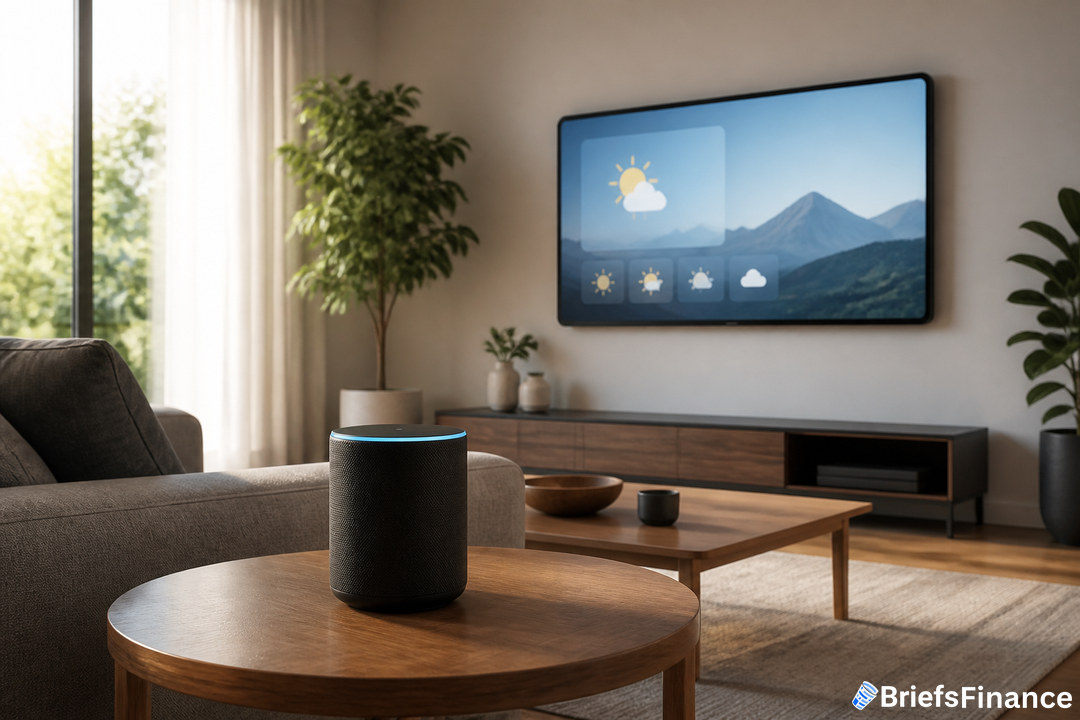
Amazon packed another hardware day into a busy fall for devices chief Panos Panay, aiming to plant Alexa in every room as Apple reenters the smart home conversation. Most of the lineup is on sale today, with Echo Show 16 preorders open ahead of shipments later this year.

There are three new Echo speakers, with two largely mirroring last year's models and getting modest upgrades. The standard Echo Dot now costs $100, up from $80, and it now doubles as a smart home hub with native support for Zigbee, Thread, and Matter to control thousands of accessories.

That hub role previously lived with the Echo Dot Max and the Echo Studio. The Dot Max stays because it still sounds better, even as the regular Dot picks up most of its capabilities. Panay said Amazon has sold more than 100 million Dot speakers cumulatively.

The Echo Studio also moves up in price to $250 from $220 and, for the first time, adds a video camera. Amazon says the camera gives Alexa visual understanding so answers can reflect what is in front of the device. Examples include holding up a board game box and asking Alexa+ to explain the rules, or showing a cereal box so Alexa can identify it and help order other flavors.

Over the next few weeks, people who own the Echo Studio with Home Camera can link it to a Fire TV streaming device to handle video calls. During a media preview, Panay placed a brief call to his parents to show it working. Amazon will continue selling last year's Echo Studio without a camera, and the company says both Studio models provide identical audio performance and its best sound quality.

Echo Time aims for the nightstand, without a camera

The standout newcomer is the $200 Echo Time. It keeps the Dot's sphere but adds a circular touchscreen that turns it into an interactive clock. You can swipe between multiple faces, from analog to digital to playful, but you cannot show personal photos. The 3.2-inch display can dim below 0.3 nits so it will not light up the room at night.

There is no camera, by design. "Bedrooms are a pretty unique sacred space for many," Panay said. "I never talk about what's not in a product, but sometimes it's a very important detail."

Echo Time introduces opt-in sleep sensing that uses ultrasonic signals to infer breathing depth and time your wake-up during a light sleep phase. Amazon says it can shift the alarm within a 10-minute to 1-hour window around your set time, or you can choose a fixed alarm instead. It is not intended for health uses such as snoring detection or possible sleep apnea alerts.

Like the updated Dot, Echo Time includes a full smart home hub and can sync with lights to brighten gradually as you wake. It can briefly surface music controls and notifications, such as a doorbell ring, then return to the clock. Some Echo display features are not here, including a calendar view.

Alexa Photo Frame and the 16-inch Echo Show

The Alexa Photo Frame goes after premium frames with three finishes: Black at $200, and genuine birch or walnut at $230. It uses a 10-inch semi-matte, anti-glare touch display that adjusts to the room's lighting and pulls images from Amazon Photos, which gives Prime members unlimited image backups. With built-in mics, you can ask Alexa to pull up pictures of a person or a specific memory.

"It's designed around three principles," Panay said.

New tools reshape how investors gather insight, and an edge often starts with curiosity. We're hosting our first ever investor livestream on 11/17 to show you how to use ChatGPT and Claude to invest like a pro, hosted by Briefs Finance CEO Jaspreet Singh. Save your seat.

"One is a collection of faces. The other one is around time. And the last one is around context. And so Alexa curates all your photos around those three premises." Alexa prioritizes your best shots, filters out things like screenshots, and can show two related photos together, such as the same person at different ages.

You're able to add spoken notes to photos and listen to them afterward. To make gifting easier, buyers can preconfigure the frame so it displays a chosen photo set and message on first setup. Panay also addressed concerns about photo libraries living in Apple's iCloud or Google Photos, noting that the Amazon Photos app is able to upload copies of images from both iPhones and Android devices.

"It doesn't take them out of the current photo library. You can still use the photo app that you love," he said.

Amazon's $500 Echo Show 16 is its most premium smart display yet and will ship later this year, following Apple's $299 HomeView arrival on Nov. 13. "This is starting from zero from the hardware all the way through the software to the experience," Panay said. Versus Echo Show 15, Amazon says you get 10% more viewing area and twice the color vibrancy. Its anodized aluminum surround trims thickness by almost 40% and contains a revamped audio array with 10 drivers designed to cut through the noise of busy kitchens or living rooms.

A Nanomatte anti-glare configuration is available for $570 to preserve clarity in harsh light. It ships with a 13-megapixel camera offering the broadest field of view of any Echo Show, and Visual ID can identify users at distances up to 17 feet. Night mode helps when the lights are low.

On software, users can flip among three "Screen Styles" - a family organizer, a smart home dashboard, and a digital photo frame. Echo Show 16 comes with Fire TV built in and includes a remote for navigating streaming apps.

Separately, Amazon previewed Alexa Home Map, which lets you scan rooms with a smartphone to create a 3D layout of your home. Updates occur in real time, showing dynamic visuals, and if you have outdoor cameras, it can display animations of passing cars. A preview begins later this year.

Most of the hardware can be bought today. Echo Show 16 is open for preorder and will start shipping later this year.

Why investors should watch

Amazon is widening Alexa's reach with devices that pull users into daily habits, from hub control in the entry-level Dot to sleep sensing and visual intelligence that make Alexa more useful. The lineup spans $100 for the updated Dot to $570 for the Nanomatte Echo Show 16, while Amazon keeps models like the Dot Max and last year's Studio in market to cover more budgets.

The bottom line: classic ecosystem expansion. More screens, sensors, and software modes add more reasons to use Alexa - and buy through it. Timing matters, too, with Echo Show 16 slated to ship after Apple's HomeView, setting up a holiday test for smart-home share.

Learning how to use emerging technology can quietly improve decision making for investors. On 11/17, our CEO Jaspreet Singh goes live for our first ever investor livestream on how to use ChatGPT and Claude to invest like a pro. Register to join him.

Disclosure

Recent News

1 2 3 … 113

Get Market Briefs delivered to your inbox every morning for free!

No fluff. No noise. No politics. Just finance news you can read in 5 minutes.

Blogs

October 23, 2026
Are We in a Recession? 5 Threats to the Economy and Where the Money Is Moving
  • The S&P 500 is up about 13% this year, but without AI it's in a bear market, with nearly 40% of its companies down more than 20% for four months or longer.
  • Jackson, Briefs Finance's head of investing research, sees five threats: rising interest rates, sticky inflation, an economy propped up by AI, a struggling UK, and high oil prices.
  • The opportunities he's watching mostly sit outside the dollar: rising economies like Brazil and Indonesia, US-backed emerging market bonds paying 7% to 9%, and the shifts that fear creates.
Read More
October 16, 2026
How Boring Math Makes You Rich: The Briefs Money Spreadsheet, Explained
  • Briefs Money shows you what to do with every paycheck, and in what order: how much to spend, save, and invest, when to build an emergency fund, and which debt to pay off first.
  • The Climb to Wealth course walks you through the system step by step, and the Personal Finance Spreadsheet is where you track your own numbers.
  • Investing is one piece of building wealth. The system that gets money to your investments, and keeps it there, decides the outcome.
Read More
October 16, 2026
Common Investing Mistakes: Why a Stock Grade Is One Tool, Not the Whole Toolkit
  • The Briefs Score shows growth, income, and wealth preservation investors how well a stock fits their goal, with a separate letter grade for each one.
  • The most common mistake is treating the letter as an instruction. An A tells you a stock scores well for one goal, not that you should buy today.
  • Research works best as one input in a process you own. The grade shows how a stock stacks up. You supply the goal, the timeline, and the rules for being wrong.
Read More
October 16, 2026
How to Read a Company's Numbers Without a Finance Degree (Using Briefs Terminal)
  • Briefs Terminal lets you size up any public company in about ten minutes: what the stock costs, what it earns, how fast sales are growing, and what it pays you, all on one page.
  • It lines those numbers up against the company's closest competitors for you, so you can tell if a number is impressive or just average.
  • Below that are the income statement, balance sheet, and cash flow statement from the company's SEC filings, the latest news, and transcripts of its earnings calls.
Read More
October 16, 2026
What Type of Investor Am I? The Three Investor Archetypes, Explained
  • Briefs sorts its stock grades and monthly reports by three investor goals: growth, income, and wealth preservation. Pick yours and you know which report and which grade to read first.
  • Growth investors want stocks that beat the S&P 500. Income investors want to get paid in cash. Wealth preservation investors want stocks that hold up when the market drops.
  • The same stock can score an A- for one goal and a D- for another, so picking your goal comes before picking any stock.
Read More
October 16, 2026
How to Build a Stock Watchlist That Isn't Just Stocks You Heard About
  • A watchlist on Briefs Terminal lets you group stocks by the idea you're tracking and follow each one's price, one-day move, and 52-week high and low in one place.
  • Each list has its own name and description, so you always know why a stock is on it, and you can make as many lists as you have ideas.
  • The monthly growth, income, and wealth preservation reports under the Briefs Research tab hand you new themes to track that you didn't hear about online.
Read More
October 16, 2026
How to Choose an ETF That Matches Your Idea (Using the ETF Planning Tool)
  • The ETF planning tool takes an idea like "I want to invest in fast food companies," asks what you mean, and finds the ETFs that match, with the reasons, the holdings, and the sources.
  • Build a Plan then shows what your money could grow to in those ETFs over the years you choose, with conservative, expected, and optimistic estimates next to the S&P 500.
  • It gets you from an idea to an actual plan without researching dozens of companies one at a time.
Read More
October 16, 2026
Is This Stock a Good Buy? How to Use the Briefs Score to Tell If a Stock Fits the Way You Invest
  • The Briefs Score shows growth, income, and wealth preservation investors how well a stock fits their goal, with a separate letter grade for each one.
  • One stock can score very differently for each. Nvidia showed an A- for growth and a D- for income, because it grows fast and pays almost no dividend.
  • Seven sub scores under each grade show what earned the letter, so you can see exactly where a stock is strong or weak for your goal.
Read More
October 16, 2026
How to Tell an Asset From a Liability: The One Question to Ask Before You Buy Anything
  • The typical American household earned more in 2025 than in any year on record, yet only 30% of Americans say they could pay a surprise $1,000 bill from savings, so the problem isn't income but what the income gets spent on.
  • An asset puts money in your pocket and a liability takes money out, and the wealthy buy assets first, then let the assets pay for the fun stuff.
  • Before you buy anything, ask one question: does this put money in my pocket, or take money out of my pocket? Then you need a plan for the money you keep.
Read More
October 16, 2026
How to Build Your First $2,000 Emergency Fund and Wipe Out Every Debt Over 10%
  • Your first money goal isn't investing, it's $2,000 in its own account named Do Not Touch, built by moving 10% of every paycheck into it automatically.
  • More than a third of American adults couldn't cover a $400 surprise bill with cash or savings, according to the Federal Reserve, and that's how one bad day turns into years of credit card payments.
  • Once the $2,000 is there, attack every debt charging more than 10% interest, highest rate first, because you can't out-invest a 22% credit card so paying it off is the investment.
Read More
1 2 3 … 29
Share via
Copy link










