Rates Are Up
A shipping route halfway around the world from the U.S. is quietly making everything you buy more expensive.
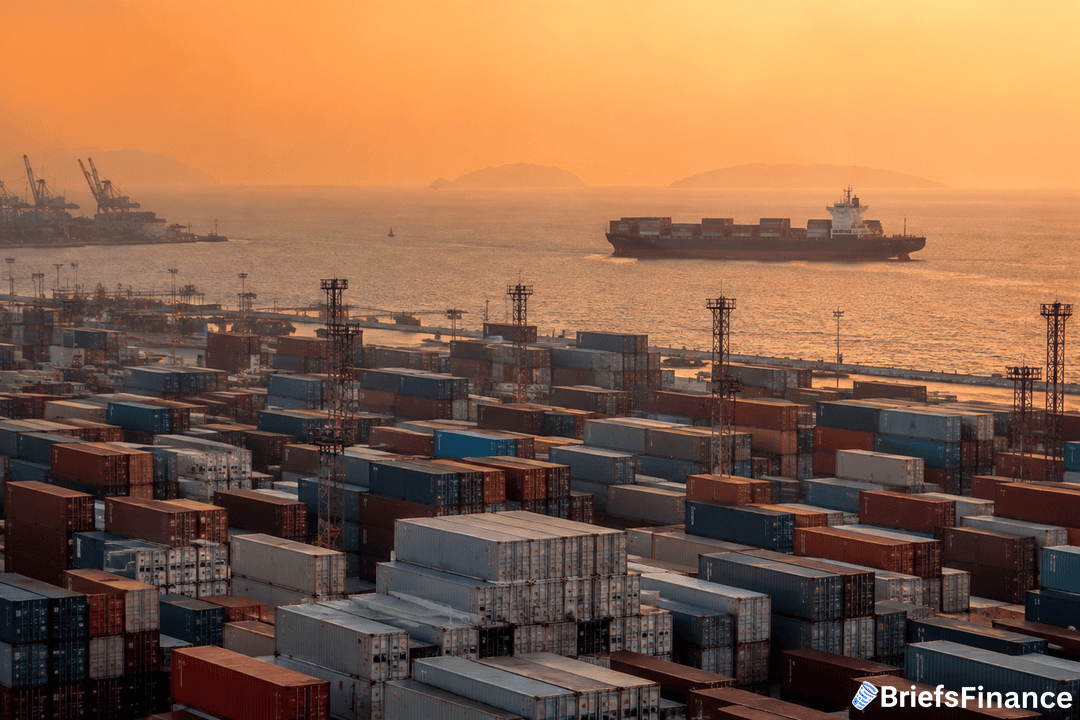
Iran's war now includes a closed Strait of Hormuz, the narrow stretch of water between the Persian Gulf and the Gulf of Oman. That closure is five weeks old, and it has already pushed up the cost of moving goods across every major ocean route, including straight to America's shores.
The numbers come from Xeneta, a company that tracks what shippers actually pay for container space. Its chief analyst, Peter Sand, said, "This is not a small ripple."
On April 1, the average spot rate for a 40-foot container moving from Asia to the U.S. West Coast hit $2,430, up 29% since the end of February. The East Coast route got hit too. A 40-foot box from Asia to the U.S. East Coast now goes for $3,382, while the Northern Europe-to-U.S. East Coast lane sits at $1,775.
The increases are not just an American problem. Asia-to-Northern Europe rates jumped 31%, and Asia-to-Mediterranean rates climbed 30%.
Sand put it bluntly: "Five weeks into the Strait of Hormuz closure and spot rates on every major east-west trade lane have risen sharply, showing this is a conflict with global repercussions for ocean supply chains."
"No shipper is insulated from financial or operational risk," Sand said.
How the Hormuz Closure Hits Local Ports
The U.S. West Coast sits an ocean away from the Middle East. But global shipping runs on hubs, and the problems are stacking up at the hub level.
Get the free Always Be Buying eBook and learn the simple system for building wealth on any income
Congestion in Middle East ports is now clogging major Asian transfer hubs that handle U.S.-bound cargo, including Port Klang, Tanjung Pelepas and Singapore. When ships cannot move through normally, everything stuck behind them backs up.
No fuel shortages have appeared for ships tied to the Strait of Hormuz, and Iran has not attacked Persian Gulf refining. Singapore, the world's leading refueling stop for ships, still has fuel at roughly double pre-crisis prices, though that is easing after an initial jump of around 200%. Ship-to-ship fuel transfers are adding expense and complexity in the Far East, and Rotterdam fuel prices keep rising.
Carriers Pass on Risk
Shipping companies are not just eating these costs. They are handing them to the people who need goods moved.
"The position of carriers is unambiguous - the cost of uncertainty sits with the shipper," Sand said.
Instead of waiting to see what happens, shippers are locking in capacity at today's rates. "Shippers booking capacity today are paying a premium for certainty, but it is a calculated risk against being caught short in peak season three months from now and paying even higher rates," Sand said.
Those who wait for calmer waters are making their own bet. As Sand put it: "Shippers who wait for conditions to stabilize are placing a bet with no clear evidence behind it."
Maersk Seeks an Emergency Surcharge
Maersk, the world's second-largest container carrier, asked U.S. regulators again for permission to skip the usual 30-day waiting period before charging emergency fuel surcharges. The Federal Maritime Commission rejected the first request in late March, and a spokesperson said it would rule on this new request on April 02.
Why It Matters
Shipping rates are a leading indicator. When it costs more to move a container, that cost eventually shows up in store prices. The jump is especially meaningful with peak season still about three months away.
During the 2024 Red Sea crisis, Houthi rebels from Yemen drove already-high rates to double as congestion built in Singapore. That memory is one reason shippers are locking in capacity now rather than waiting.
If today's premium buys a guarantee that your goods actually arrive, it might look reasonable. If the crisis drags on, the people who waited could be paying far worse.
Download the free Always Be Buying eBook and start putting your money to work today