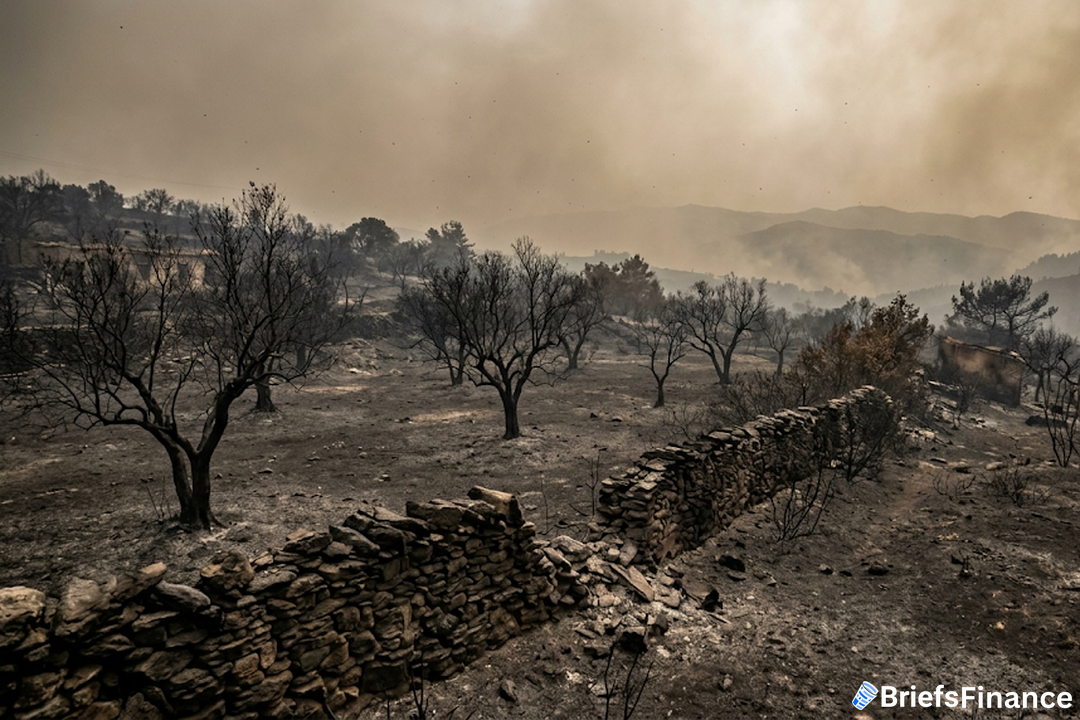
Heatwaves Aren't Just Weather Anymore
Carsten Brzeski, Global Head of Macro at ING, said in a June report: "The uncomfortable truth is that heatwaves have quietly graduated from 'weather event' to 'macro variable.'"
According to economists, repeated heatwaves represent a recurring macroeconomic threat because they reduce labor productivity, interrupt supply chains, lower tourism revenue, and increase food costs.
The Cost Is Already Piling Up
On Monday, French Finance Minister Roland Lescure described the latest wildfires as "like a clap of thunder" for the local economy.
Get the market news that matters in a five-minute read with Market Briefs, our free daily newsletter
In an appearance on CNBC's "Squawk Box Europe," Georg Zachmann, a Bruegel senior fellow specializing in energy and climate policy, estimated the 2025 California wildfires caused $40-$60 billion in direct damage and roughly $300 billion in indirect costs. He noted that unpredictable disasters tend to fuel inflation and raise risk premiums.
Why This Keeps Getting Worse
Stefan Doerr, a wildland fire science professor at Swansea University, explained on CNBC's "Squawk Box Europe" that climate change and inadequate landscape management significantly contribute to the wildfires. He noted that years of farmland abandonment and centuries of human-altered terrain have made southern European regions more prone to wildfires, as they now feature thick, easily ignited vegetation under extreme heat and drought conditions.
"If we had a natural landscape, we would have actually, in some places, at least far less flammable forests," Doerr said. "This is man-made. It's not that the plants are not natural, but the way the landscape looks now is entirely artificial."
Zachmann said: "This is really a big economic challenge. We need really to do everything we can do to make sure that our systems are adapted early on, as much as possible, and the speed of climate change is slowed down as much as possible, so that we don't get into a situation where our absorptive capacity for such risks is not exceeded."
What It Means for Your Portfolio
Commodities like cocoa, coffee, and wheat are predicted to be among the most affected by the heatwave, because hotter and more erratic weather reduces harvests and pushes food costs higher. Zachmann noted that extreme weather, including European wildfires, will likely strain national budgets due to expenses for evacuations, firefighting, and rebuilding infrastructure.
ING's Brzeski told CNBC that a "bittersweet consequence" of the fires in France and Spain is that reconstruction will likely generate economic activity, similar to other natural disasters.
Allianz Commercial highlighted that sectors such as utilities, energy, construction, real estate, agriculture, and transportation will face the most significant consequences.
Join Market Briefs, our free daily newsletter, for a quick daily rundown of the markets