Free NewsletterPro Login
S&P 500 6,287 +0.42%
DOW 44,521 -0.18%
NASDAQ 21,103 +0.71%

Warning: Undefined variable $funds in /var/www/briefs.co/htdocs/wp-content/plugins/oxygen/component-framework/components/classes/code-block.class.php(133) : eval()'d code on line 491

Warning: foreach() argument must be of type array|object, null given in /var/www/briefs.co/htdocs/wp-content/plugins/oxygen/component-framework/components/classes/code-block.class.php(133) : eval()'d code on line 491
/* the link was here */

Wildfires and Heatwaves in Europe Drive Up Investor Costs

Published Jul 31, 2026
[tts_player]
Share:
Wildfires and Heatwaves in Europe Drive Up Investor Costs
Summary:
  • Economists now treat repeated European heatwaves as a recurring macroeconomic threat rather than isolated weather.
  • Heat and wildfires cut labor productivity, disrupt supply chains, reduce tourism and push food costs higher.
  • Analysts estimate recent wildfire seasons caused tens of billions in direct damage and far more in indirect costs.

Heatwaves Aren't Just Weather Anymore

Carsten Brzeski, Global Head of Macro at ING, said in a June report: "The uncomfortable truth is that heatwaves have quietly graduated from 'weather event' to 'macro variable.'"

According to economists, repeated heatwaves represent a recurring macroeconomic threat because they reduce labor productivity, interrupt supply chains, lower tourism revenue, and increase food costs.

The Cost Is Already Piling Up

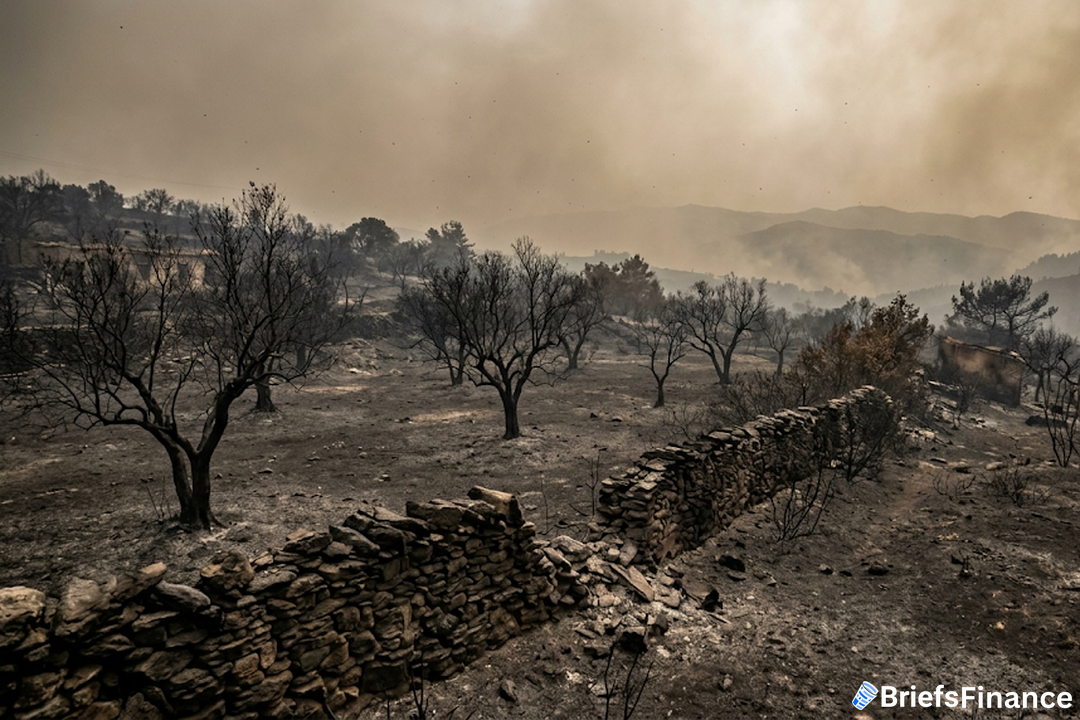
On Monday, French Finance Minister Roland Lescure described the latest wildfires as "like a clap of thunder" for the local economy.

Get the market news that matters in a five-minute read with Market Briefs, our free daily newsletter

In an appearance on CNBC's "Squawk Box Europe," Georg Zachmann, a Bruegel senior fellow specializing in energy and climate policy, estimated the 2025 California wildfires caused $40-$60 billion in direct damage and roughly $300 billion in indirect costs. He noted that unpredictable disasters tend to fuel inflation and raise risk premiums.

Why This Keeps Getting Worse

Stefan Doerr, a wildland fire science professor at Swansea University, explained on CNBC's "Squawk Box Europe" that climate change and inadequate landscape management significantly contribute to the wildfires. He noted that years of farmland abandonment and centuries of human-altered terrain have made southern European regions more prone to wildfires, as they now feature thick, easily ignited vegetation under extreme heat and drought conditions.

"If we had a natural landscape, we would have actually, in some places, at least far less flammable forests," Doerr said. "This is man-made. It's not that the plants are not natural, but the way the landscape looks now is entirely artificial."

Zachmann said: "This is really a big economic challenge. We need really to do everything we can do to make sure that our systems are adapted early on, as much as possible, and the speed of climate change is slowed down as much as possible, so that we don't get into a situation where our absorptive capacity for such risks is not exceeded."

What It Means for Your Portfolio

Commodities like cocoa, coffee, and wheat are predicted to be among the most affected by the heatwave, because hotter and more erratic weather reduces harvests and pushes food costs higher. Zachmann noted that extreme weather, including European wildfires, will likely strain national budgets due to expenses for evacuations, firefighting, and rebuilding infrastructure.

ING's Brzeski told CNBC that a "bittersweet consequence" of the fires in France and Spain is that reconstruction will likely generate economic activity, similar to other natural disasters.

Allianz Commercial highlighted that sectors such as utilities, energy, construction, real estate, agriculture, and transportation will face the most significant consequences.

Join Market Briefs, our free daily newsletter, for a quick daily rundown of the markets
Disclosure

Recent News

1 2 3 46

Get Market Briefs delivered to your inbox every morning for free!

No fluff. No noise. No politics. Just finance news you can read in 5 minutes.

Blogs

June 29, 2026
Portfolio Diversification: Why Putting All Your Eggs in One Basket Destroys Wealth
  • Real diversification means spreading investments across all 11 economic sectors plus bonds, alternatives, and cash so no single bet can sink the portfolio.
  • Different sectors perform at different times, so a diversified portfolio captures upswings while smoothing the brutal drawdowns that wipe out concentrated bets.
  • Total market index funds offer the simplest path to diversification, and annual rebalancing is what keeps the structure working over time.
Read More
June 29, 2026
Non Taxable Income: What It Is and Why It Matters
  • Non taxable income is money you receive that you don't owe income tax on.
  • The tax code treats workers, investors, and business owners very differently, and investors often come out ahead.
  • Learning how income is taxed is a quiet superpower for keeping more of what you earn.
Read More
June 29, 2026
Semiconductor Stocks: A Simple Guide for Investors
  • Semiconductor stocks are companies that design and make computer chips, the brains inside nearly every modern device.
  • The AI boom has turned chips into one of the market's most important and most watched groups.
  • They offer big growth potential, but come with high valuations and a notoriously cyclical history.
Read More
June 25, 2026
How Stocks Work: A Simple Guide for Beginners
  • A stock is a slice of ownership in a company - buy one, and you own a piece of the business.
  • You make money two ways: the share price rising over time, and dividends paid to shareholders.
  • The simplest path for most beginners is buying into the whole market through a low-cost index fund.
Read More
June 25, 2026
Stop Loss vs Stop Limit: What's the Difference?
  • A stop loss order sells your stock once it hits a trigger price, prioritizing getting you out.
  • A stop limit order only sells within a price range you set, prioritizing price over a guaranteed exit.
  • The trade-off: a stop loss almost always executes; a stop limit might not if the price moves too fast.
Read More
June 25, 2026
Energy Stocks: A Simple Guide for Investors
  • Energy stocks are companies that produce and supply the power the world runs on, from oil and gas to newer sources.
  • They make up one of the 11 sectors of the market and tend to move with energy prices and big-picture shifts.
  • Like any sector, the key is diversification and understanding the forces driving demand.
Read More
June 18, 2026
What Is a Stop Loss Order? A Simple Guide
  • A stop loss order automatically sells a stock once it falls to a price you set.
  • It's a tool to cap losses or lock in gains without watching the market all day.
  • It works best for active strategies, and can backfire if used carelessly on long-term holdings.
Read More
June 18, 2026
Best S&P 500 Index Fund: How to Choose One
  • The best S&P 500 index fund for most investors is simply the cheapest, most established one that tracks the index well.
  • Funds like VOO, IVV, and SPY all hold the same 500 companies, so the biggest difference is the fee.
  • Pick one, automate your buys, and let time do the heavy lifting.
Read More
June 17, 2026
What Are Penny Stocks? Risks and Rewards Explained
  • Penny stocks are very low-priced shares of very small companies, often trading for just a few dollars or less.
  • They promise huge gains but carry huge risks: low liquidity, high failure rates, and wild price swings.
  • Most investors are better served by quality companies and funds than by chasing cheap shares.
Read More
June 17, 2026
Best Stocks for Beginners With Little Money
  • The best stocks for beginners with little money usually aren't individual stocks at all - they're low-cost index funds.
  • You can start with $100 or less and use small, regular investments to build wealth over time.
  • Focus on diversification and consistency, not on picking the next big winner.
Read More
1 2 3 24
Share via
Copy link











