Warning: Undefined variable $stocks in /var/www/briefs.co/htdocs/wp-content/plugins/oxygen/component-framework/components/classes/code-block.class.php(133) : eval()'d code on line 448
Warning: foreach() argument must be of type array|object, null given in /var/www/briefs.co/htdocs/wp-content/plugins/oxygen/component-framework/components/classes/code-block.class.php(133) : eval()'d code on line 448
Warning: Undefined variable $funds in /var/www/briefs.co/htdocs/wp-content/plugins/oxygen/component-framework/components/classes/code-block.class.php(133) : eval()'d code on line 472
Warning: foreach() argument must be of type array|object, null given in /var/www/briefs.co/htdocs/wp-content/plugins/oxygen/component-framework/components/classes/code-block.class.php(133) : eval()'d code on line 472
/* the link was here */
×
Free investor livestream — Nov 17
How To Use ChatGPT & Claude To Research Stocks Like A Pro
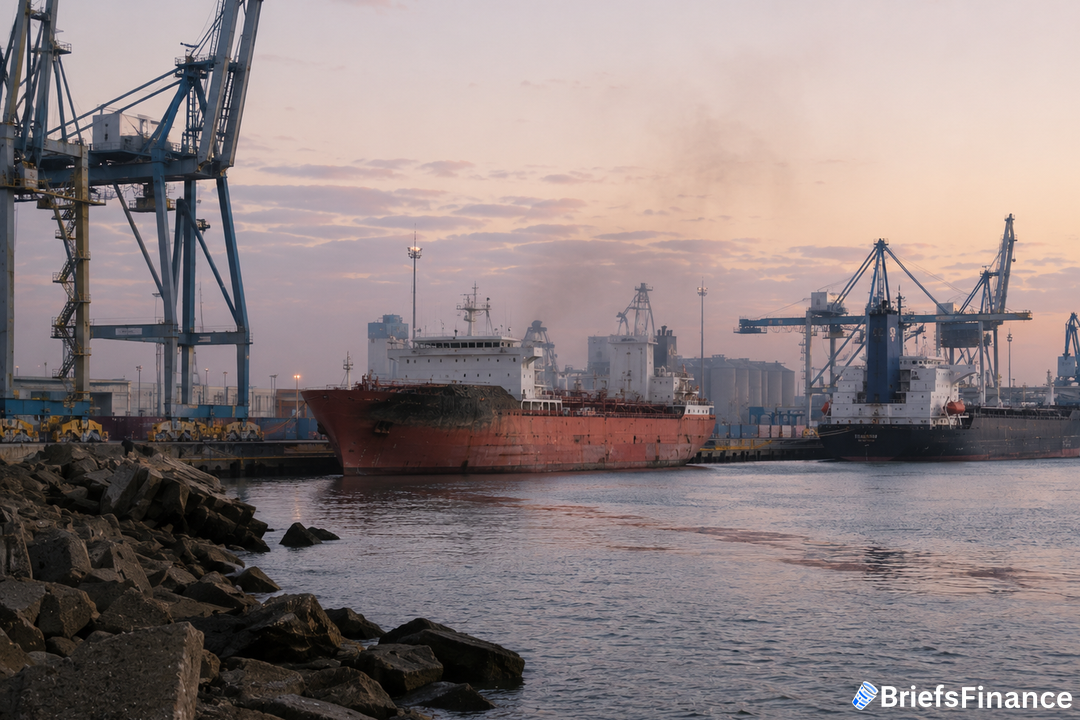
Two vessels came under drone fire at Egypt's Damietta port on the Mediterranean coast.
Kpler identified them as the LNG carrier GasLog Salem and the regasification barge Energos Winter.
No group claimed responsibility, in a widening pattern of attacks on regional energy infrastructure.
What Happened at Damietta
An official from Egypt's Ministry of Petroleum stated, "Emergency protocols were activated and firefighting crews from multiple agencies worked together to bring the situation under control."
Trade intelligence firm Kpler identified the damaged vessels as the Energos Winter, a barge that stores and regasifies LNG, and the GasLog Salem, an LNG tanker.
So far, no entity has claimed responsibility for the assault.
The Bigger Picture: A Spreading Conflict
This incident is part of a broader pattern in which Iran, its Houthi partners in Yemen, and Iraqi-backed militias have increased attacks on regional energy infrastructure. Just last week, the Houthis announced a maritime blockade against Saudi Arabia. On Monday, they stated they had struck a Saudi pipeline network that delivers crude to the Red Sea terminal at Yanbu.
Meanwhile, pro-Iran militias in Iraq launched drone attacks this week on Saudi oil facilities in the Riyadh and Eastern Province areas. In response, U.S. and Saudi air forces conducted joint strikes on Tuesday targeting those Iraqi groups.
Additionally, the United States carried out a fresh round of airstrikes against Iran overnight, retaliating for a failed missile surprise by the Islamic Revolutionary Guard Corps that targeted American troops in the region.
The Damietta strike underscores how vulnerable energy infrastructure close to the Suez Canal has become, especially since the Houthis are trying to block vessels transiting the Bab el-Mandeb Strait, a waterway located in the southern part of the Red Sea. Saudi Arabia can divert some oil via a pipeline running across Egypt, but fully loaded supertankers cannot transit the Suez Canal due to depth restrictions, meaning Riyadh must offload crude at the pipeline's Red Sea end and then reload it on the Mediterranean side.
Crude oil futures dipped slightly on Thursday despite the heightened tensions.
Broader Implications for Energy Security
The attack at Damietta underscores the escalating risk to critical energy chokepoints. The port serves as a key entry point for liquefied natural gas (LNG) and oil imports to Egypt, and its proximity to the Suez Canal makes it a strategic hub. The Houthis have shown they can attack targets far from Yemen, and the participation of Iraqi militias backed by Iran points to a unified effort. While oil prices have not yet spiked, analysts warn that continued incidents could lead to higher insurance premiums for vessels transiting the Red Sea and Mediterranean, potentially raising transportation costs.
The Suez Canal and surrounding waters handle a significant share of global oil and LNG trade, making any disruption in this corridor a threat to international supply chains. Floating LNG infrastructure, such as the Energos Winter barge, is particularly vulnerable because it remains stationary for long periods. If such attacks become more frequent, they could disrupt global energy supply chains, particularly for European nations that rely on LNG from the Middle East.
Anthropic has gone public at a valuation of about $1.5 trillion, while Amazon went public in 1997 at around $440 million. Anthropic has about $33 billion in revenue this year and no profit, and investors are paying more than 40 times its sales, against about 3 times for Amazon. Briefs Finance CEO Jaspreet Singh says nobody knows what comes next, and that long-term investors use downturns to buy instead of panic selling.
Tech stocks are selling off because investors don't know who will lead Nvidia, the company that has been funding the AI industry and selling it chips.
Inflation has the Federal Reserve planning to raise interest rates, with a hike expected in December, and that puts pressure on homebuyers, private equity and the $40 trillion national debt.
Briefs Finance CEO Jaspreet Singh says nobody has a crystal ball, so his rules are to buy when markets are low, hold long term and invest only what you're willing to lose.
The national debt is above $40 trillion, and the Federal Reserve has gone from sending Washington its profits to losing money.
President Trump's four-part plan leans on shorter-term debt, stablecoin companies buying Treasuries, a bigger balance sheet and government stakes in private companies.
The goal is to outgrow the debt, not pay it off, so Jaspreet Singh points investors to the seven industries where Washington wants growth.
The Fed makes its next rate decision on December 9 and is now talking about jumbo interest rate hikes of 0.5%, though one in December looks unlikely.
Washington will pay a record $1.05 trillion in interest this year on $40 trillion of debt, and that debt resets at higher rates as the Fed hikes.
Jaspreet Singh's five moves are to pay down variable-rate debt, earn interest on your savings, know which stocks feel the pressure, look at value and hedge.
Margin debt, the money investors borrow to buy stocks, is at a record of around 4.6% of GDP, up from 3.9% in 2021.
ETF money has more than tripled in five years to 7% of GDP, while corporate buybacks and 401(k) money sit below their earlier peaks.
Margin calls and panic selling can make the next downturn deeper, so Jaspreet Singh keeps buying broad market funds and says most investors should skip margin debt.
Jensen Huang is out at Nvidia over affairs with multiple people, and the company he founded has been the bank of American AI, with about $30 billion into OpenAI and $10 billion into Anthropic.
A hotter-than-expected inflation report has Fed officials talking about a possible 0.5% hike in December, and gold, silver, and bitcoin fell on the news.
President Trump said the US may not need a deal with Iran, keeping oil prices and inflation risk high. Jaspreet Singh breaks down what it all means for AI stocks and your portfolio.
Stocks are booming at the fastest pace in years, jobless claims just hit a 57-year low, and most investors still feel like nobody is hiring.
The Fed is protecting the dollar over the economy, oil swings on every Iran headline, and a few AI companies are carrying an S&P 500 where four of five stocks sit in a correction.
Jaspreet Singh explains why circular financing between Nvidia, OpenAI, Anthropic, and SpaceX rhymes with 2008's house of cards, and how his three investing pillars handle a stock market bubble.
The Fed has raised rates, cut them, then raised them again only twice in the last 60 years, and both times the economy fell into a recession and stocks crashed.
The same stop-and-go cycle is playing out now, with one big difference: US debt is 125% of GDP today versus about 30% in 1980.
In the 1970s gold rose roughly 24x, real estate 157%, stocks lagged, and cash lost half its value. Jaspreet Singh lays out five assets to consider before the next flip.
The IRS 2027 tax plan keeps the same seven rates but widens every bracket and lifts the married-filing-jointly standard deduction to $33,200.
The 0% long-term capital gains bracket rises to $102,100, so a household living on $135,300 of investment income could owe $0 in federal income tax.
C corporations still pay 21%, small businesses keep the 20% QBI deduction, and the 401(k) limit climbs to $25,500 with an $8,500 catch-up for investors over 50.
Make sure to check your inbox for the first email.
Before you go
We’re hosting our first ever livestream on how investors can use ChatGPT & Claude to invest like a pro. It’s on 11/17 and is hosted by our CEO Jaspreet Singh.