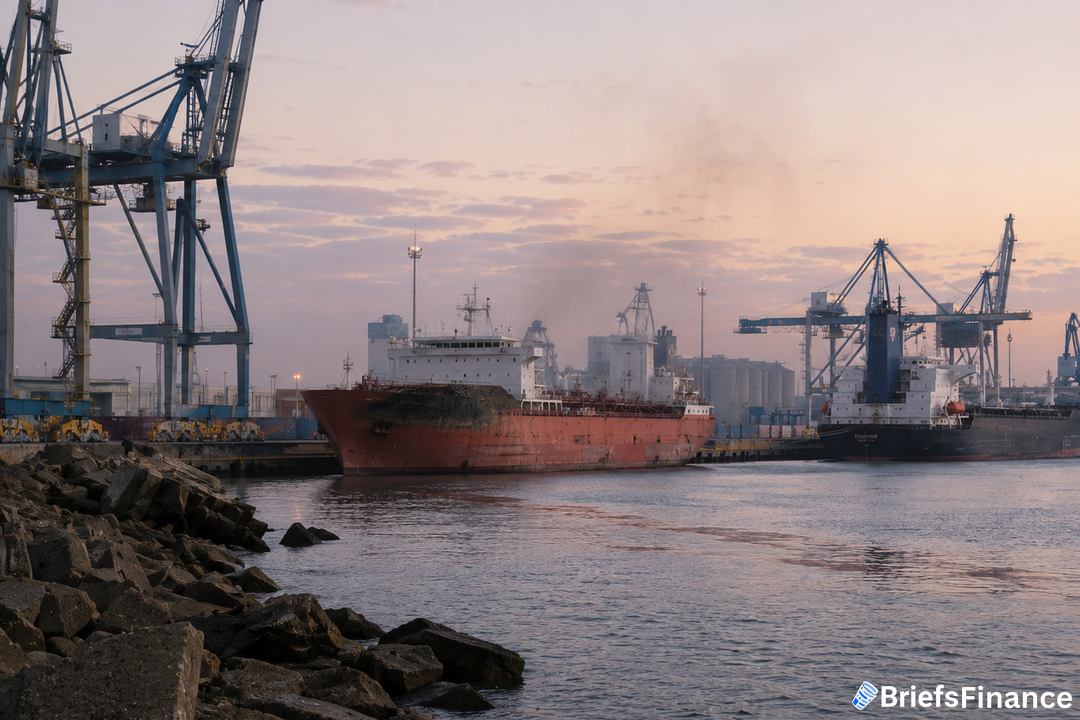
What Happened at Damietta
An official from Egypt's Ministry of Petroleum stated, "Emergency protocols were activated and firefighting crews from multiple agencies worked together to bring the situation under control."
Trade intelligence firm Kpler identified the damaged vessels as the Energos Winter, a barge that stores and regasifies LNG, and the GasLog Salem, an LNG tanker.
So far, no entity has claimed responsibility for the assault.
The Bigger Picture: A Spreading Conflict
This incident is part of a broader pattern in which Iran, its Houthi partners in Yemen, and Iraqi-backed militias have increased attacks on regional energy infrastructure. Just last week, the Houthis announced a maritime blockade against Saudi Arabia. On Monday, they stated they had struck a Saudi pipeline network that delivers crude to the Red Sea terminal at Yanbu.
Get the market news that matters in a five-minute read with Market Briefs, our free daily newsletter
Meanwhile, pro-Iran militias in Iraq launched drone attacks this week on Saudi oil facilities in the Riyadh and Eastern Province areas. In response, U.S. and Saudi air forces conducted joint strikes on Tuesday targeting those Iraqi groups.
Additionally, the United States carried out a fresh round of airstrikes against Iran overnight, retaliating for a failed missile surprise by the Islamic Revolutionary Guard Corps that targeted American troops in the region.
The Damietta strike underscores how vulnerable energy infrastructure close to the Suez Canal has become, especially since the Houthis are trying to block vessels transiting the Bab el-Mandeb Strait, a waterway located in the southern part of the Red Sea. Saudi Arabia can divert some oil via a pipeline running across Egypt, but fully loaded supertankers cannot transit the Suez Canal due to depth restrictions, meaning Riyadh must offload crude at the pipeline's Red Sea end and then reload it on the Mediterranean side.
Crude oil futures dipped slightly on Thursday despite the heightened tensions.
Broader Implications for Energy Security
The attack at Damietta underscores the escalating risk to critical energy chokepoints. The port serves as a key entry point for liquefied natural gas (LNG) and oil imports to Egypt, and its proximity to the Suez Canal makes it a strategic hub. The Houthis have shown they can attack targets far from Yemen, and the participation of Iraqi militias backed by Iran points to a unified effort. While oil prices have not yet spiked, analysts warn that continued incidents could lead to higher insurance premiums for vessels transiting the Red Sea and Mediterranean, potentially raising transportation costs.
The Suez Canal and surrounding waters handle a significant share of global oil and LNG trade, making any disruption in this corridor a threat to international supply chains. Floating LNG infrastructure, such as the Energos Winter barge, is particularly vulnerable because it remains stationary for long periods. If such attacks become more frequent, they could disrupt global energy supply chains, particularly for European nations that rely on LNG from the Middle East.
Join Market Briefs, our free daily newsletter, for a quick daily rundown of the markets