Free NewsletterPro Login
S&P 500 6,287 +0.42%
DOW 44,521 -0.18%
NASDAQ 21,103 +0.71%
S&P 500 +12.4%
Briefs Finance Fund +24.8%
JOIN THE FUND →
BREAKING
×

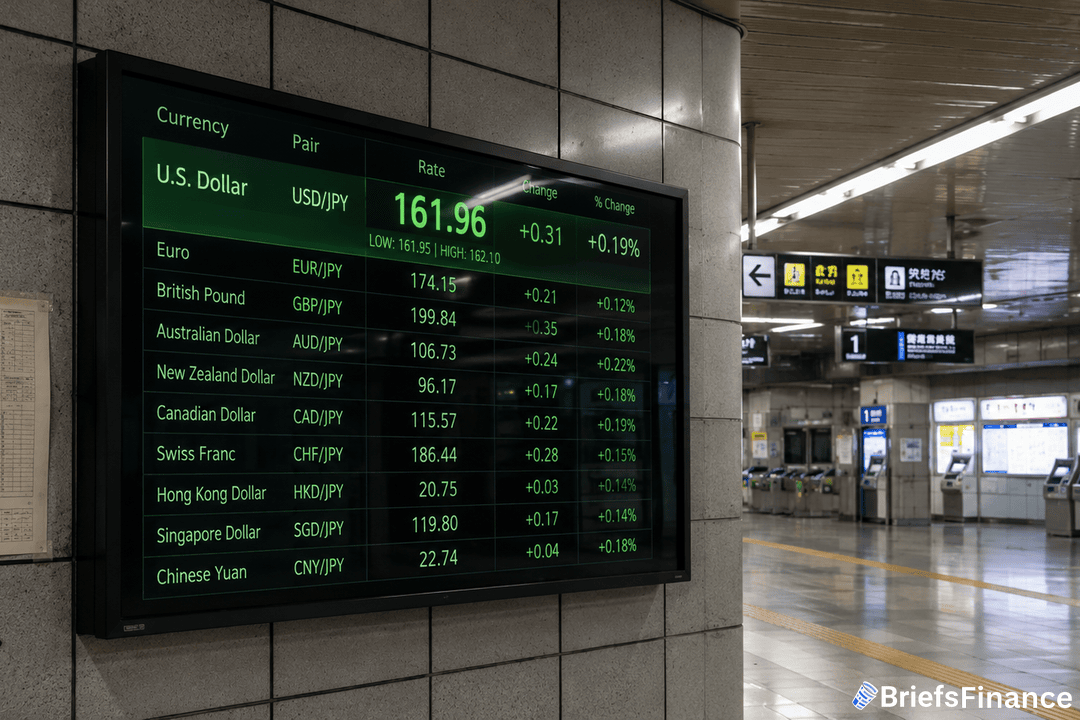
Yen Slides to 161.96, Weakest Level Since 1986

Published Jun 29, 2026
[tts_player]
Share:
Summary:
  • The yen hit 161.96 per US dollar on Monday, its weakest since 1986.
  • Japan spent 11.73 trillion yen ($72.5 billion) on currency intervention from April 28 to May 27, 2026.
  • The Bank of Japan raised its benchmark interest rate to 1% in June 2026, the highest since 1995.

On Monday in New York, the yen fell as much as 0.1% to 161.96 per dollar, surpassing the 161.95 level seen in July 2024 when Japan previously attempted to support the currency. That level had not been seen since 1986, when the yen was in the midst of a prolonged appreciation following a US-engineered currency accord.

The yen's ongoing weakness persists despite the Bank of Japan's policy shift, which saw it abandon negative rates in 2024 and raise its key rate to 1% on June 16 - the highest since 1995. However, this move had little effect as market participants anticipate the Federal Reserve will maintain a hawkish stance. Meanwhile, Japan's government is poised to urge "appropriate" monetary policy in its basic guidelines, likely to discourage further rate increases.

"Doubtless, the Bank of Japan is watching things closely," Shaun Osborne, Scotiabank's head of currency strategy, said after the yen crept past the key level on Monday.

Get your free investing masterclass bonus when you join Market Briefs, our free daily newsletter

The huge amount spent underscores not only how much is at stake for Japan, but also the difficulty involved in pushing back against the tide in the $9.5 trillion-a-day global foreign exchange market.

Japanese Finance Minister Satsuki Katayama reiterated on June 19 that authorities were ready to take "bold action" to damp excessive speculative moves in the foreign exchange market. In her remarks, Katayama noted that the US and Japan have grown more coordinated on foreign exchange matters following talks with Treasury Secretary Scott Bessent, and that both nations committed to implementing forceful measures regarding currencies as necessary. Japan's market interventions in 2022 - its first yen-buying operations since 1998 - and again in 2024 provided only short-lived stability, with the currency soon weakening further. The most recent round of intervention began on April 28, when officials stepped in repeatedly to prop up the yen.

Andrew Hazlett, a currency trader at Monex Inc., stated, "Intervention is right around the corner if we don't see a quick correction." However, Hazlett added, intervention is "only a temporary fix if they do not address the interest-rate differential."

Exporters are seeing higher profits from the weak yen, which has also pushed the nation's stock market to new highs. However, the cost of imports is rising sharply, especially for oil and gas that are dollar-denominated. This inflation is squeezing households, driving up costs for basic goods and utilities, and threatening the approval ratings of Prime Minister Sanae Takaichi's administration.

The main driver is often attributed to interest-rate gaps - both current and anticipated - with Japan's low rates encouraging investors to sell yen for foreign assets. Long-term factors like an aging, shrinking population and high public debt also drag on growth and limit the scope for significant rate increases.

Subscribe to Market Briefs, our free daily newsletter, and claim your bonus investing masterclass

Disclosure

Recent News

1 2 3 29

Get Market Briefs delivered to your inbox every morning for free!

No fluff. No noise. No politics. Just finance news you can read in 5 minutes.

Blogs

June 29, 2026
Portfolio Diversification: Why Putting All Your Eggs in One Basket Destroys Wealth
  • Real diversification means spreading investments across all 11 economic sectors plus bonds, alternatives, and cash so no single bet can sink the portfolio.
  • Different sectors perform at different times, so a diversified portfolio captures upswings while smoothing the brutal drawdowns that wipe out concentrated bets.
  • Total market index funds offer the simplest path to diversification, and annual rebalancing is what keeps the structure working over time.
Read More
June 29, 2026
Non Taxable Income: What It Is and Why It Matters
  • Non taxable income is money you receive that you don't owe income tax on.
  • The tax code treats workers, investors, and business owners very differently, and investors often come out ahead.
  • Learning how income is taxed is a quiet superpower for keeping more of what you earn.
Read More
June 29, 2026
Semiconductor Stocks: A Simple Guide for Investors
  • Semiconductor stocks are companies that design and make computer chips, the brains inside nearly every modern device.
  • The AI boom has turned chips into one of the market's most important and most watched groups.
  • They offer big growth potential, but come with high valuations and a notoriously cyclical history.
Read More
June 25, 2026
How Stocks Work: A Simple Guide for Beginners
  • A stock is a slice of ownership in a company - buy one, and you own a piece of the business.
  • You make money two ways: the share price rising over time, and dividends paid to shareholders.
  • The simplest path for most beginners is buying into the whole market through a low-cost index fund.
Read More
June 25, 2026
Stop Loss vs Stop Limit: What's the Difference?
  • A stop loss order sells your stock once it hits a trigger price, prioritizing getting you out.
  • A stop limit order only sells within a price range you set, prioritizing price over a guaranteed exit.
  • The trade-off: a stop loss almost always executes; a stop limit might not if the price moves too fast.
Read More
June 25, 2026
Energy Stocks: A Simple Guide for Investors
  • Energy stocks are companies that produce and supply the power the world runs on, from oil and gas to newer sources.
  • They make up one of the 11 sectors of the market and tend to move with energy prices and big-picture shifts.
  • Like any sector, the key is diversification and understanding the forces driving demand.
Read More
June 18, 2026
What Is a Stop Loss Order? A Simple Guide
  • A stop loss order automatically sells a stock once it falls to a price you set.
  • It's a tool to cap losses or lock in gains without watching the market all day.
  • It works best for active strategies, and can backfire if used carelessly on long-term holdings.
Read More
June 18, 2026
Best S&P 500 Index Fund: How to Choose One
  • The best S&P 500 index fund for most investors is simply the cheapest, most established one that tracks the index well.
  • Funds like VOO, IVV, and SPY all hold the same 500 companies, so the biggest difference is the fee.
  • Pick one, automate your buys, and let time do the heavy lifting.
Read More
June 17, 2026
What Are Penny Stocks? Risks and Rewards Explained
  • Penny stocks are very low-priced shares of very small companies, often trading for just a few dollars or less.
  • They promise huge gains but carry huge risks: low liquidity, high failure rates, and wild price swings.
  • Most investors are better served by quality companies and funds than by chasing cheap shares.
Read More
June 17, 2026
Best Stocks for Beginners With Little Money
  • The best stocks for beginners with little money usually aren't individual stocks at all - they're low-cost index funds.
  • You can start with $100 or less and use small, regular investments to build wealth over time.
  • Focus on diversification and consistency, not on picking the next big winner.
Read More
1 2 3 24
Share via
Copy link










