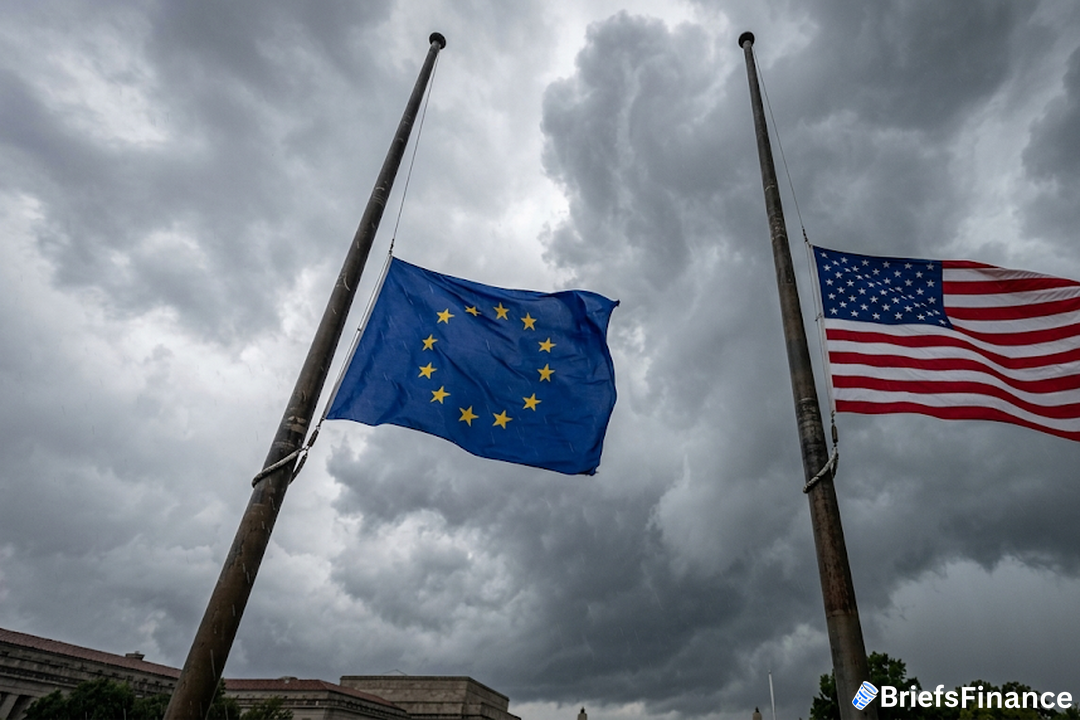
What Trump Said and Why
President Donald Trump is opening a new front in his trade war, and this time the target is the European Union.
On July 24, Trump announced a Section 301 trade investigation into the 27-member bloc. He said the investigation will almost certainly end with a "substantial" tariff on EU goods. His reasoning? The EU has been fining U.S. tech companies, and he does not like it.
A notable recent instance is the $1 billion fine (€890 million) the European Commission levied against Google. The penalty was part of the EU's broader crackdown on U.S. tech companies under the Digital Markets Act. But Google is not alone.
Trump also mentioned that Apple, Meta, and Amazon have all been hit by EU fines in the past. He called the EU's conduct "illegal and highly unethical" and declared, "The European Union is ROBBING American Companies and, in turn, the American Taxpayer."
Get the market news that matters in a five-minute read with Market Briefs, our free daily newsletter
Trump said, "The European Union will pay a very big price for this illegal and highly unethical conduct, which I have consistently warned them about."
The Tariffs Already in Place
This threat comes on the same day the U.S. already hit a huge group of countries with new tariffs.
Just hours earlier, the administration imposed duties ranging from 10% up to 12.5% across over 80 nations, including EU member states. So the existing tariffs are still fresh, and now Trump is threatening to pile more on top of them specifically for Europe. The new tariffs target a wide range of goods, from machinery to agricultural products, impacting global supply chains.
The method he is using is called a Section 301 investigation. Under this trade-law tool, the government can impose tariffs against foreign practices determined to place an unfair burden on U.S. commerce. It is the same legal authority he used against China a few years back.
Broader Context of the Dispute
The EU has long defended its digital enforcement actions as necessary to protect competition and consumer rights under laws such as the Digital Markets Act. However, Trump's administration views these penalties as a coordinated effort to drain revenue from U.S. tech giants.
The Liberty Justice Center lawsuit argues that the administration is bypassing Supreme Court rulings that struck down earlier tariff actions. Meanwhile, the EU has signaled it will retaliate if tariffs are imposed, potentially escalating a transatlantic trade war. Trump's threat of additional tariffs on EU goods has already caused uncertainty in financial markets.
This legal challenge adds another layer of complexity: if courts block the use of Section 301 for these tariffs, the administration may have to find new authority or face a stalled trade offensive. The Digital Markets Act itself remains a point of contention, with European regulators insisting their fines are meant to curb monopolistic behavior, not target American companies specifically.
Join Market Briefs, our free daily newsletter, for a quick daily rundown of the markets