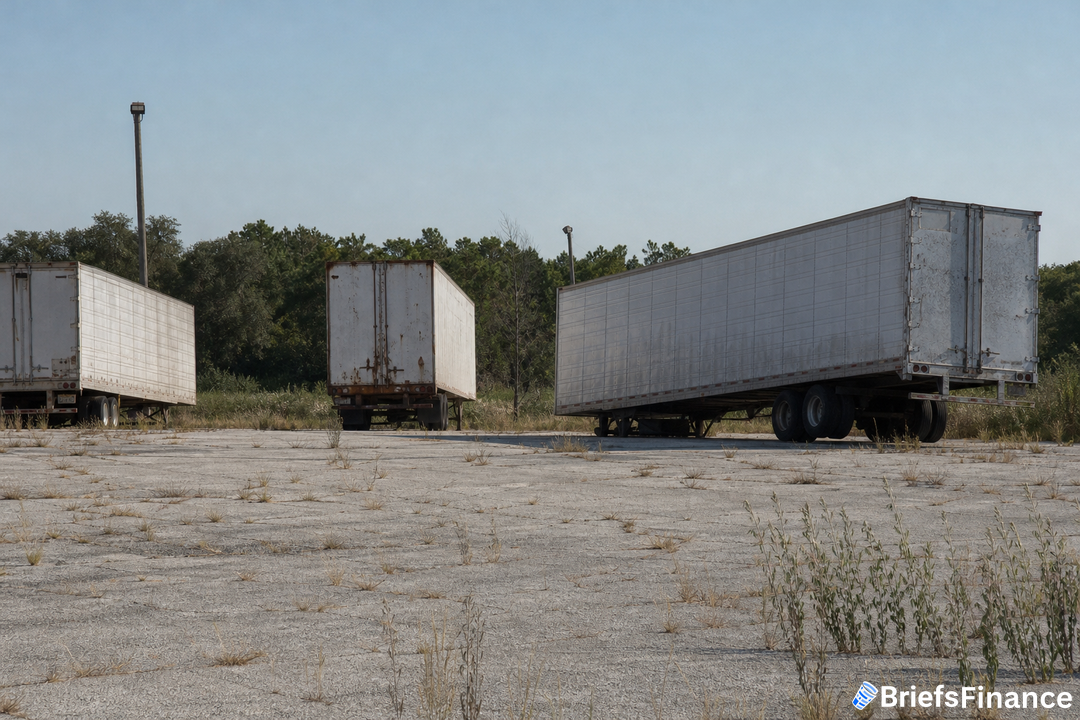
What happened to operators like Justin Stoneman
Justin Stoneman built his company in central Michigan's farm country, moving grain and fertilizer around the Midwest. At its peak, about a dozen tractors helped generate more than $3 million a year.
The past year turned that upside down. War-driven diesel spikes, rising insurance, and heavy debts pushed the business to the edge. In May, Stoneman Trucking LLC sought bankruptcy protection, and he is now transitioning to chapter 7 to shut down operations. "I'm so frustrated," Stoneman said. "It's like, what about all this 'Drill, baby, drill'?"
Financing became a weight. He started with equipment loans, then, when cash tightened in 2023, took two merchant cash advances adding up to about $125,000. After a driver accident, an insurer quoted him $155,000 to cover 2 trucks and 3 trailers, a number that pushed him to liquidate.
The scale: filings up, revenue down, and the capital gap
Bankruptcies are stacking up. To date this year, 221 trucking companies have entered bankruptcy, extending a multi-year rise at levels not seen in decades. The totals are through Oct. 27 and draw on Bloomberg and U.S. Department of Transportation records.
A recent Truckstop and Bloomberg Intelligence poll of hundreds of small carriers - usually 20 or fewer tractors, often just one - found about two-thirds reporting revenue flat or falling from a year earlier. Nearly 40% said they might be out of trucking within six months or were uncertain.
Demand for legal triage is climbing. Chip Lane, managing partner at Texas-based Lane Law Firm, which focuses on bankruptcy, said he is seeing a "massive uptick," with as many as three or four trucking companies a week exploring restructuring. Many small operators start as drivers, go solo, and because they lack the cash to buy equipment outright, they rely on credit.
Scale cushions shocks. Christopher Ward of Lowenstein Sandler said, "It's much easier for the large J.B. Hunt to absorb higher fuel prices than it is for the $2.5 million dollar mom-and-pop trucking company that has five trucks doing local deliveries." J.B. Hunt said this month it planned to raise prices to relieve margin pressure. Aaron Graft, CEO of Triumph Financial, put it bluntly: "It's a feast or famine," with debt-free fleets and strong safety records - often larger carriers - holding up better. Filings are concentrated in California, Illinois and Texas.
When industries shift, investors who use smarter tools can spot calmer opportunities. We're hosting our first ever investor livestream on 11/17 to show you how to use ChatGPT and Claude to invest like a pro, hosted by Briefs Finance CEO Jaspreet Singh. Save your seat.
Why the squeeze is lasting longer
The Covid boom drew newcomers with hot demand, near-zero rates, and generous government loans. As the surge faded, freight rates fell and work thinned out, setting off a deep downturn and a wave of bankruptcies.
Survivors now face what Lane calls a triple hit: higher fuel costs, rising interest rates, and burdensome credit. Smaller carriers often carry large equipment loans and, in a cash crunch, turn to what Lane termed "bad money" - variable-rate debt and short-term, high-rate loans. Many also use merchant cash advances and factoring to plug gaps, which stack on fees and squeeze margins.
Fraud is another drain. Jennifer Lockett, operations manager at factoring firm altLINE, said identity-theft scams have accelerated, with thieves using a trucker's identification number to intercept loads and steal cargo. Highway's Freight Fraud Index estimates losses at about $18 million per day.
Insurance is climbing too, and Lockett said a fraud claim or even a speeding ticket can lift premiums. Equipment and labor costs are up as well.
Rules and enforcement are reshaping hiring. Last year, regulators increased enforcement of English-language proficiency for drivers, a move that Secretary of Transportation Sean Duffy aims to formalize in regulation. Some truckers also say government deportation actions have discouraged drivers. Both have made it harder to staff.
In 2021, Kevin McAllister set up a fleet of three trucks, taking loads ranging from auto parts to chemical dyes; as rates fell, he shut it down in 2024. "At the end of the day, when you do an evaluation, it was not going to be long-term profitable," he said. "It was almost like treading water."
What this means for your portfolio
Small carriers are taking repeated hits at once: pricier diesel, higher insurance, fraud losses, staffing constraints, and big equipment debt layered with variable and short-term loans. That reality shows up in the numbers - 221 filings so far this year and survey data pointing to weaker revenue and shaky six-month outlooks.
Watch the credit cycle around trucking's money pipes. Lenders, factors, and payment platforms with exposure to highly leveraged small fleets face more stress, while larger carriers with little equipment debt and strong safety records have more room to pass on costs.
Markets reward investors who learn to combine judgment with better analytical tools. On 11/17, our CEO Jaspreet Singh goes live for our first ever investor livestream on how to use ChatGPT and Claude to invest like a pro. Register to join him.