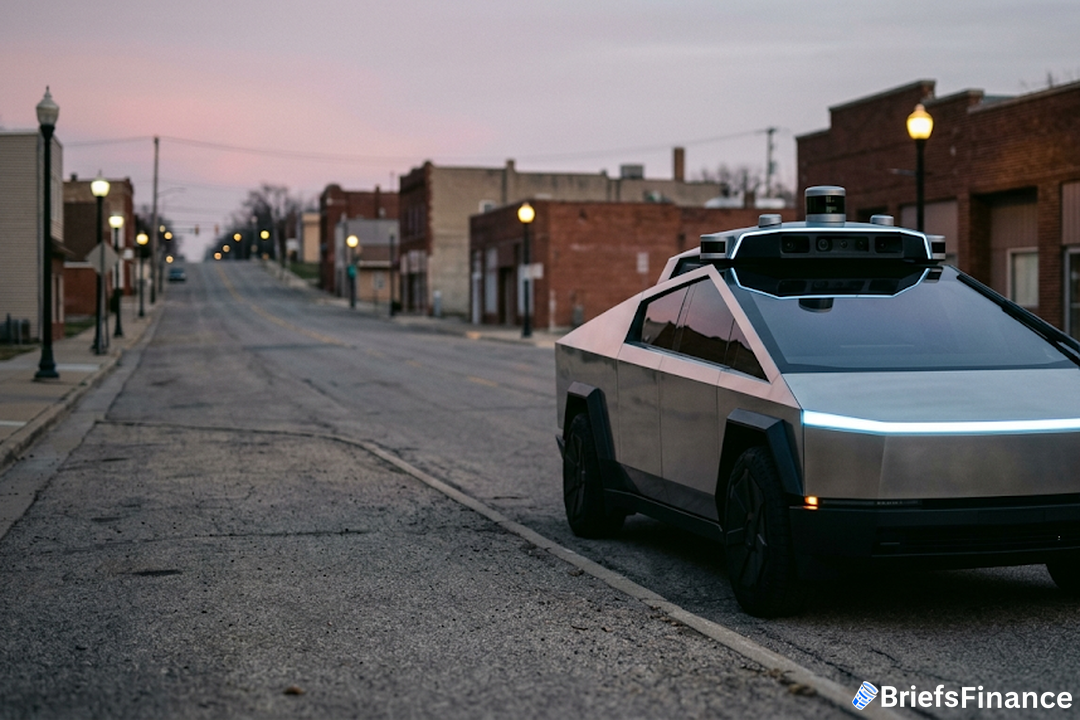
The Robotaxi That Lost Some Miles
Tesla's push into robotaxis just hit a pothole.
In the second quarter of 2026, Tesla's for-hire autonomous taxi fleet logged fewer miles with paying riders compared to the first quarter. That is not the kind of number investors want to see from a business Elon Musk has called the future of the company.
Wall Street reacted fast. The price of Tesla shares dropped by more than 13% during the morning session on the Thursday that followed the earnings disclosure.
So what went wrong? It is not that the technology stopped working. It is that Tesla needs to train its system on a new vehicle.
The company is rolling out the Cybercab, a dedicated robotaxi design. Unlike the Model 3 or Model Y cars that already have millions of miles on the road, the Cybercab is new. To teach its software, Tesla is gathering data from Cybercabs equipped with temporary steering wheels and pedals so the system can adapt to that particular vehicle platform.
Musk put it plainly: "We don't have that for Cybercab. So we actually have to accumulate miles with Cybercabs … to calibrate to the Cybercab chassis."
Get the market news that matters in a five-minute read with Market Briefs, our free daily newsletter
Once the company feels confident in the data, it plans to flood cities with the vehicles. "The number of Cybercabs in cities will increase dramatically," Musk said.
Safety First, Even When It Slows You Down
The cautious approach is intentional. Tesla knows that one bad accident could put the whole program at risk.
Musk said, "There are 30 to 40,000 automotive deaths per year in the United States alone." But those deaths mostly do not make news. "But if we injure even one person, it will be worldwide headline news," he said, and regulators would immediately clamp down on their activities.
Since launching its Robotaxi service, Tesla has filed 22 crash reports with the National Highway Traffic Safety Administration. Most accidents involve other vehicles striking Tesla's robotaxis, but the company also noted three incidents caused by teleoperators remotely moving the cars, as well as several low-speed impacts with curbs, utility poles, and a tow truck bed.
He claimed that Tesla's robotaxis have experienced "zero notable incidents" over more than 380,000 miles of driving with no safety operator present. Elluswamy left it unclear what exactly Tesla counts as a "notable incident."
The company is leaning into its camera-only approach to self-driving, a contrast to rivals like Waymo that use lidar and radar. Elluswamy dismissed the argument that those extra sensors are necessary. "You can have safe, comfortable, and affordable autonomy with just cameras," he said.
The catch is that the camera-only system needs a lot of real-world miles to learn, and the Cybercab is starting from scratch. That is what is slowing the rollout right now.
What's Next
Tesla's robotaxi ambitions are still moving forward, just not in a straight line.
Since Tesla began offering unsupervised miles without a safety driver at the end of last year, the number has increased roughly 10% weekly. Musk said the company will continue to scale "very, very rapidly." The paid miles drop is a short-term hiccup tied to a vehicle transition, not a sign that the whole idea is broken.
The robotaxi service currently operates in six Texas and Florida cities, combining both unsupervised and supervised vehicles. Paid miles in the San Francisco Bay Area are also probably included, despite the fact that those robotaxis lack the necessary state permits for autonomous operation and always have a safety driver.
During the earnings call, executives described the gradual pace as a deliberate effort to prioritize safety. "Our goals are very ambitious for Robotaxi, but we do need to be cautious about causing any accidents or causing any harm to anyone," Musk said.
Join Market Briefs, our free daily newsletter, for a quick daily rundown of the markets