Free NewsletterPro Login
S&P 500 6,287 +0.42%
DOW 44,521 -0.18%
NASDAQ 21,103 +0.71%
S&P 500 +12.4%
Briefs Finance Fund +24.8%
JOIN THE FUND →

Tesla's Cybercab Shift Reduces Paid Robotaxi Miles by 36%, Stock Falls 13%

Published Jul 24, 2026
[tts_player]
Share:
Summary:
  • Tesla's paid robotaxi service covered 700,000 miles in Q2 2026, a decline from the 1.1 million miles recorded in the previous quarter.
  • Tesla shares tumbled over 13% during Thursday morning trading following the earnings announcement.
  • Tesla says the decline is due to the need to accumulate driving data specific to its new Cybercab vehicle while being cautious about safety.

The Robotaxi That Lost Some Miles

Tesla's push into robotaxis just hit a pothole.

In the second quarter of 2026, Tesla's for-hire autonomous taxi fleet logged fewer miles with paying riders compared to the first quarter. That is not the kind of number investors want to see from a business Elon Musk has called the future of the company.

Wall Street reacted fast. The price of Tesla shares dropped by more than 13% during the morning session on the Thursday that followed the earnings disclosure.

So what went wrong? It is not that the technology stopped working. It is that Tesla needs to train its system on a new vehicle.

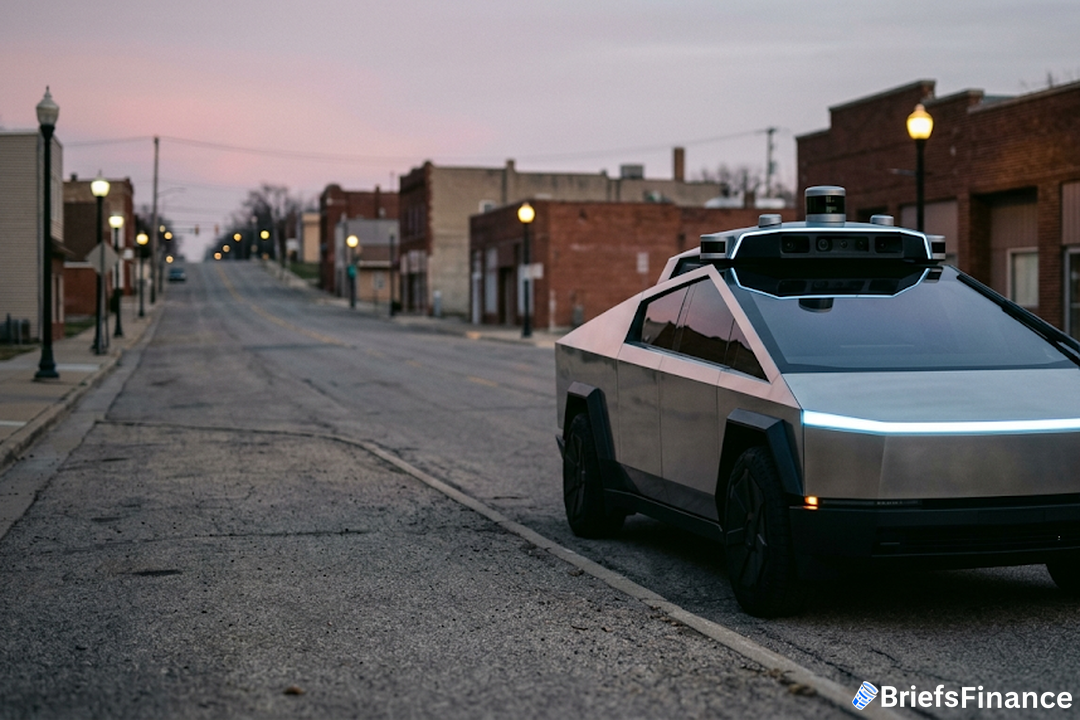
The company is rolling out the Cybercab, a dedicated robotaxi design. Unlike the Model 3 or Model Y cars that already have millions of miles on the road, the Cybercab is new. To teach its software, Tesla is gathering data from Cybercabs equipped with temporary steering wheels and pedals so the system can adapt to that particular vehicle platform.

Musk put it plainly: "We don't have that for Cybercab. So we actually have to accumulate miles with Cybercabs … to calibrate to the Cybercab chassis."

Get the market news that matters in a five-minute read with Market Briefs, our free daily newsletter

Once the company feels confident in the data, it plans to flood cities with the vehicles. "The number of Cybercabs in cities will increase dramatically," Musk said.

Safety First, Even When It Slows You Down

The cautious approach is intentional. Tesla knows that one bad accident could put the whole program at risk.

Musk said, "There are 30 to 40,000 automotive deaths per year in the United States alone." But those deaths mostly do not make news. "But if we injure even one person, it will be worldwide headline news," he said, and regulators would immediately clamp down on their activities.

Since launching its Robotaxi service, Tesla has filed 22 crash reports with the National Highway Traffic Safety Administration. Most accidents involve other vehicles striking Tesla's robotaxis, but the company also noted three incidents caused by teleoperators remotely moving the cars, as well as several low-speed impacts with curbs, utility poles, and a tow truck bed.

He claimed that Tesla's robotaxis have experienced "zero notable incidents" over more than 380,000 miles of driving with no safety operator present. Elluswamy left it unclear what exactly Tesla counts as a "notable incident."

The company is leaning into its camera-only approach to self-driving, a contrast to rivals like Waymo that use lidar and radar. Elluswamy dismissed the argument that those extra sensors are necessary. "You can have safe, comfortable, and affordable autonomy with just cameras," he said.

The catch is that the camera-only system needs a lot of real-world miles to learn, and the Cybercab is starting from scratch. That is what is slowing the rollout right now.

What's Next

Tesla's robotaxi ambitions are still moving forward, just not in a straight line.

Since Tesla began offering unsupervised miles without a safety driver at the end of last year, the number has increased roughly 10% weekly. Musk said the company will continue to scale "very, very rapidly." The paid miles drop is a short-term hiccup tied to a vehicle transition, not a sign that the whole idea is broken.

The robotaxi service currently operates in six Texas and Florida cities, combining both unsupervised and supervised vehicles. Paid miles in the San Francisco Bay Area are also probably included, despite the fact that those robotaxis lack the necessary state permits for autonomous operation and always have a safety driver.

During the earnings call, executives described the gradual pace as a deliberate effort to prioritize safety. "Our goals are very ambitious for Robotaxi, but we do need to be cautious about causing any accidents or causing any harm to anyone," Musk said.

Join Market Briefs, our free daily newsletter, for a quick daily rundown of the markets
Disclosure

Recent News

1 2 3 41

Get Market Briefs delivered to your inbox every morning for free!

No fluff. No noise. No politics. Just finance news you can read in 5 minutes.

Blogs

June 29, 2026
Portfolio Diversification: Why Putting All Your Eggs in One Basket Destroys Wealth
  • Real diversification means spreading investments across all 11 economic sectors plus bonds, alternatives, and cash so no single bet can sink the portfolio.
  • Different sectors perform at different times, so a diversified portfolio captures upswings while smoothing the brutal drawdowns that wipe out concentrated bets.
  • Total market index funds offer the simplest path to diversification, and annual rebalancing is what keeps the structure working over time.
Read More
June 29, 2026
Non Taxable Income: What It Is and Why It Matters
  • Non taxable income is money you receive that you don't owe income tax on.
  • The tax code treats workers, investors, and business owners very differently, and investors often come out ahead.
  • Learning how income is taxed is a quiet superpower for keeping more of what you earn.
Read More
June 29, 2026
Semiconductor Stocks: A Simple Guide for Investors
  • Semiconductor stocks are companies that design and make computer chips, the brains inside nearly every modern device.
  • The AI boom has turned chips into one of the market's most important and most watched groups.
  • They offer big growth potential, but come with high valuations and a notoriously cyclical history.
Read More
June 25, 2026
How Stocks Work: A Simple Guide for Beginners
  • A stock is a slice of ownership in a company - buy one, and you own a piece of the business.
  • You make money two ways: the share price rising over time, and dividends paid to shareholders.
  • The simplest path for most beginners is buying into the whole market through a low-cost index fund.
Read More
June 25, 2026
Stop Loss vs Stop Limit: What's the Difference?
  • A stop loss order sells your stock once it hits a trigger price, prioritizing getting you out.
  • A stop limit order only sells within a price range you set, prioritizing price over a guaranteed exit.
  • The trade-off: a stop loss almost always executes; a stop limit might not if the price moves too fast.
Read More
June 25, 2026
Energy Stocks: A Simple Guide for Investors
  • Energy stocks are companies that produce and supply the power the world runs on, from oil and gas to newer sources.
  • They make up one of the 11 sectors of the market and tend to move with energy prices and big-picture shifts.
  • Like any sector, the key is diversification and understanding the forces driving demand.
Read More
June 18, 2026
What Is a Stop Loss Order? A Simple Guide
  • A stop loss order automatically sells a stock once it falls to a price you set.
  • It's a tool to cap losses or lock in gains without watching the market all day.
  • It works best for active strategies, and can backfire if used carelessly on long-term holdings.
Read More
June 18, 2026
Best S&P 500 Index Fund: How to Choose One
  • The best S&P 500 index fund for most investors is simply the cheapest, most established one that tracks the index well.
  • Funds like VOO, IVV, and SPY all hold the same 500 companies, so the biggest difference is the fee.
  • Pick one, automate your buys, and let time do the heavy lifting.
Read More
June 17, 2026
What Are Penny Stocks? Risks and Rewards Explained
  • Penny stocks are very low-priced shares of very small companies, often trading for just a few dollars or less.
  • They promise huge gains but carry huge risks: low liquidity, high failure rates, and wild price swings.
  • Most investors are better served by quality companies and funds than by chasing cheap shares.
Read More
June 17, 2026
Best Stocks for Beginners With Little Money
  • The best stocks for beginners with little money usually aren't individual stocks at all - they're low-cost index funds.
  • You can start with $100 or less and use small, regular investments to build wealth over time.
  • Focus on diversification and consistency, not on picking the next big winner.
Read More
1 2 3 24
Share via
Copy link












