Free NewsletterPro Login
S&P 500 6,287 +0.42%
DOW 44,521 -0.18%
NASDAQ 21,103 +0.71%
S&P 500 +12.4%
Briefs Finance Fund +24.8%
JOIN THE FUND →

Moon Rover to Carry Nvidia's Advanced GPU Chip

Published Jul 24, 2026
[tts_player]
Share:
Summary:
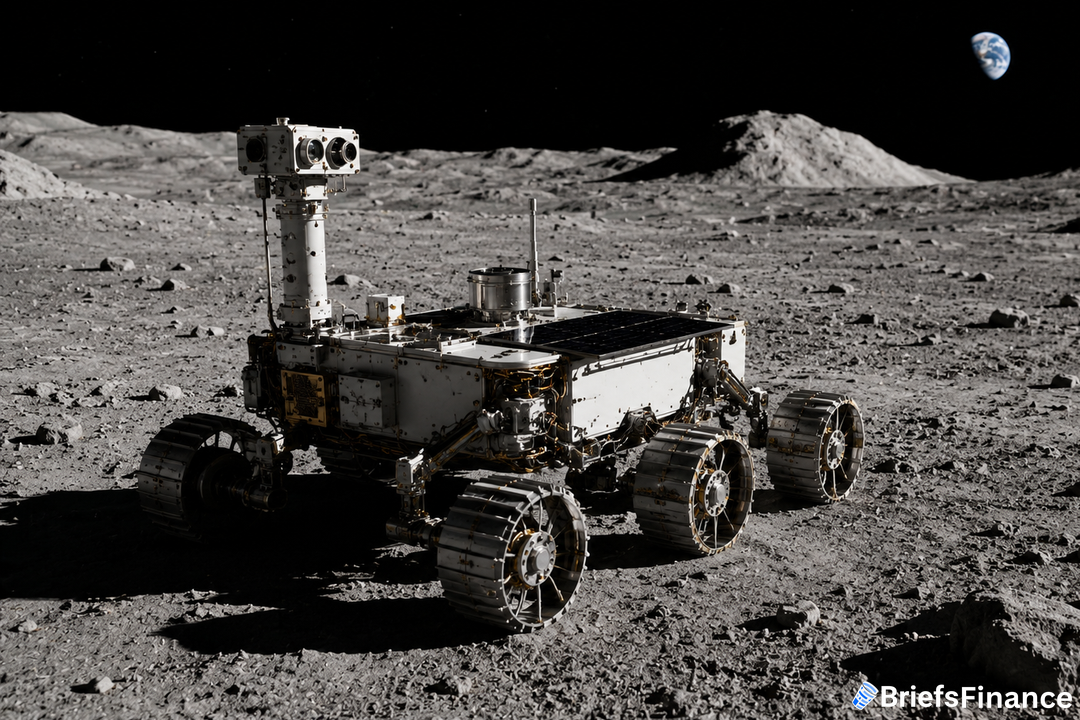
  • Lunar Outpost will equip its moon rover with Nvidia's Jetson chip, marking the first time a GPU has been sent to the lunar surface.
  • The rover is set to launch before end of 2026 on a Falcon 9 rocket, alongside a Firefly Aerospace satellite also using Nvidia hardware.
  • NASA's Commercial Lunar Payload Services program funds private companies to advance lunar exploration ahead of human missions.

The moon is about to get a serious computer upgrade.

On July 23, 2026, Lunar Outpost - a Colorado-based space robotics company - revealed its next rover will be equipped with Nvidia's Jetson chips. The Jetson chip is a small, energy-efficient type of graphics processing unit for which Nvidia has become well known. While GPUs are mostly known for powering video games and AI data centers back on Earth, this one will be handling navigation and decision-making in an extreme environment.

This chip would likely be the first GPU to operate on the moon. The company is testing it against its existing flight computer, which has a longer history in space.

"We're taking the Nvidia Jetson and comparing it to our flight compute platform that has a little bit more spaceflight heritage," said Justin Cyrus, CEO of Lunar Outpost. "We're really pushing towards trying to adopt these more capable GPU-powered systems in these extreme environments."

The rover will travel aboard a lander from Intuitive Machines, a fellow lunar-focused firm. Also launching in that window is a Firefly Aerospace satellite - Firefly, which became the first private firm to achieve a safe lunar landing with a robot, will carry Nvidia's Jetson platform into lunar orbit.

Why the Moon Needs Smarter Robots

Five years ago, Lunar Outpost's rover software was what Cyrus calls "more deterministic." That meant it followed a strict set of rules. But space is messy, and you cannot predict every rock.

Get the market news that matters in a five-minute read with Market Briefs, our free daily newsletter

Now the company is blending that old-school approach with physical AI - artificial intelligence that can adapt to the real world. The rover can learn and adjust on the fly, which is a big deal when you are driving on a surface that has no roads and no GPS.

But the moon is brutal on electronics. Lunar night lasts about two weeks, and the cold can kill unshielded hardware.

"Your system has to survive lunar night and has to do so on very low power," Cyrus said. Nvidia's chip is designed to deliver a lot of computing punch without draining the battery.

The company runs its deterministic software and the new AI software side by side to figure out where the AI can handle tasks no robot has ever done before.

Nvidia's Jetson chip, designed for low power consumption while delivering high computational performance, is a critical enabler for robotic autonomy in such conditions.

What Comes Next

Two missions are lined up for Falcon 9 rockets before the end of 2026: Lunar Outpost's rover on an Intuitive Machines lander and Firefly's satellite. Both should reach the moon within months of each other.

Lunar Outpost is also building a much larger rover called Pegasus, designed to carry astronauts, targeted for a 2028 launch on a Blue Origin rocket. Blue Origin suffered an anomaly this summer, but Cyrus remains optimistic. "It does seem like they're making pretty darn good progress on the pad," he said. "Everything we've been told, we're on the same timeline for 2028."

Rather than developing everything in-house, NASA contracts private firms to construct spacecraft that transport scientific instruments to the lunar surface. Those sensors study the terrain and look for useful resources - water ice is a big one, because it could be turned into fuel and air for future astronauts.

The bottom line: The moon is becoming a place where private companies compete for government contracts, and where their technology gets stress-tested like nowhere on Earth.

Join Market Briefs, our free daily newsletter, for a quick daily rundown of the markets
Disclosure

Recent News

1 2 3 41

Get Market Briefs delivered to your inbox every morning for free!

No fluff. No noise. No politics. Just finance news you can read in 5 minutes.

Blogs

June 29, 2026
Portfolio Diversification: Why Putting All Your Eggs in One Basket Destroys Wealth
  • Real diversification means spreading investments across all 11 economic sectors plus bonds, alternatives, and cash so no single bet can sink the portfolio.
  • Different sectors perform at different times, so a diversified portfolio captures upswings while smoothing the brutal drawdowns that wipe out concentrated bets.
  • Total market index funds offer the simplest path to diversification, and annual rebalancing is what keeps the structure working over time.
Read More
June 29, 2026
Non Taxable Income: What It Is and Why It Matters
  • Non taxable income is money you receive that you don't owe income tax on.
  • The tax code treats workers, investors, and business owners very differently, and investors often come out ahead.
  • Learning how income is taxed is a quiet superpower for keeping more of what you earn.
Read More
June 29, 2026
Semiconductor Stocks: A Simple Guide for Investors
  • Semiconductor stocks are companies that design and make computer chips, the brains inside nearly every modern device.
  • The AI boom has turned chips into one of the market's most important and most watched groups.
  • They offer big growth potential, but come with high valuations and a notoriously cyclical history.
Read More
June 25, 2026
How Stocks Work: A Simple Guide for Beginners
  • A stock is a slice of ownership in a company - buy one, and you own a piece of the business.
  • You make money two ways: the share price rising over time, and dividends paid to shareholders.
  • The simplest path for most beginners is buying into the whole market through a low-cost index fund.
Read More
June 25, 2026
Stop Loss vs Stop Limit: What's the Difference?
  • A stop loss order sells your stock once it hits a trigger price, prioritizing getting you out.
  • A stop limit order only sells within a price range you set, prioritizing price over a guaranteed exit.
  • The trade-off: a stop loss almost always executes; a stop limit might not if the price moves too fast.
Read More
June 25, 2026
Energy Stocks: A Simple Guide for Investors
  • Energy stocks are companies that produce and supply the power the world runs on, from oil and gas to newer sources.
  • They make up one of the 11 sectors of the market and tend to move with energy prices and big-picture shifts.
  • Like any sector, the key is diversification and understanding the forces driving demand.
Read More
June 18, 2026
What Is a Stop Loss Order? A Simple Guide
  • A stop loss order automatically sells a stock once it falls to a price you set.
  • It's a tool to cap losses or lock in gains without watching the market all day.
  • It works best for active strategies, and can backfire if used carelessly on long-term holdings.
Read More
June 18, 2026
Best S&P 500 Index Fund: How to Choose One
  • The best S&P 500 index fund for most investors is simply the cheapest, most established one that tracks the index well.
  • Funds like VOO, IVV, and SPY all hold the same 500 companies, so the biggest difference is the fee.
  • Pick one, automate your buys, and let time do the heavy lifting.
Read More
June 17, 2026
What Are Penny Stocks? Risks and Rewards Explained
  • Penny stocks are very low-priced shares of very small companies, often trading for just a few dollars or less.
  • They promise huge gains but carry huge risks: low liquidity, high failure rates, and wild price swings.
  • Most investors are better served by quality companies and funds than by chasing cheap shares.
Read More
June 17, 2026
Best Stocks for Beginners With Little Money
  • The best stocks for beginners with little money usually aren't individual stocks at all - they're low-cost index funds.
  • You can start with $100 or less and use small, regular investments to build wealth over time.
  • Focus on diversification and consistency, not on picking the next big winner.
Read More
1 2 3 24
Share via
Copy link