Free NewsletterPro Login

Singapore's Seatrium Is Building Monster HVDC Platforms For Europe's Offshore Wind Push

Published Oct 24, 2026
Share:
Summary:
  • A 30,000 ton converter platform rising in northern Singapore, roughly the height of a 15 story block, is slated to sail to the North Sea in 2028 and operate 60 kilometers offshore.
  • Seatrium's designs can move roughly 2 gigawatts each, use HVDC tech from GE Vernova Inc., and are part of a four platform order from European grid operator TenneT Holding BV.
  • Even as BloombergNEF says offshore wind investment slid 72% year over year to about $12 billion in 1H 2026, Seatrium is chasing S$9 billion ($7 billion) of HVDC and HVAC work, with clean energy now about 40% of its order book.

A giant taking shape in Singapore

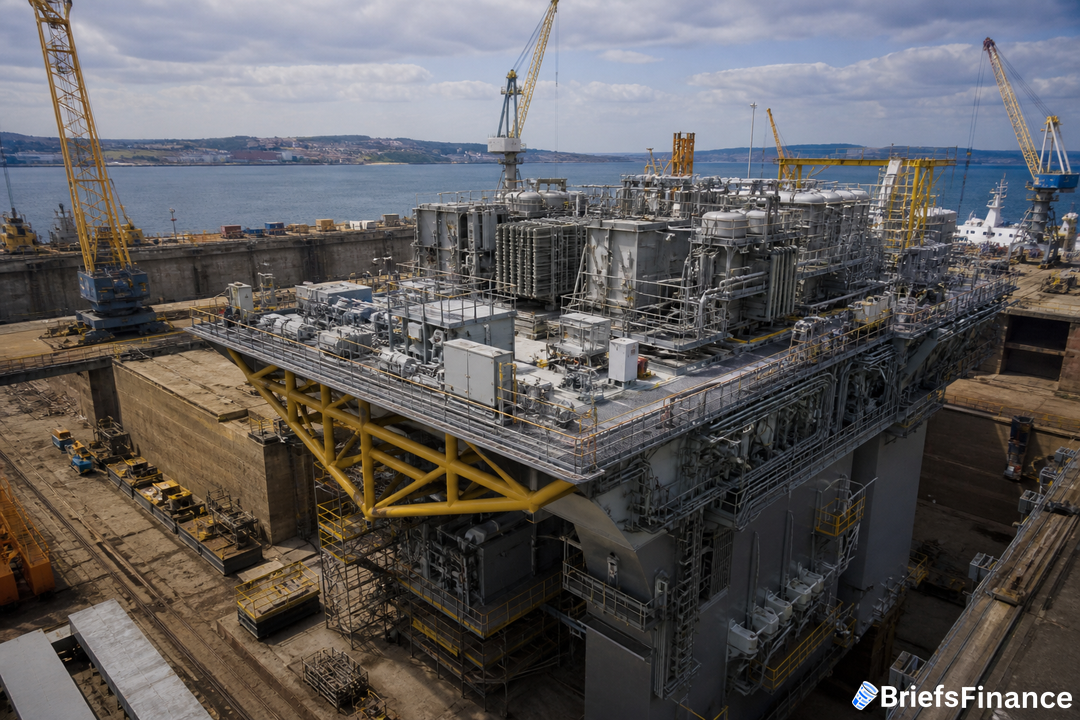
At Seatrium's northern Singapore yard, welders are assembling a towering yellow structure module by module. The finished unit will weigh 30,000 tons and serve as a high voltage direct current converter platform.

These platforms are billed as the largest of their type globally and each is built to handle around 2 gigawatts of power. One takes five years to construct and is meant to run for about four decades.

How it works and where it is headed

In 2028, the unit will set out toward the North Sea and be stationed 60 kilometers offshore to channel electricity from the turbines back to land. Turbines generate alternating current; the platform switches it to direct current so power can travel long distances with lower losses as projects move farther from crowded coasts.

Singapore is leaning on decades of offshore oil and gas know how to pivot into Europe's clean energy buildout, with HVDC platforms a core export. Few yards worldwide can deliver them at scale, raising the risk of a supply squeeze as the European Union pushes capacity growth.

Why Singapore is winning the work

TenneT chose Seatrium - which is partly owned by state investor Temasek Holdings Pte - to supply four platforms serving clusters in the North Sea. Roughly 7,000 people will construct the equipment at sites in Singapore and Batam, Indonesia, a roughly 50 minute ferry trip away. TenneT says each platform plus its connecting kit can run up to €5 billion ($5.6 billion).

The city state and nearby islands now make up as much as 20% of non China global capacity to produce these platforms, up from almost nothing a few years back, according to Ember's Lam Pham. With Middle Eastern yards disrupted by regional conflict, China and South Korea focused at home, and European yards busy with defense work, Singapore's labor intensive model can still come out cheaper even after shipping, Lam said. "The country has invested, the company has invested - and this is a showcase of what is possible," said Seatrium CEO Chris Ong.

When big projects reshape industries, staying informed matters, so sign up for the free Market Briefs newsletter for five-minute daily updates.

The market backdrop and your money

Offshore wind's near term has been bumpy. According to BloombergNEF, financing fell 72% year over year to around $12 billion during the first half of 2026, amid rising costs, constrained supply chains, and regulatory hurdles. Europe is still pushing: the UK's most recent auction resulted in a record 8.2 gigawatts being awarded, while Germany and the Netherlands are introducing new revenue support mechanisms. With sufficient state support, BNEF sees global installations roughly doubling by 2030, led by China, the UK, and Germany.

For investors, two threads matter. First, scarcity: only a handful of yards can build HVDC platforms, they take years to deliver, and price tags can reach the billions. Second, pipeline: as of July, Seatrium was pursuing S$9 billion ($7 billion) of HVDC and HVAC opportunities across Europe and Asia Pacific, with clean energy now around 40% of its order book.

Ong, formerly the head of Keppel Offshore & Marine before its merger with Sembcorp Marine to form Seatrium in 2023, frames the demand as both transition and security policy for Europe. "The scale and the massive need for offshore wind is a big security drive," he said. "It has to happen."

Because global energy and finance intersect in surprising ways, get the free Market Briefs to cut through complexity in minutes.

Disclosure

Recent News

1 2 3 … 110

Get Market Briefs delivered to your inbox every morning for free!

No fluff. No noise. No politics. Just finance news you can read in 5 minutes.

Blogs

October 23, 2026
Are We in a Recession? 5 Threats to the Economy and Where the Money Is Moving
  • The S&P 500 is up about 13% this year, but without AI it's in a bear market, with nearly 40% of its companies down more than 20% for four months or longer.
  • Jackson, Briefs Finance's head of investing research, sees five threats: rising interest rates, sticky inflation, an economy propped up by AI, a struggling UK, and high oil prices.
  • The opportunities he's watching mostly sit outside the dollar: rising economies like Brazil and Indonesia, US-backed emerging market bonds paying 7% to 9%, and the shifts that fear creates.
Read More
October 16, 2026
How Boring Math Makes You Rich: The Briefs Money Spreadsheet, Explained
  • Briefs Money shows you what to do with every paycheck, and in what order: how much to spend, save, and invest, when to build an emergency fund, and which debt to pay off first.
  • The Climb to Wealth course walks you through the system step by step, and the Personal Finance Spreadsheet is where you track your own numbers.
  • Investing is one piece of building wealth. The system that gets money to your investments, and keeps it there, decides the outcome.
Read More
October 16, 2026
Common Investing Mistakes: Why a Stock Grade Is One Tool, Not the Whole Toolkit
  • The Briefs Score shows growth, income, and wealth preservation investors how well a stock fits their goal, with a separate letter grade for each one.
  • The most common mistake is treating the letter as an instruction. An A tells you a stock scores well for one goal, not that you should buy today.
  • Research works best as one input in a process you own. The grade shows how a stock stacks up. You supply the goal, the timeline, and the rules for being wrong.
Read More
October 16, 2026
How to Read a Company's Numbers Without a Finance Degree (Using Briefs Terminal)
  • Briefs Terminal lets you size up any public company in about ten minutes: what the stock costs, what it earns, how fast sales are growing, and what it pays you, all on one page.
  • It lines those numbers up against the company's closest competitors for you, so you can tell if a number is impressive or just average.
  • Below that are the income statement, balance sheet, and cash flow statement from the company's SEC filings, the latest news, and transcripts of its earnings calls.
Read More
October 16, 2026
What Type of Investor Am I? The Three Investor Archetypes, Explained
  • Briefs sorts its stock grades and monthly reports by three investor goals: growth, income, and wealth preservation. Pick yours and you know which report and which grade to read first.
  • Growth investors want stocks that beat the S&P 500. Income investors want to get paid in cash. Wealth preservation investors want stocks that hold up when the market drops.
  • The same stock can score an A- for one goal and a D- for another, so picking your goal comes before picking any stock.
Read More
October 16, 2026
How to Build a Stock Watchlist That Isn't Just Stocks You Heard About
  • A watchlist on Briefs Terminal lets you group stocks by the idea you're tracking and follow each one's price, one-day move, and 52-week high and low in one place.
  • Each list has its own name and description, so you always know why a stock is on it, and you can make as many lists as you have ideas.
  • The monthly growth, income, and wealth preservation reports under the Briefs Research tab hand you new themes to track that you didn't hear about online.
Read More
October 16, 2026
How to Choose an ETF That Matches Your Idea (Using the ETF Planning Tool)
  • The ETF planning tool takes an idea like "I want to invest in fast food companies," asks what you mean, and finds the ETFs that match, with the reasons, the holdings, and the sources.
  • Build a Plan then shows what your money could grow to in those ETFs over the years you choose, with conservative, expected, and optimistic estimates next to the S&P 500.
  • It gets you from an idea to an actual plan without researching dozens of companies one at a time.
Read More
October 16, 2026
Is This Stock a Good Buy? How to Use the Briefs Score to Tell If a Stock Fits the Way You Invest
  • The Briefs Score shows growth, income, and wealth preservation investors how well a stock fits their goal, with a separate letter grade for each one.
  • One stock can score very differently for each. Nvidia showed an A- for growth and a D- for income, because it grows fast and pays almost no dividend.
  • Seven sub scores under each grade show what earned the letter, so you can see exactly where a stock is strong or weak for your goal.
Read More
October 16, 2026
How to Tell an Asset From a Liability: The One Question to Ask Before You Buy Anything
  • The typical American household earned more in 2025 than in any year on record, yet only 30% of Americans say they could pay a surprise $1,000 bill from savings, so the problem isn't income but what the income gets spent on.
  • An asset puts money in your pocket and a liability takes money out, and the wealthy buy assets first, then let the assets pay for the fun stuff.
  • Before you buy anything, ask one question: does this put money in my pocket, or take money out of my pocket? Then you need a plan for the money you keep.
Read More
October 16, 2026
How to Build Your First $2,000 Emergency Fund and Wipe Out Every Debt Over 10%
  • Your first money goal isn't investing, it's $2,000 in its own account named Do Not Touch, built by moving 10% of every paycheck into it automatically.
  • More than a third of American adults couldn't cover a $400 surprise bill with cash or savings, according to the Federal Reserve, and that's how one bad day turns into years of credit card payments.
  • Once the $2,000 is there, attack every debt charging more than 10% interest, highest rate first, because you can't out-invest a 22% credit card so paying it off is the investment.
Read More
1 2 3 … 29
Share via
Copy link










