Free NewsletterPro Login

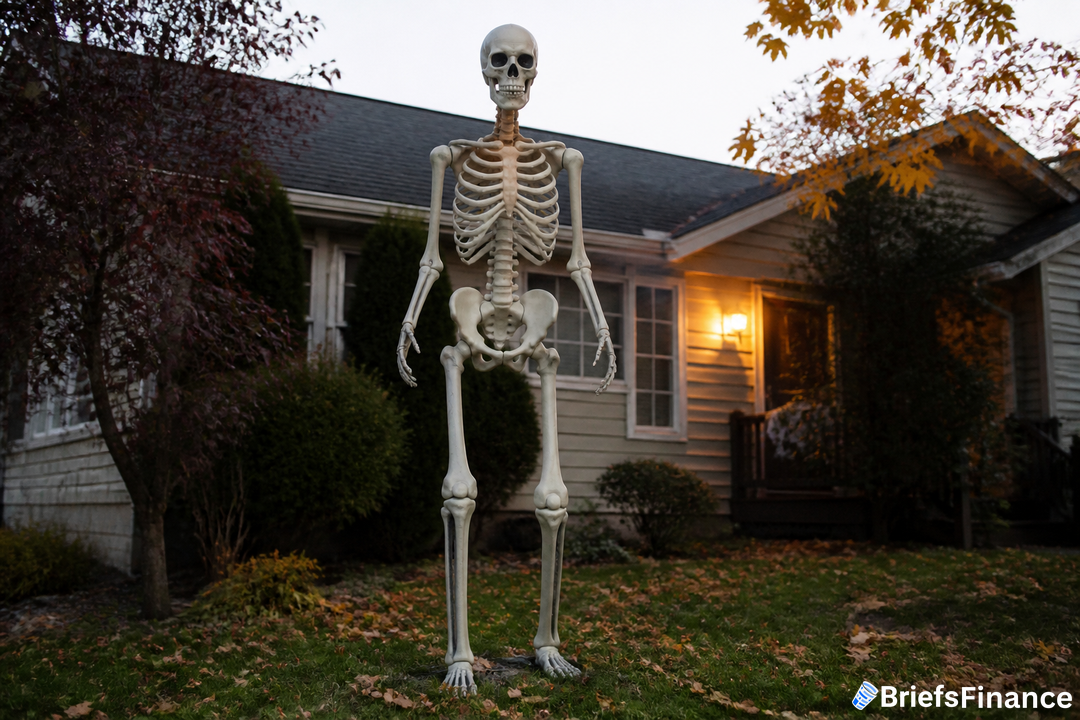
Giant skeletons are no joke: Halloween's towering trend is big business

Published Oct 23, 2026
Share:
Summary:
  • What started as a quirky hit six years ago is now a core category, with retailers rolling out ever-taller animatronics and molded yard beasts.
  • This year, Americans are expected to spend $13.5 billion on Halloween, up from $8.8 billion in 2019, and décor purchases have climbed during that span to $4.3 billion from $2.6 billion.
  • Home Depot's $299, 12-foot Skelly debuted in 2020, sold out, and fetched around $1,000 on resale; by 2024 the company had quadrupled Skelly production and increased its giant lineup fivefold.

How a meme became a must-have

Six Halloweens ago, the supersized skeleton gag took off and never looked back. "In 2020, Skelly's debut really was … the genesis of these fully molded structures that people could put in their yards," said Tyler Pelfrey, a brand communications manager at Home Depot.

The idea was baked in before the craze. As Home Depot started work on Skelly in 2019, the goal was to outgrow the usual yard prop. Senior product merchant Lance Allen later recalled pushing past 10 feet to something that felt overpowering, which produced the 12-foot version that launched in 2020.

That timing mattered. It was the first Halloween of Covid, when households were staying put. "With everyone being at home, I think [Skelly] being so giant and being able to [be seen] from a far distance, really helped with him being so popular," said Rachel Little, formerly a product engineer at Home Depot who helped develop it.

Bigger products, earlier aisles, fatter receipts

Once Skelly hit, retailers piled in with larger, louder creatures. Home Depot's original 12-footer cost $299 and sold out quickly, with some listings near $1,000 on secondary markets at the time. By 2024, Home Depot had produced roughly four times as many Skellies as in year one and offered five times more giant-scale Halloween pieces, and, according to Pelfrey, the company has introduced no fewer than one new giant annually since 2021.

Features scaled up, too. A newer Skelly pairs with an app to swivel its head and mouth, lets owners talk through it live, and can even switch to American-flag eyeballs. Sam's Club now sells oversized animatronics up to 12 feet tall, and its 11-foot Towering Reaper is among the retailer's 10 top-selling Halloween products this year, and some locations have sold through stock while overall sales are pacing ahead of plan.

Interest is showing up online as well, with July visits to Sam's Club's Halloween décor pages up 67% versus a year earlier, Business Insider reports. Lowe's is selling a 15-foot headless Skeleton Watcher that hoists its skull and throws spotlight beams from its glowing eyes.

The category has diversified into a small ecosystem: motion-triggered 12-foot pumpkin monarchs, bone-studded, three-headed carnivorous plants, and even a 5-foot undead parrot that answers yes or no. Shoppers are lugging 85-pound boxes that may not squeeze into a trunk, and tinkerers are buying third-party elbows and joints to give their giants more pose options.

As trends move from novelty to routine, sign up for our free Market Briefs for quick daily context on markets

From seasonal stunt to year-round mascot

At first, Skelly was built for October only. Then owners refused to take it down. "One of the things we didn't prepare for was, we didn't know people were going to keep these up year-round," Allen said.

Fans dressed them for Christmas and Independence Day, prompting Home Depot to add UV protection and switch the resin so the figures could handle summer heat. Brands noticed, too: Arby's rolled out a $46.66 Meat Sweats tracksuit tailored to a 12-foot skeleton.

Inside the stores, Halloween's footprint has stretched. In 2013, Home Depot's Halloween goods fit on a single endcap. By 2026, its seasonal setups can cover more than 800 square feet.

Shoppers are also starting sooner. Nearly half planned to begin buying by September or earlier this year, up from roughly one-third a decade ago, per the National Retail Federation.

Why it sticks - and what that means for your money

These giants are built to be seen. "Giant Halloween displays are directed outward towards a public and the front lawn becomes a stage, the homeowner becomes a producer, and neighbors and passersby become the audience," said Timothy Malefyt, a Fordham University scholar in marketing and business anthropology. The social pull is durable, both on the block and online, where owners post tableaus featuring skeleton families or a colossal dog walker. As consumer psychologist Ross Steinman at Widener University puts it, "Halloween has evolved from a discrete event into an extended consumption season," and "Large-scale displays transform a home from a private space into part of a shared neighborhood experience."

In plain English: the holiday has turned into a longer, higher-ticket retail window. That is a clear read-through for retailers that lean into early setups, dedicate more floor space, and refresh assortments with eye-catching, premium items. For investors tracking consumer discretionary names, the giant-skeleton era is not a blip so much as a seasonal growth lane.

Because the financial landscape touches many parts of life, sign up for the Market Briefs newsletter for concise five minute updates

Disclosure

Recent News

1 2 3 … 109

Get Market Briefs delivered to your inbox every morning for free!

No fluff. No noise. No politics. Just finance news you can read in 5 minutes.

Blogs

October 16, 2026
How Boring Math Makes You Rich: The Briefs Money Spreadsheet, Explained
  • Briefs Money shows you what to do with every paycheck, and in what order: how much to spend, save, and invest, when to build an emergency fund, and which debt to pay off first.
  • The Climb to Wealth course walks you through the system step by step, and the Personal Finance Spreadsheet is where you track your own numbers.
  • Investing is one piece of building wealth. The system that gets money to your investments, and keeps it there, decides the outcome.
Read More
October 16, 2026
Common Investing Mistakes: Why a Stock Grade Is One Tool, Not the Whole Toolkit
  • The Briefs Score shows growth, income, and wealth preservation investors how well a stock fits their goal, with a separate letter grade for each one.
  • The most common mistake is treating the letter as an instruction. An A tells you a stock scores well for one goal, not that you should buy today.
  • Research works best as one input in a process you own. The grade shows how a stock stacks up. You supply the goal, the timeline, and the rules for being wrong.
Read More
October 16, 2026
How to Read a Company's Numbers Without a Finance Degree (Using Briefs Terminal)
  • Briefs Terminal lets you size up any public company in about ten minutes: what the stock costs, what it earns, how fast sales are growing, and what it pays you, all on one page.
  • It lines those numbers up against the company's closest competitors for you, so you can tell if a number is impressive or just average.
  • Below that are the income statement, balance sheet, and cash flow statement from the company's SEC filings, the latest news, and transcripts of its earnings calls.
Read More
October 16, 2026
What Type of Investor Am I? The Three Investor Archetypes, Explained
  • Briefs sorts its stock grades and monthly reports by three investor goals: growth, income, and wealth preservation. Pick yours and you know which report and which grade to read first.
  • Growth investors want stocks that beat the S&P 500. Income investors want to get paid in cash. Wealth preservation investors want stocks that hold up when the market drops.
  • The same stock can score an A- for one goal and a D- for another, so picking your goal comes before picking any stock.
Read More
October 16, 2026
How to Build a Stock Watchlist That Isn't Just Stocks You Heard About
  • A watchlist on Briefs Terminal lets you group stocks by the idea you're tracking and follow each one's price, one-day move, and 52-week high and low in one place.
  • Each list has its own name and description, so you always know why a stock is on it, and you can make as many lists as you have ideas.
  • The monthly growth, income, and wealth preservation reports under the Briefs Research tab hand you new themes to track that you didn't hear about online.
Read More
October 16, 2026
How to Choose an ETF That Matches Your Idea (Using the ETF Planning Tool)
  • The ETF planning tool takes an idea like "I want to invest in fast food companies," asks what you mean, and finds the ETFs that match, with the reasons, the holdings, and the sources.
  • Build a Plan then shows what your money could grow to in those ETFs over the years you choose, with conservative, expected, and optimistic estimates next to the S&P 500.
  • It gets you from an idea to an actual plan without researching dozens of companies one at a time.
Read More
October 16, 2026
Is This Stock a Good Buy? How to Use the Briefs Score to Tell If a Stock Fits the Way You Invest
  • The Briefs Score shows growth, income, and wealth preservation investors how well a stock fits their goal, with a separate letter grade for each one.
  • One stock can score very differently for each. Nvidia showed an A- for growth and a D- for income, because it grows fast and pays almost no dividend.
  • Seven sub scores under each grade show what earned the letter, so you can see exactly where a stock is strong or weak for your goal.
Read More
October 16, 2026
How to Tell an Asset From a Liability: The One Question to Ask Before You Buy Anything
  • The typical American household earned more in 2025 than in any year on record, yet only 30% of Americans say they could pay a surprise $1,000 bill from savings, so the problem isn't income but what the income gets spent on.
  • An asset puts money in your pocket and a liability takes money out, and the wealthy buy assets first, then let the assets pay for the fun stuff.
  • Before you buy anything, ask one question: does this put money in my pocket, or take money out of my pocket? Then you need a plan for the money you keep.
Read More
October 16, 2026
How to Build Your First $2,000 Emergency Fund and Wipe Out Every Debt Over 10%
  • Your first money goal isn't investing, it's $2,000 in its own account named Do Not Touch, built by moving 10% of every paycheck into it automatically.
  • More than a third of American adults couldn't cover a $400 surprise bill with cash or savings, according to the Federal Reserve, and that's how one bad day turns into years of credit card payments.
  • Once the $2,000 is there, attack every debt charging more than 10% interest, highest rate first, because you can't out-invest a 22% credit card so paying it off is the investment.
Read More
October 16, 2026
How to Invest Through a Crash: 3 Rules From the Worst-Timed Investor Alive
  • Meet Bunty, a fictional investor with the worst timing in history: he put $100,000 into the market in four chunks right before four crashes, never sold, and by 2025 it had grown to more than $500,000.
  • Investors who jump in and out of the market miss its best days, and missing just a handful of those days can cut your final result roughly in half.
  • The fix is ABB, Always Be Buying: you buy on a schedule through booms, crashes and scary headlines, which matches the market, and beating it takes knowing where the money is moving first.
Read More
1 2 3 … 29
Share via
Copy link










