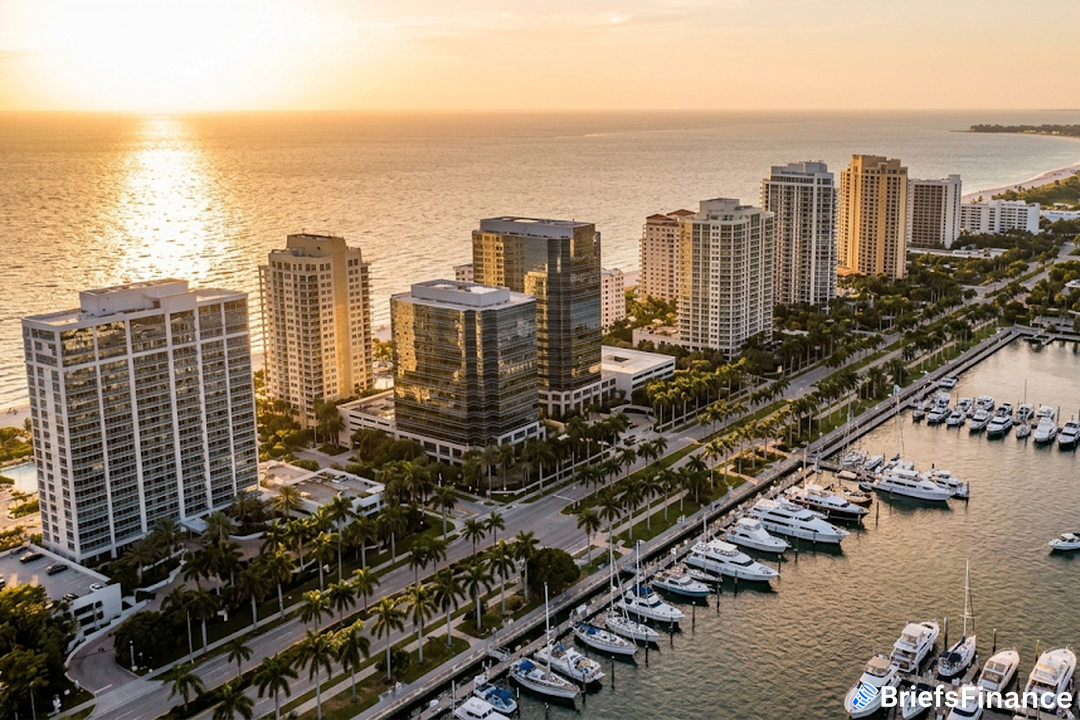
How Florida Got Here
Most people think of Florida as the place for beaches and theme parks. But the state has quietly built an economy that now beats most countries.
The Florida Chamber of Commerce released the numbers, showing a $1.8 trillion gross domestic product (GDP) - the total value of everything produced in the state. Florida trails South Korea, which holds the 13th spot, by a narrow margin - only about 2% additional growth would push it ahead, and roughly 21% growth would be needed to surpass Canada at No. 10.
Florida's rise did not happen overnight. For two decades, the state has deliberately pursued policies to attract businesses and residents, shifting away from its traditional reliance on tourism and agriculture. This long-term strategy has diversified its economy into high-growth sectors like aerospace and technology, creating a resilient economic base.
Mark Wilson, president and CEO of the Florida Chamber of Commerce, said: "The best way to help America move forward is to have Florida lead the country forward when it comes to free enterprise and freedom."
The state's approach, Wilson explained, includes lower taxes, streamlined regulations, and a long-term strategy. "The secret sauce for us in Florida is this has been part of a 20-year plan," he said. "From the governor to the legislature, to nearly all of us in the business community, we've been on an ultra-focused pathway here of doing the right things from a policy standpoint."
Get the market news that matters in a five-minute read with Market Briefs, our free daily newsletter
That plan shows in the flow of people and money.
The chamber's data underscores how Florida's fiscal discipline and low taxes have positioned it as an alternative to states with higher burdens.
Florida secured the top national ranking for new business starts and manufacturing employment increases, per the chamber. Wilson pointed to expansion across areas such as aerospace, defense, fintech, healthcare, logistics, and the modeling-and-simulation sector in Central Florida, valued at $11.6 billion.
The Numbers Behind the Ranking
But what stands out is how lean the state runs.
A recent Bloomberg analysis found that the tri-county area encompassing Miami, Fort Lauderdale, and Palm Beach has a cost of living roughly 5% higher than the New York metro region. Wilson responded to that report, saying: "We're taking a deep dive into that [report], that actually doesn't compare New York to Florida, it compares Miami to New York City." He added: "Miami is now one of the safest places in America… It's safe to walk the streets at night. Sometimes there's no price tag you can put on some of these amenities Florida has."
Florida's economic growth is not an accident but the result of deliberate policy choices over two decades, according to Chamber officials. The state's focus on keeping taxes low and regulations minimal has attracted both businesses and individuals, contributing to a virtuous cycle of population and wealth influx. Meanwhile, states with higher tax burdens, such as New York and California, have seen net outflows, reinforcing Florida's competitive advantage.
What's Next
Wilson maintained that Florida's low debt cushions local businesses from shocks in the national economy. He pointed to the contrast with states he called "death spiral states" like New York, which he said have adopted policies that increase taxes and regulations.
The Florida Chamber of Commerce stated that the state's daily influx of new residents has stabilized at 500 to 600 after the post-pandemic surge.
Join Market Briefs, our free daily newsletter, for a quick daily rundown of the markets