Free NewsletterPro Login
S&P 500 6,287 +0.42%
DOW 44,521 -0.18%
NASDAQ 21,103 +0.71%
S&P 500 +12.4%
Briefs Finance Fund +24.8%
JOIN THE FUND →

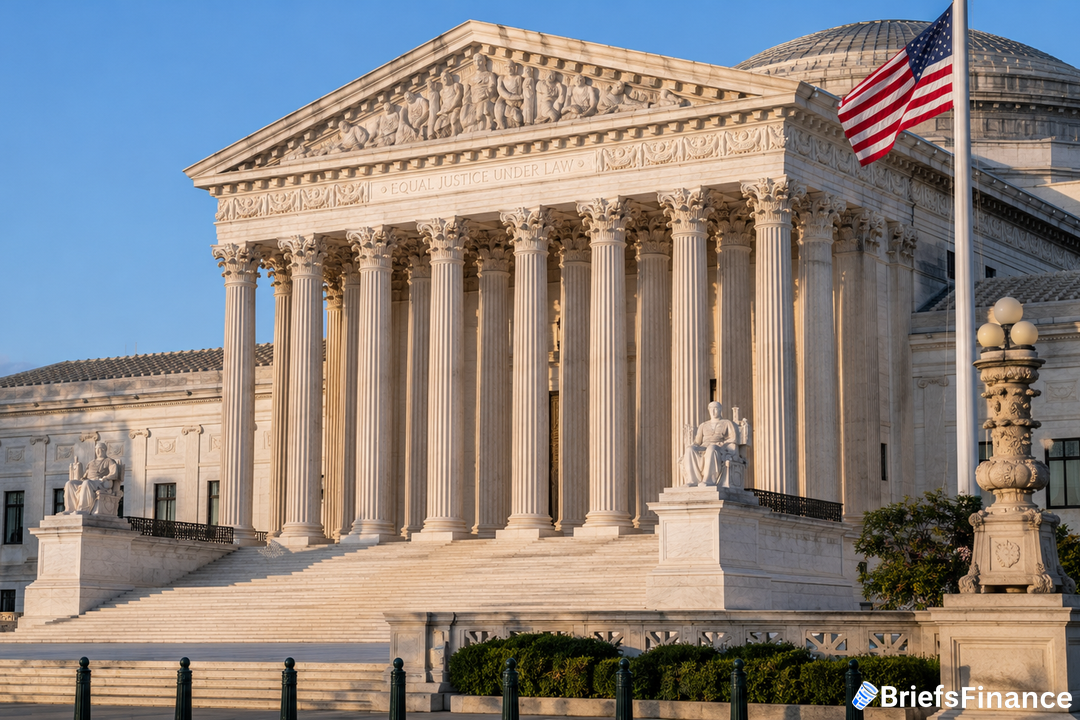
Supreme Court Ends $130,600 Cap on Coordinated Party Ads

Published Jun 30, 2026
[tts_player]
Share:
Summary:
  • The Supreme Court voted 6-3 to remove the $130,600 limit on coordinated spending between party committees and candidates, calling the cap a violation of free speech.
  • Republicans hold $256 million in their national party accounts - twice what Democrats have - and can now spend that money at low candidate advertising rates on broadcast TV.
  • The ruling only applies to broadcast, cable, and satellite ads within 45 days of a primary or 60 days of a general election; digital and streaming ads are not covered.

OPENING: Democratic candidates have raised far more money than Republicans for House and Senate races this cycle. The Supreme Court just gave Republicans a new way to spend that money: unlimited coordinated ad buys at candidate-friendly rates.

Unlimited Coordination, Limited Channels

Before the ruling, limits on coordinated spending were as low as $130,600 for some Senate races. The Supreme Court struck down that limit in a 6-3 decision. Republicans praised the ruling, describing it as a significant victory for free speech rights. Now parties can spend as much as they want on ads that directly support their candidates - as long as those ads run on broadcast, cable, or satellite within the 45- or 60-day window before an election.

That window locks in the lowest advertising rate that candidates get. John Link, the senior vice president of data at AdImpact, an advertising analytics firm, noted, "Broadcast reach is still generally unmatched." The new freedom does not apply to digital, streaming, or connected TV.

Get your free investing masterclass bonus when you join Market Briefs, our free daily newsletter

GOP's Cash Advantage

But the ruling helps Republicans spend their war chest more efficiently. Sarah Bryner, who serves as a director at the nonpartisan research organization Public Agenda, stated, "Getting more money from parties via large donations will lower the advantage that candidates can wield through their fundraising." The GOP's Senate Leadership Fund plans to spend $342 million in eight states before Election Day. The Democratic Senate Majority PAC has pledged $144.4 million.

Reactions Split Along Party Lines

Republicans celebrated the decision. South Carolina Senator Tim Scott, who chairs the NRSC, and Representative Richard Hudson of the NRCC said in a joint statement: "The Court has restored core political speech and ensured parties can compete on a level playing field." They added, "We are ready to fully support our candidates."

Democrats warned the ruling gives billionaires and special interests more influence. Senator Kirsten Gillibrand, Representative Suzan DelBene, and DNC chair Ken Martin said: "Today's ruling is a win for billionaire donors and special interests who want more influence over the GOP agenda." Bryner noted that "the major super PACs are themselves major spending arms of the national parties."

What to Watch

With unlimited coordinated spending, local TV stations will see surging ad demand in competitive races. Nexstar CFO Lee Ann Gliha explained: "Really, it comes down to a supply-demand calculation. And as you get closer and closer to that election, there's just more demand than there is supply." Expect ad rates to climb and commercial advertisers to get squeezed out.

"The races that are going to be competitive are going to be extremely competitive," said Link. That means the GOP's cash advantage could shape the fight for control of the House and Senate.

Subscribe to Market Briefs, our free daily newsletter, and claim your bonus investing masterclass

Disclosure

Recent News

1 2 3 30

Get Market Briefs delivered to your inbox every morning for free!

No fluff. No noise. No politics. Just finance news you can read in 5 minutes.

Blogs

June 29, 2026
Portfolio Diversification: Why Putting All Your Eggs in One Basket Destroys Wealth
  • Real diversification means spreading investments across all 11 economic sectors plus bonds, alternatives, and cash so no single bet can sink the portfolio.
  • Different sectors perform at different times, so a diversified portfolio captures upswings while smoothing the brutal drawdowns that wipe out concentrated bets.
  • Total market index funds offer the simplest path to diversification, and annual rebalancing is what keeps the structure working over time.
Read More
June 29, 2026
Non Taxable Income: What It Is and Why It Matters
  • Non taxable income is money you receive that you don't owe income tax on.
  • The tax code treats workers, investors, and business owners very differently, and investors often come out ahead.
  • Learning how income is taxed is a quiet superpower for keeping more of what you earn.
Read More
June 29, 2026
Semiconductor Stocks: A Simple Guide for Investors
  • Semiconductor stocks are companies that design and make computer chips, the brains inside nearly every modern device.
  • The AI boom has turned chips into one of the market's most important and most watched groups.
  • They offer big growth potential, but come with high valuations and a notoriously cyclical history.
Read More
June 25, 2026
How Stocks Work: A Simple Guide for Beginners
  • A stock is a slice of ownership in a company - buy one, and you own a piece of the business.
  • You make money two ways: the share price rising over time, and dividends paid to shareholders.
  • The simplest path for most beginners is buying into the whole market through a low-cost index fund.
Read More
June 25, 2026
Stop Loss vs Stop Limit: What's the Difference?
  • A stop loss order sells your stock once it hits a trigger price, prioritizing getting you out.
  • A stop limit order only sells within a price range you set, prioritizing price over a guaranteed exit.
  • The trade-off: a stop loss almost always executes; a stop limit might not if the price moves too fast.
Read More
June 25, 2026
Energy Stocks: A Simple Guide for Investors
  • Energy stocks are companies that produce and supply the power the world runs on, from oil and gas to newer sources.
  • They make up one of the 11 sectors of the market and tend to move with energy prices and big-picture shifts.
  • Like any sector, the key is diversification and understanding the forces driving demand.
Read More
June 18, 2026
What Is a Stop Loss Order? A Simple Guide
  • A stop loss order automatically sells a stock once it falls to a price you set.
  • It's a tool to cap losses or lock in gains without watching the market all day.
  • It works best for active strategies, and can backfire if used carelessly on long-term holdings.
Read More
June 18, 2026
Best S&P 500 Index Fund: How to Choose One
  • The best S&P 500 index fund for most investors is simply the cheapest, most established one that tracks the index well.
  • Funds like VOO, IVV, and SPY all hold the same 500 companies, so the biggest difference is the fee.
  • Pick one, automate your buys, and let time do the heavy lifting.
Read More
June 17, 2026
What Are Penny Stocks? Risks and Rewards Explained
  • Penny stocks are very low-priced shares of very small companies, often trading for just a few dollars or less.
  • They promise huge gains but carry huge risks: low liquidity, high failure rates, and wild price swings.
  • Most investors are better served by quality companies and funds than by chasing cheap shares.
Read More
June 17, 2026
Best Stocks for Beginners With Little Money
  • The best stocks for beginners with little money usually aren't individual stocks at all - they're low-cost index funds.
  • You can start with $100 or less and use small, regular investments to build wealth over time.
  • Focus on diversification and consistency, not on picking the next big winner.
Read More
1 2 3 24
Share via
Copy link










