Free NewsletterPro Login
S&P 500 6,287 +0.42%
DOW 44,521 -0.18%
NASDAQ 21,103 +0.71%
S&P 500 +12.4%
Briefs Finance Fund +24.8%
JOIN THE FUND →

Starship's Reentry Shield Not Ready for Quick Reuse, Ex-NASA Experts Say

Published Jul 30, 2026
[tts_player]
Share:
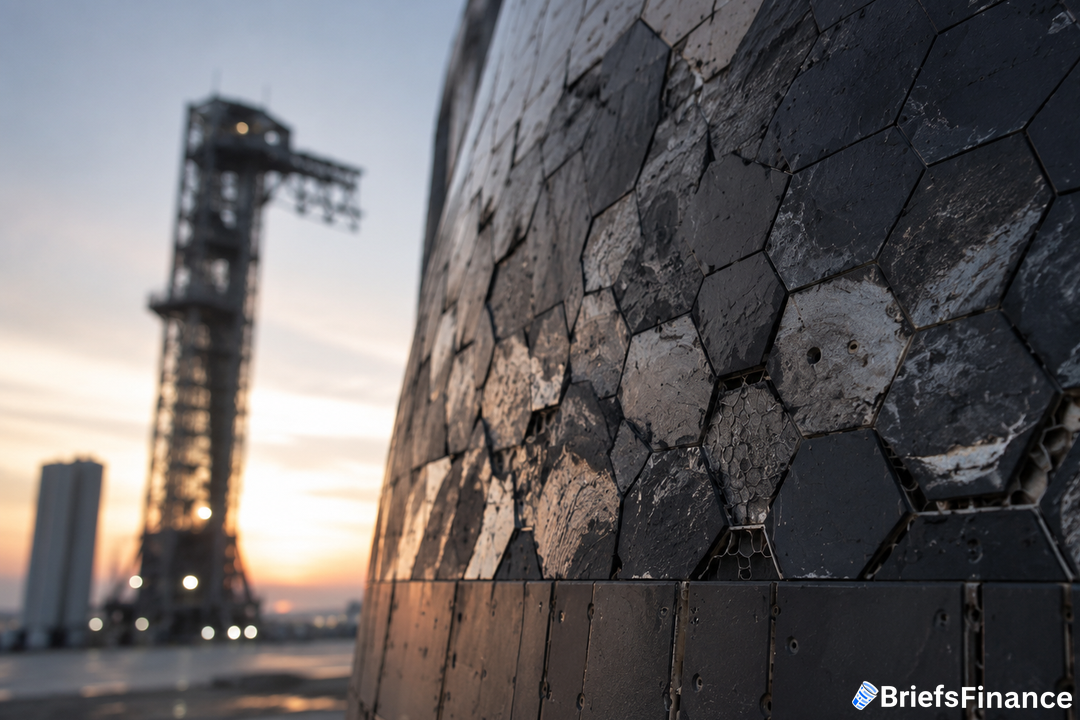
Close-up of scorched hexagonal spacecraft heat shield tiles
Summary:
  • Three former NASA researchers say the heat shield on SpaceX's Starship cannot handle the company's goal of launching the same rocket again within hours.
  • The protective tiles showed significant cracks and damage after the July 24 test flight, the thirteenth flight overall.
  • The heat-shield problems could slow plans to launch one million AI-data-center satellites and raise costs for the NASA Moon landing contract.

What the Experts Are Saying

SpaceX has been clear about its big ambitions. The company wants to eventually fly Starship within hours after it comes back from space. But three people who know spacecraft heat shields better than almost anyone say that dream is a long way off.

A former senior advisor at NASA who now competes with SpaceX's Starlink business, Charles Miller, put it bluntly. "The current TPS is not good enough and it's a dead end," he said. TPS stands for thermal protection system - the layer that keeps a rocket from burning up when it re-enters the atmosphere. Miller added that even if SpaceX gets full reusability, "it's not going to be rapid."

Daniel Rasky worked on heat-shield materials at NASA for years and even co-invented the material used on SpaceX's Dragon capsule. He expects a lot of hands-on work between flights. "It's probably going to take a fair amount of inspection, repair and replacement," he said.

Charles Camarda, a former NASA astronaut, rounds out the group. All three say the current tile design borrows heavily from the old Space Shuttle program - and that is a problem.

Get the market news that matters in a five-minute read with Market Briefs, our free daily newsletter

The Heat Shield's Design Problem

The Space Shuttle's heat shield required constant maintenance. After every flight, crews had to check thousands of tiles, swap out damaged ones, and reapply coatings. It worked, but it was slow. SpaceX's Starship uses a similar system of individual ceramic tiles, and the July 24 test flight showed the same kind of damage.

Elon Musk himself acknowledged the challenge on the All-In Podcast. "For full reusability of the ship, there's still a lot of work that remains on the heat shield," he said.

The three experts advocate for a federally funded effort to create superior thermal protection materials. They point to Stoke Space Technologies, a private startup that is working on a new heat-shield design for its own rocket. The idea is that better materials could solve the problem from the ground up.

What It Means for SpaceX's Plans

SpaceX has a lot riding on that heat shield. The company aims to deploy up to one million AI data center satellites - a massive project that depends on low-cost, high-frequency flights. If each Starship requires inspections and repairs spanning days to weeks, as Rasky predicts, the economic model collapses.

Then there is the NASA contract. The space agency wants to use Starship to land astronauts on the Moon. That mission is already expensive and complex. Adding heat-shield delays or cost overruns would only make it worse.

To investigate, SpaceX says it will send a boat to retrieve the flown Starship from the ocean and analyze how the heat shield performed. That will give engineers data, but fixing the design will take more than a lab report.

Lockheed Martin, which builds NASA's Orion spacecraft - a vehicle that faced its own heat-shield criticism - saw its stock rise 0.89% on the article date to $576.16. SpaceX shares, which trade as Space Exploration Technologies Corp, were up 1.85% to $114.26. For now, the market is not panicking.

The bottom line: The heat shield is a classic engineering trade-off. SpaceX has shown it can fly Starship over and over. What it has not shown is that it can fly it over and over fast.

Join Market Briefs, our free daily newsletter, for a quick daily rundown of the markets
Disclosure

Recent News

1 2 3 45

Get Market Briefs delivered to your inbox every morning for free!

No fluff. No noise. No politics. Just finance news you can read in 5 minutes.

Blogs

June 29, 2026
Portfolio Diversification: Why Putting All Your Eggs in One Basket Destroys Wealth
  • Real diversification means spreading investments across all 11 economic sectors plus bonds, alternatives, and cash so no single bet can sink the portfolio.
  • Different sectors perform at different times, so a diversified portfolio captures upswings while smoothing the brutal drawdowns that wipe out concentrated bets.
  • Total market index funds offer the simplest path to diversification, and annual rebalancing is what keeps the structure working over time.
Read More
June 29, 2026
Non Taxable Income: What It Is and Why It Matters
  • Non taxable income is money you receive that you don't owe income tax on.
  • The tax code treats workers, investors, and business owners very differently, and investors often come out ahead.
  • Learning how income is taxed is a quiet superpower for keeping more of what you earn.
Read More
June 29, 2026
Semiconductor Stocks: A Simple Guide for Investors
  • Semiconductor stocks are companies that design and make computer chips, the brains inside nearly every modern device.
  • The AI boom has turned chips into one of the market's most important and most watched groups.
  • They offer big growth potential, but come with high valuations and a notoriously cyclical history.
Read More
June 25, 2026
How Stocks Work: A Simple Guide for Beginners
  • A stock is a slice of ownership in a company - buy one, and you own a piece of the business.
  • You make money two ways: the share price rising over time, and dividends paid to shareholders.
  • The simplest path for most beginners is buying into the whole market through a low-cost index fund.
Read More
June 25, 2026
Stop Loss vs Stop Limit: What's the Difference?
  • A stop loss order sells your stock once it hits a trigger price, prioritizing getting you out.
  • A stop limit order only sells within a price range you set, prioritizing price over a guaranteed exit.
  • The trade-off: a stop loss almost always executes; a stop limit might not if the price moves too fast.
Read More
June 25, 2026
Energy Stocks: A Simple Guide for Investors
  • Energy stocks are companies that produce and supply the power the world runs on, from oil and gas to newer sources.
  • They make up one of the 11 sectors of the market and tend to move with energy prices and big-picture shifts.
  • Like any sector, the key is diversification and understanding the forces driving demand.
Read More
June 18, 2026
What Is a Stop Loss Order? A Simple Guide
  • A stop loss order automatically sells a stock once it falls to a price you set.
  • It's a tool to cap losses or lock in gains without watching the market all day.
  • It works best for active strategies, and can backfire if used carelessly on long-term holdings.
Read More
June 18, 2026
Best S&P 500 Index Fund: How to Choose One
  • The best S&P 500 index fund for most investors is simply the cheapest, most established one that tracks the index well.
  • Funds like VOO, IVV, and SPY all hold the same 500 companies, so the biggest difference is the fee.
  • Pick one, automate your buys, and let time do the heavy lifting.
Read More
June 17, 2026
What Are Penny Stocks? Risks and Rewards Explained
  • Penny stocks are very low-priced shares of very small companies, often trading for just a few dollars or less.
  • They promise huge gains but carry huge risks: low liquidity, high failure rates, and wild price swings.
  • Most investors are better served by quality companies and funds than by chasing cheap shares.
Read More
June 17, 2026
Best Stocks for Beginners With Little Money
  • The best stocks for beginners with little money usually aren't individual stocks at all - they're low-cost index funds.
  • You can start with $100 or less and use small, regular investments to build wealth over time.
  • Focus on diversification and consistency, not on picking the next big winner.
Read More
1 2 3 24
Share via
Copy link











