Free NewsletterPro Login
S&P 500 6,287 +0.42%
DOW 44,521 -0.18%
NASDAQ 21,103 +0.71%
S&P 500 +12.4%
Briefs Finance Fund +24.8%
JOIN THE FUND →

Audi Launches Large SUV Q9 as U.S. Sales Decline

Published Jul 29, 2026
[tts_player]
Share:
Audi Launches Large SUV Q9 as U.S. Sales Decline
Summary:
  • The full-size three-row Q9 SUV starts at $89,095, with a high-performance SQ9 variant at $119,395.
  • Audi's U.S. sales dropped 16% in 2025 and 17% in the first half of 2026, partly due to tariffs and an overemphasis on EVs.
  • Unlike BMW and Mercedes, Audi imports all vehicles and has no U.S. factory, though it is exploring production at a VW plant in South Carolina.

The New Flagship SUV

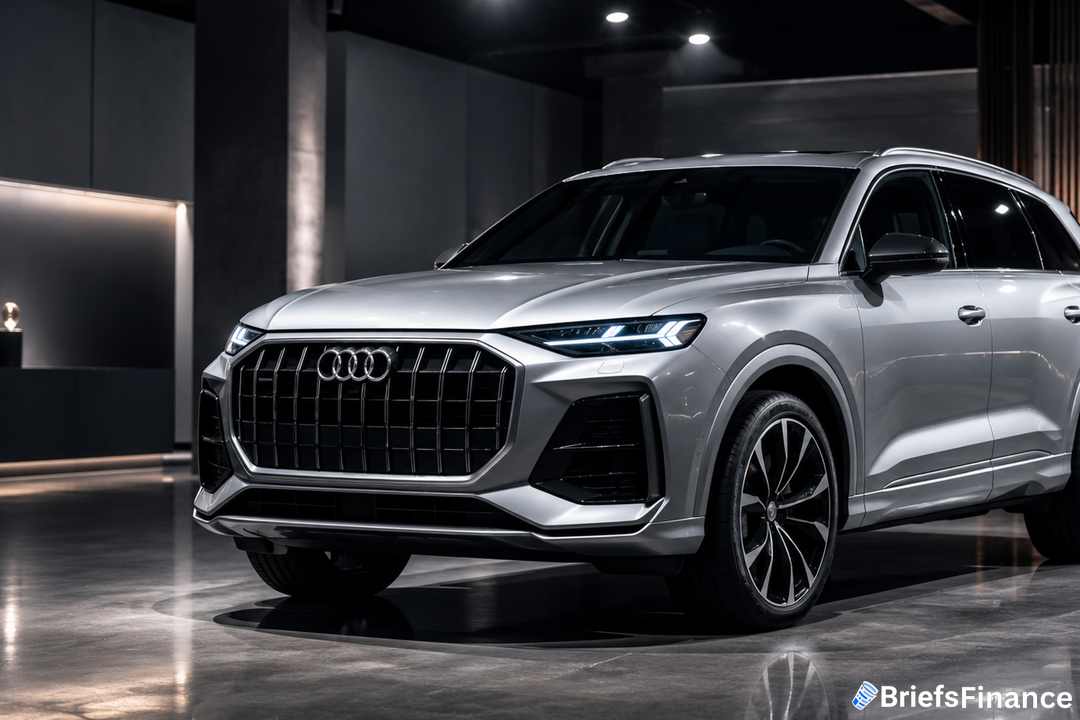
On Tuesday, Audi introduced the full-size Q9 SUV. The three-row model stretches 209 inches in length and 86.8 inches wide (including mirrors), making it slightly larger than the Mercedes-Benz GLS and BMW X7. Adults can comfortably sit in the third row.

The standard Q9 is powered by a 2.9-liter V6 that produces 429 horsepower and accelerates from 0 to 60 mph in 4.9 seconds. The higher-performance SQ9 variant uses a 4.0-liter V8 generating 591 horsepower and 590 lb-ft of torque, reaching 60 mph in 3.8 seconds.

Audi of America's senior vice president of product management, Filip Brabec, described the Q9 as "the most lavish luxury car that we have in this space." Karl Brauer, executive analyst for iSeeCars, said the vehicle has "real decadent features, I would almost say, like power opening doors and crazy interior materials, even by Audi standards."

The Q9 also comes with features including "matrix adaptive beam" headlights, a ChatGPT-powered voice assistant, a driver assist system with a hands-free function, and the largest moonroof Audi has ever put on a vehicle.

Get the market news that matters in a five-minute read with Market Briefs, our free daily newsletter

Why Audi Needs This Car So Badly

Audi's U.S. sales have been sliding. The first three months of 2026 were particularly severe, seeing a 30% decline year-over-year.

Audi attributed its weak U.S. results to tariffs and the expiration of federal EV incentives. The brand also bet heavily on electric vehicles, but by June 2026, battery-electric models represented only 5.4% of the overall U.S. auto market.

As Brauer put it: "A lot of manufacturers were caught out by this. But Audi is probably one of the more substantial ones in terms of how much energy and resources they put into and expected to get back from the electric car world and how far those realities fell from expectations."

Meanwhile, BMW's U.S. sales were up 4.7% through June, while Mercedes-Benz sales were down about 3.5%.

The New Product Push and What Comes Next

Audi is trying to turn things around with a wave of new SUVs. The brand unveiled the compact Q3 in March 2026 and the midsize Q7 in June 2026. Now comes the Q9, which along with the SQ9 variant will be the brand's flagship U.S. model. Brabec noted that SUVs now make up over 80% of the premium auto space, and Audi wants "absolute top contenders in each and every part of those segments."

RBC Capital Markets global autos analyst Tom Narayan noted that Audi had been "nipping at the heels of what used to be a duopoly of German OEMs" and had gained market share over time. But he noted that Audi's pricing edge has disappeared due to tariffs, and "that will still dominate their performance in the U.S."

There is a possible workaround. According to reports, Audi executives are exploring the possibility of producing some SUVs at Volkswagen's upcoming South Carolina plant, which is being set up for its Scout SUV brand. No final decision has been announced.

Audi's lack of domestic production remains a structural challenge. While competitors can mitigate tariff impacts by building vehicles locally, Audi's entire lineup is imported, making it uniquely vulnerable to trade policy shifts. This disadvantage has been a key factor in its recent sales struggles, as analysts have repeatedly noted. The potential move to South Carolina, if realized, could eventually help Audi regain pricing competitiveness.

Join Market Briefs, our free daily newsletter, for a quick daily rundown of the markets
Disclosure

Recent News

1 2 3 45

Get Market Briefs delivered to your inbox every morning for free!

No fluff. No noise. No politics. Just finance news you can read in 5 minutes.

Blogs

June 29, 2026
Portfolio Diversification: Why Putting All Your Eggs in One Basket Destroys Wealth
  • Real diversification means spreading investments across all 11 economic sectors plus bonds, alternatives, and cash so no single bet can sink the portfolio.
  • Different sectors perform at different times, so a diversified portfolio captures upswings while smoothing the brutal drawdowns that wipe out concentrated bets.
  • Total market index funds offer the simplest path to diversification, and annual rebalancing is what keeps the structure working over time.
Read More
June 29, 2026
Non Taxable Income: What It Is and Why It Matters
  • Non taxable income is money you receive that you don't owe income tax on.
  • The tax code treats workers, investors, and business owners very differently, and investors often come out ahead.
  • Learning how income is taxed is a quiet superpower for keeping more of what you earn.
Read More
June 29, 2026
Semiconductor Stocks: A Simple Guide for Investors
  • Semiconductor stocks are companies that design and make computer chips, the brains inside nearly every modern device.
  • The AI boom has turned chips into one of the market's most important and most watched groups.
  • They offer big growth potential, but come with high valuations and a notoriously cyclical history.
Read More
June 25, 2026
How Stocks Work: A Simple Guide for Beginners
  • A stock is a slice of ownership in a company - buy one, and you own a piece of the business.
  • You make money two ways: the share price rising over time, and dividends paid to shareholders.
  • The simplest path for most beginners is buying into the whole market through a low-cost index fund.
Read More
June 25, 2026
Stop Loss vs Stop Limit: What's the Difference?
  • A stop loss order sells your stock once it hits a trigger price, prioritizing getting you out.
  • A stop limit order only sells within a price range you set, prioritizing price over a guaranteed exit.
  • The trade-off: a stop loss almost always executes; a stop limit might not if the price moves too fast.
Read More
June 25, 2026
Energy Stocks: A Simple Guide for Investors
  • Energy stocks are companies that produce and supply the power the world runs on, from oil and gas to newer sources.
  • They make up one of the 11 sectors of the market and tend to move with energy prices and big-picture shifts.
  • Like any sector, the key is diversification and understanding the forces driving demand.
Read More
June 18, 2026
What Is a Stop Loss Order? A Simple Guide
  • A stop loss order automatically sells a stock once it falls to a price you set.
  • It's a tool to cap losses or lock in gains without watching the market all day.
  • It works best for active strategies, and can backfire if used carelessly on long-term holdings.
Read More
June 18, 2026
Best S&P 500 Index Fund: How to Choose One
  • The best S&P 500 index fund for most investors is simply the cheapest, most established one that tracks the index well.
  • Funds like VOO, IVV, and SPY all hold the same 500 companies, so the biggest difference is the fee.
  • Pick one, automate your buys, and let time do the heavy lifting.
Read More
June 17, 2026
What Are Penny Stocks? Risks and Rewards Explained
  • Penny stocks are very low-priced shares of very small companies, often trading for just a few dollars or less.
  • They promise huge gains but carry huge risks: low liquidity, high failure rates, and wild price swings.
  • Most investors are better served by quality companies and funds than by chasing cheap shares.
Read More
June 17, 2026
Best Stocks for Beginners With Little Money
  • The best stocks for beginners with little money usually aren't individual stocks at all - they're low-cost index funds.
  • You can start with $100 or less and use small, regular investments to build wealth over time.
  • Focus on diversification and consistency, not on picking the next big winner.
Read More
1 2 3 24
Share via
Copy link












