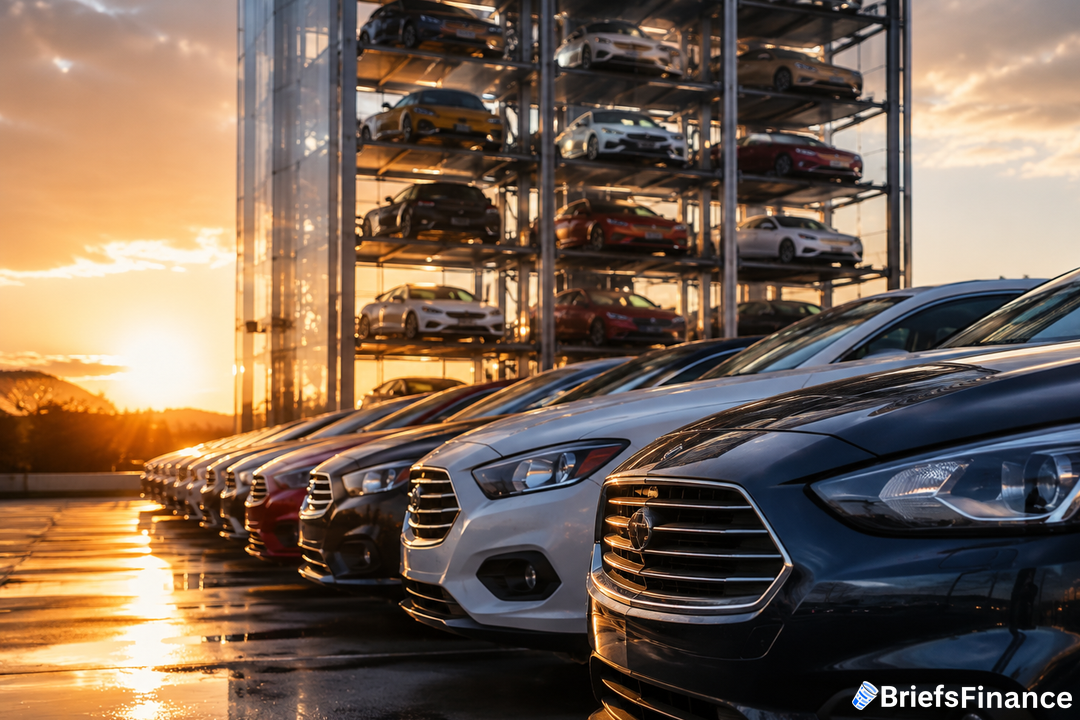
A Surprising Forecast Disappoints Investors
Carvana just posted some of its best numbers in years. Revenue is way up. Net income is climbing. The company sold more cars than almost anyone predicted.
And yet the stock is getting hammered.
It is a story that goes like this: you can beat expectations in the short term but still get punished if the long-term outlook spooks the room. Carvana told investors it expects adjusted earnings between $2.7 billion and $3 billion for the full year 2026. That figure - Wall Street calls it adjusted EBITDA, shorthand for earnings after stripping out interest, taxes, depreciation, and amortization - matters because it strips out one-time costs and gives a cleaner look at how the core business is running.
The problem is that analysts at Deutsche Bank were expecting something higher, in the range of $3 billion to $3.2 billion. Morgan Stanley's forecast was way up at $4.45 billion. When a company tells the market it will make less profit than a major bank predicted, investors tend to head for the exit.
By the time the company's earnings call started, the stock was still down by roughly 10%.
Get the market news that matters in a five-minute read with Market Briefs, our free daily newsletter
The Good News Buried in the Report
None of this means Carvana is in trouble. The company's second-quarter results were strong by almost any measure.
Carvana earned 42 cents per share of stock, known as earnings per share, during the second quarter. That was one penny above what analysts expected, according to data from LSEG. Adjusted earnings for the quarter hit a record $769 million, and the company's adjusted earnings for the full first half of 2026 reached $1.4 billion - already more than half of what it made in all of 2025.
CEO Ernie Garcia sounded confident. "Q2 2026 was Carvana's 10th consecutive quarter of industry-leading growth and profitability, and it was made possible by the foundations we laid in the 10 years prior," he said.
The catch: Compared to the same quarter last year, the company's adjusted EBITDA margin fell by two percentage points, landing at 10.4%. That is the kind of thing that makes analysts nervous about whether the growth is getting more expensive to maintain.
What Comes Next for Carvana and Your Portfolio
For the latter half of 2026, Carvana projects adjusted earnings ranging from $1.3 billion to $1.6 billion. Even the low end of that range would push the company past the record $2.2 billion it earned for the full year in 2025.
The company says it expects retail vehicle sales to keep rising in the third quarter, building on the momentum from earlier this year. And Garcia is thinking big. He says Carvana is on track to sell 3 million cars per year by 2030 to 2035, with a profit margin of 13.5%.
That sounds like a long way off. But here is the context that matters for investors: Carvana currently holds only 2% of the market for used retail vehicles and just 1.5% of the entire automotive retail market. "Our runway is huge," Garcia said.
For anyone watching this stock, the question is not whether Carvana is growing. It clearly is. The question is whether the growth will eventually deliver the kind of profit Wall Street was hoping for in 2026. The company's own forecast suggests the answer is yes - just not as fast, and not by as much, as the optimists wanted.
Join Market Briefs, our free daily newsletter, for a quick daily rundown of the markets