Warning: Undefined variable $stocks in /var/www/briefs.co/htdocs/wp-content/plugins/oxygen/component-framework/components/classes/code-block.class.php(133) : eval()'d code on line 448
Warning: foreach() argument must be of type array|object, null given in /var/www/briefs.co/htdocs/wp-content/plugins/oxygen/component-framework/components/classes/code-block.class.php(133) : eval()'d code on line 448
Warning: Undefined variable $funds in /var/www/briefs.co/htdocs/wp-content/plugins/oxygen/component-framework/components/classes/code-block.class.php(133) : eval()'d code on line 472
Warning: foreach() argument must be of type array|object, null given in /var/www/briefs.co/htdocs/wp-content/plugins/oxygen/component-framework/components/classes/code-block.class.php(133) : eval()'d code on line 472
/* the link was here */
×
Free investor livestream — Nov 17
How To Use ChatGPT & Claude To Research Stocks Like A Pro
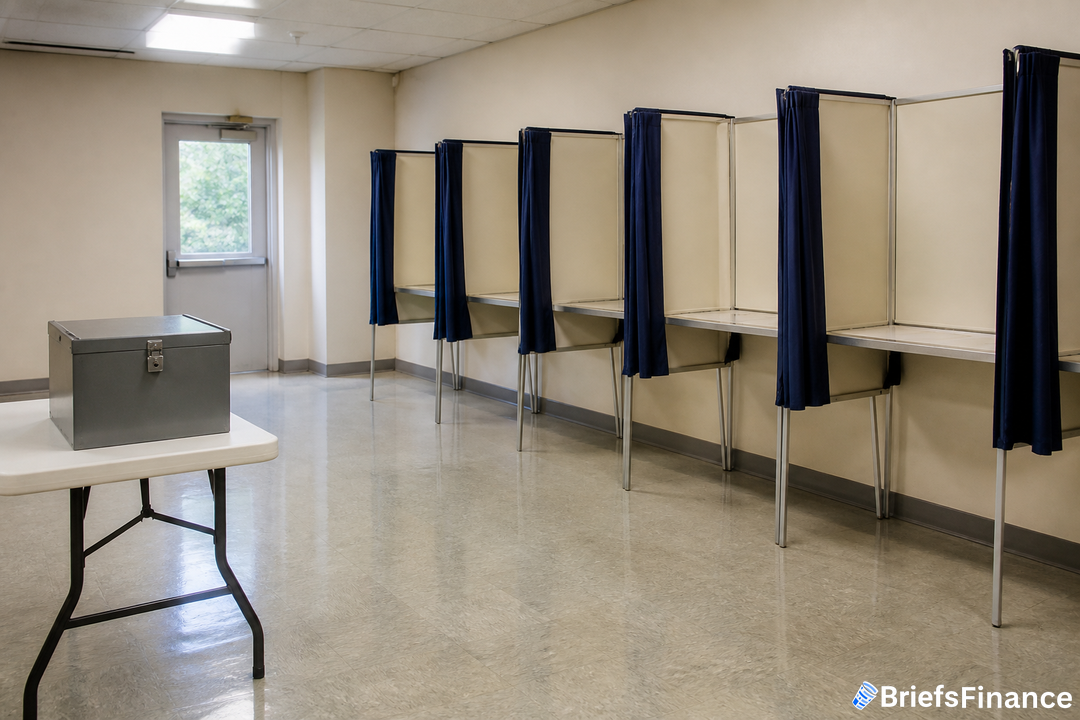
Voters on Nov. 3 will decide whether every contender for state and congressional seats appears on a single primary ballot, with the top two finishers moving on to November no matter their party label.
Backers have pulled in $5.6 million, with nearly $4 million already spent, much of it from current and former Boston private equity leaders.
A University of Massachusetts Amherst and WCVB-TV survey last month showed 51% in favor and 32% opposed among registered voters.
What The Measure Would Do
Instead of separate Democratic and Republican primaries, this proposal would place all candidates for Massachusetts state offices and U.S. House and Senate seats on one primary ballot. The two highest vote earners would advance to the general election, regardless of affiliation. California and Washington use versions of this top-two setup, while Alaska and Louisiana run different open formats.
Supporters argue the change would blunt extremes at a moment when democratic socialists and ultra-conservatives are drawing more attention nationally, and they say it could light a fire under a legislature often knocked for its slow pace in a heavily Democratic state. Harvard government professor Danielle Allen is spearheading the push; she founded the Massachusetts-based nonprofit Partners in Democracy, which backs the measure.
Where The Money Is Coming From
This is the most expensive ballot battle this cycle, eclipsing the other eight measures that remain after the state's Supreme Judicial Court threw out initiatives aimed at reducing the income tax and imposing rent caps. Donors have committed $5.6 million to the cause, and the campaign has already laid out close to $4 million, according to filings with the Massachusetts Office of Campaign and Political Finance. Some of that total was pledged last year, when the same organization also led a separate public-records measure that is now being run by a different group.
Private equity figures loom large among the biggest checks. Among the top contributors are Bain Capital Chairman John Connaughton, along with Randy Peeler, who serves as a strategic adviser at Berkshire Partners. Connaughton's giving spans both parties, while Peeler has lately concentrated on Democrats. Charlesbank Capital Partners co-founder Michael Eisenson, based in Boston, has contributed $150,000 and contends that non-partisan primaries favor candidates "who understand the need to build consensus in order to accomplish anything important." He identifies as an independent and has steered tens of thousands of dollars this cycle to Democratic congressional campaigns around the country.
Allen said she kicked off the effort with roughly $50,000 of her own funds. She added that private equity money is prominent in the mix because some of the earliest champions of the idea have deep networks in that industry.
Who's Backing And Who's Pushing Back
A handful of prominent Democrats have lined up in support, including former Governor Deval Patrick, who joined Bain following his time in office and currently serves as a senior partner at Vistria Group. The campaign is also backed by U.S. Representative Seth Moulton and former U.S. Representative Joe Kennedy III. Both Kennedy and Moulton lost Democratic Senate primary battles to progressive favorite Ed Markey - Kennedy in 2020 and Moulton in 2026. Markey opposes the ballot question, with a spokesperson saying parties should select their own strongest nominees in Massachusetts.
Opponents had raised about $150,000 through Sept. 15, but their alliance packs clout, bringing together the state Democratic and Republican parties as well as several of Massachusetts' largest labor unions. Their case is that a top-two format advantages well funded candidates who can afford what could feel like two general-election campaigns.
Political shifts remind us to keep our financial plan steady and adaptable. Join Briefs Finance CEO Jaspreet Singh on September 29th for a FREE live investor workshop, How to Profit From A Dollar That's Losing its Value, where he shows how we're spotting investment opportunities as the dollar falls. Save your spot.
Democratic state senator Lydia Edwards of Boston says there are fairer fixes, like ranked choice voting and lowering the signature threshold to get on the ballot. Similar attempts to consolidate primaries in Arizona and Nevada have fallen short in recent years.
How It Could Reshape Politics In A One-Party State
Although democratic socialists have rarely won office in Massachusetts, some on the left fear the approach could marginalize progressive contenders. Republicans, meanwhile, worry they could be excluded altogether in a state where they contend less than 10% of voters belong to their party. Most Bay Staters aren't registered with any party and can already choose which partisan primary to vote in.
Michael Minogue, the Republican challenging Democratic Governor Maura Healey in November, put it bluntly: Massachusetts has a "one-party system that is pretty corrupt and unethical, and so that one-party system would never allow anyone outside of them." Voters here have picked GOP governors, but only one Republican has made it to Washington from Massachusetts in the past three decades. In California, a Republican sometimes slips into the general when several Democrats split the left-leaning vote, which is what happened in this year's governor's race.
Jerren Chang, chief executive officer of Partners in Democracy, says a nonpartisan primary in a deep-blue state could be healthy for Democrats wrestling with how progressive or centrist they should be. "So many more folks are going to get engaged," he said.
What This Means For Your Portfolio
If voters sign off, who makes November ballots could look different, and that can change how candidates court voters and govern once in office.
When systems change, protecting and growing your savings starts with clear planning. Our CEO Jaspreet Singh is hosting a FREE live investor workshop, How to Profit From A Dollar That's Losing its Value, on September 29th. Sign up free to join him live.
Anthropic has gone public at a valuation of about $1.5 trillion, while Amazon went public in 1997 at around $440 million. Anthropic has about $33 billion in revenue this year and no profit, and investors are paying more than 40 times its sales, against about 3 times for Amazon. Briefs Finance CEO Jaspreet Singh says nobody knows what comes next, and that long-term investors use downturns to buy instead of panic selling.
Tech stocks are selling off because investors don't know who will lead Nvidia, the company that has been funding the AI industry and selling it chips.
Inflation has the Federal Reserve planning to raise interest rates, with a hike expected in December, and that puts pressure on homebuyers, private equity and the $40 trillion national debt.
Briefs Finance CEO Jaspreet Singh says nobody has a crystal ball, so his rules are to buy when markets are low, hold long term and invest only what you're willing to lose.
The national debt is above $40 trillion, and the Federal Reserve has gone from sending Washington its profits to losing money.
President Trump's four-part plan leans on shorter-term debt, stablecoin companies buying Treasuries, a bigger balance sheet and government stakes in private companies.
The goal is to outgrow the debt, not pay it off, so Jaspreet Singh points investors to the seven industries where Washington wants growth.
The Fed makes its next rate decision on December 9 and is now talking about jumbo interest rate hikes of 0.5%, though one in December looks unlikely.
Washington will pay a record $1.05 trillion in interest this year on $40 trillion of debt, and that debt resets at higher rates as the Fed hikes.
Jaspreet Singh's five moves are to pay down variable-rate debt, earn interest on your savings, know which stocks feel the pressure, look at value and hedge.
Margin debt, the money investors borrow to buy stocks, is at a record of around 4.6% of GDP, up from 3.9% in 2021.
ETF money has more than tripled in five years to 7% of GDP, while corporate buybacks and 401(k) money sit below their earlier peaks.
Margin calls and panic selling can make the next downturn deeper, so Jaspreet Singh keeps buying broad market funds and says most investors should skip margin debt.
Jensen Huang is out at Nvidia over affairs with multiple people, and the company he founded has been the bank of American AI, with about $30 billion into OpenAI and $10 billion into Anthropic.
A hotter-than-expected inflation report has Fed officials talking about a possible 0.5% hike in December, and gold, silver, and bitcoin fell on the news.
President Trump said the US may not need a deal with Iran, keeping oil prices and inflation risk high. Jaspreet Singh breaks down what it all means for AI stocks and your portfolio.
Stocks are booming at the fastest pace in years, jobless claims just hit a 57-year low, and most investors still feel like nobody is hiring.
The Fed is protecting the dollar over the economy, oil swings on every Iran headline, and a few AI companies are carrying an S&P 500 where four of five stocks sit in a correction.
Jaspreet Singh explains why circular financing between Nvidia, OpenAI, Anthropic, and SpaceX rhymes with 2008's house of cards, and how his three investing pillars handle a stock market bubble.
The Fed has raised rates, cut them, then raised them again only twice in the last 60 years, and both times the economy fell into a recession and stocks crashed.
The same stop-and-go cycle is playing out now, with one big difference: US debt is 125% of GDP today versus about 30% in 1980.
In the 1970s gold rose roughly 24x, real estate 157%, stocks lagged, and cash lost half its value. Jaspreet Singh lays out five assets to consider before the next flip.
The IRS 2027 tax plan keeps the same seven rates but widens every bracket and lifts the married-filing-jointly standard deduction to $33,200.
The 0% long-term capital gains bracket rises to $102,100, so a household living on $135,300 of investment income could owe $0 in federal income tax.
C corporations still pay 21%, small businesses keep the 20% QBI deduction, and the 401(k) limit climbs to $25,500 with an $8,500 catch-up for investors over 50.
Make sure to check your inbox for the first email.
Before you go
We’re hosting our first ever livestream on how investors can use ChatGPT & Claude to invest like a pro. It’s on 11/17 and is hosted by our CEO Jaspreet Singh.