Free NewsletterPro Login
Free Live Investors Workshop
Seats limited
Tue, Sep 29.
The dollar is losing value.
Here’s how investors can still profit.
Hosted By
Jaspreet Singh
Founder, Briefs Finance
X

Warning: Undefined variable $stocks in /var/www/briefs.co/htdocs/wp-content/plugins/oxygen/component-framework/components/classes/code-block.class.php(133) : eval()'d code on line 448

Warning: foreach() argument must be of type array|object, null given in /var/www/briefs.co/htdocs/wp-content/plugins/oxygen/component-framework/components/classes/code-block.class.php(133) : eval()'d code on line 448

Warning: Undefined variable $funds in /var/www/briefs.co/htdocs/wp-content/plugins/oxygen/component-framework/components/classes/code-block.class.php(133) : eval()'d code on line 472

Warning: foreach() argument must be of type array|object, null given in /var/www/briefs.co/htdocs/wp-content/plugins/oxygen/component-framework/components/classes/code-block.class.php(133) : eval()'d code on line 472
/* the link was here */

CMA CGM Reports 31% Profit Jump as US Firms Rush to Import Before Tariff Hikes

Published Jul 29, 2026
Share:
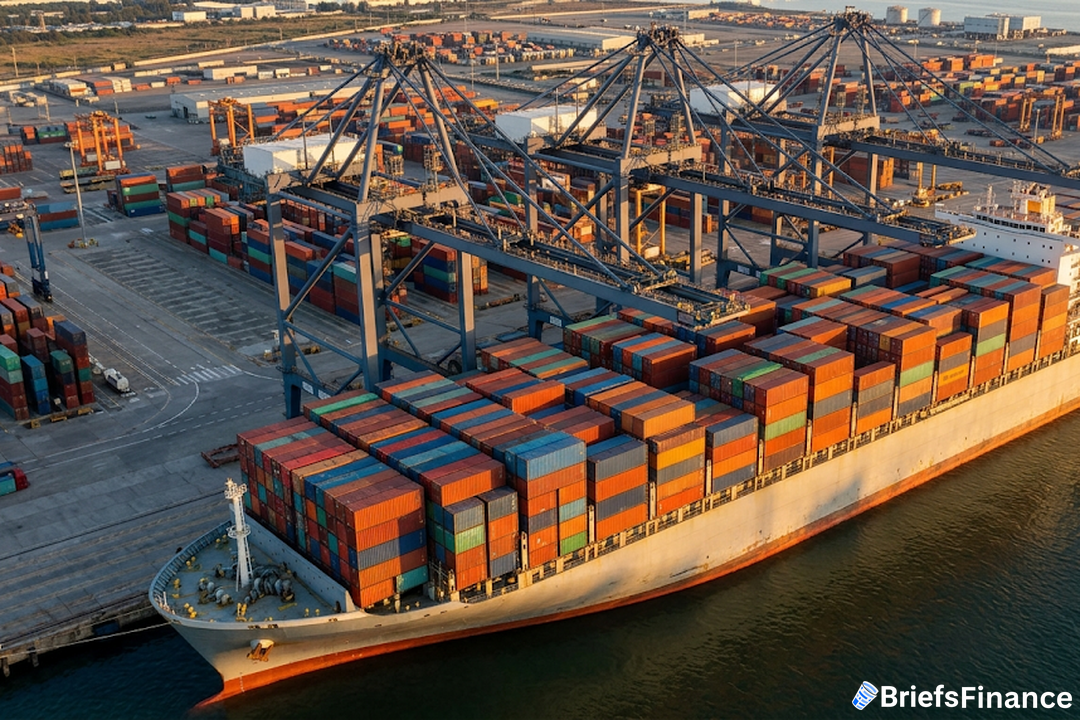
Container ship loaded with colorful containers at a busy port with cranes
Summary:
  • CMA CGM's quarterly revenue rose 19% year over year, with EBITDA climbing 31%.
  • Container volumes increased 6% as American importers stockpiled goods ahead of potential tariff hikes.
  • The company agreed to buy FedEx's logistics arm for $1.4 billion, while four of its ships remain stranded in the Persian Gulf.

Strong Earnings on a Trade Surge

CMA CGM, the world's third-largest container shipping line, is controlled by the billionaire Saade family. The company operates a vast fleet and has been navigating geopolitical tensions, including disruptions in the Red Sea and shifting US trade policies. Both a recovery in global trade and US companies stockpiling goods out of fear of future tariffs have propelled CMA CGM's recent financial performance.

The FedEx supply chain deal, expected to close later this year, will bolster CMA CGM's logistics offerings. The Saade family's controlling stake in CMA CGM has a net worth of approximately $45 billion, as estimated by the Bloomberg Billionaires Index, giving the firm significant financial flexibility to weather disruptions and pursue acquisitions.

A familiar dynamic is behind these results: US buyers have returned to Chinese suppliers, causing a surge in shipments. "Over the past months there has been a rebound of Chinese exports to the US compared to what was seen over the previous year," said CFO Ramon Fernandez on a conference call.

A Window of Opportunity

Trade decoupling simply "didn't happen" last quarter, Fernandez said.

Get the market news that matters in a five-minute read with Market Briefs, our free daily newsletter

Why? Uncertainty over US tariff policy. In February, the Supreme Court dealt a setback to President Trump's tariff strategy. Fernandez described this period as a temporary opportunity for businesses to rebuild their inventories.

Trade Rerouting and Rate Support

The ongoing Red Sea crisis has forced container lines to reroute around the Cape of Good Hope, adding weeks to voyage times and consuming vessel capacity that would otherwise be available. This supply constraint has pushed up spot freight rates, providing a tailwind for carriers. CMA CGM's four vessels stranded in the Persian Gulf underscore the geopolitical risks, but the company's diversified fleet and ability to deploy alternative routes have helped cushion the impact. Meanwhile, the broader rebound in global trade - particularly Chinese exports to the US - has further boosted volumes.

Broader Context and Strategic Position

CMA CGM operates a fleet of over 600 vessels serving more than 420 ports worldwide, giving it a global footprint that allows rapid adaptation to regional disruptions. The company has also been expanding its logistics arm through acquisitions, including the recent $1.4 billion purchase of FedEx's supply chain unit, which will add warehousing and distribution capabilities. Meanwhile, the ongoing Red Sea crisis has forced many shipping lines to take longer routes, absorbing excess capacity and supporting freight rates.

CMA CGM's strategic flexibility in adjusting its shipping routes - choosing to cross the Red Sea only when conditions are deemed safe - has set it apart from competitors.

What Comes Next

The restocking could last for months, Fernandez said. Large container shipping companies continue to reroute their ships around the Cape of Good Hope in Africa, avoiding the Red Sea route. CMA CGM says it only transits the Red Sea "when security permits."

These prolonged diversions have added weeks to transit times and pushed up freight rates, benefiting carriers like CMA CGM that have maintained flexible routing strategies. The combination of trade rerouting, pre-tariff inventory building, and a rebound in Chinese exports created an unusually supportive environment for the shipping giant.

The four stranded vessels in the Persian Gulf highlight the persistent geopolitical risks, yet the company's diversified fleet and routing options have allowed it to mitigate losses.

Join Market Briefs, our free daily newsletter, for a quick daily rundown of the markets
Disclosure

Recent News

1 2 3 82

Get Market Briefs delivered to your inbox every morning for free!

No fluff. No noise. No politics. Just finance news you can read in 5 minutes.

Blogs

September 21, 2026
How the Federal Reserve Makes Money - and Why It Just Posted Its Biggest Loss Ever
  • For 109 years the Federal Reserve created money, lent it to the U.S. government and handed the interest it collected back to Washington - almost $1 trillion in the decade starting in 2011.
  • Pandemic-era lending locked the Fed into earning about 2% on trillions of dollars while it now pays banks around 4%, producing a record loss of hundreds of billions in 2026.
  • The Fed covers its losses by creating money and the government covers its lost revenue by borrowing, and both feed the inflation that eats at the dollars in your account.
Read More
September 18, 2026
Kevin Warsh Just Defied Trump: What the Fed Rate Hike Means for Your Money
  • The Fed raised rates for the first time since 2023 in a unanimous vote led by Kevin Warsh, the chairman President Trump appointed to cut them.
  • Higher rates make the $40 trillion national debt, business loan resets and mortgages more expensive, but they strengthen the dollar and pay investors holding cash.
  • The war with Iran is pushing up oil, grocery and chip prices, another hike is likely in 2026, and recession talk is about to get louder.
Read More
September 17, 2026
Why America Bailed Out the Yen: The Japan Carry Trade, the Dollar and Your Mortgage Rate
  • In July 2026 the US sent money to steady the yen because Japan is the largest foreign owner of US debt, and Washington needs Japan to keep lending.
  • For decades the Japan carry trade let Wall Street borrow yen at essentially 0% and pour it into US stocks, real estate and Treasuries, and rising Japanese rates are shutting that off.
  • A weaker yen means fewer buyers for the dollar and for US debt, which pushes Treasury rates up and drags mortgage, car loan and credit card rates up with them.
Read More
September 16, 2026
Treasury Yields Are Spiking Because Lenders Are Backing Away From U.S. Debt
  • The U.S. is paying its highest 30-year borrowing rate in about two decades because its biggest lenders, the Fed, foreign governments, and banks, are all pulling back from Treasuries.
  • Every mortgage, car loan, credit card, and business loan is priced off the 10-year Treasury yield, so when Washington pays more to borrow, so do you.
  • With about $40 trillion of debt against a $32 trillion economy, the country either outgrows its debt or slides into a doom loop, and investors need a plan for both.
Read More
September 15, 2026
Fiat Currency Runs on Trust, and the World Just Stopped Trusting the Dollar
  • Gold has overtaken US treasuries as the world's top reserve asset, and central banks are now buying less US debt and more gold.
  • The US dollar is a fiat currency, meaning it's backed by a promise rather than gold, so it loses value when fewer countries want to hold it.
  • Whether the US economy or its national debt grows faster from here decides which assets stand to benefit next.
Read More
September 14, 2026
Why RAM Prices Are Soaring - and Where the Money Is Moving
  • Memory chips - the RAM inside phones, laptops, fridges, and trucks - are in a shortage Tim Cook called a 100-year flood, and some memory prices have climbed about 90% in a single quarter.
  • Four forces hit at once: AI demand, a production shutdown in 2023, build times that push any fix to 2028 at the earliest, and a bombed helium plant in Qatar.
  • The last two supply shocks ended in aggressive Fed rate hikes and market drops of around 45% and 20%, and this time Washington is spending heavily to bring memory production home.
Read More
September 11, 2026
How Is the Economy Doing? Washington Says It's Fixed, but the Numbers Don't Agree
  • Treasury Secretary Scott Bessent says the economy is fixed because lower earners' incomes are now rising faster than top earners'.
  • The Atlanta Fed and Bank of America show different numbers, and Hilton, Marriott, and McDonald's can't agree on what they're seeing either.
  • Whichever side is right, the economy is built to make investors rich, and inflation is how it does it.
Read More
September 10, 2026
US National Debt Hits $40 Trillion: Why the Economy Hasn't Collapsed Yet
  • The US national debt crossed $40 trillion in 2026 and is growing faster than the economy. The debt to GDP ratio now sits at 125%, the highest outside the pandemic and higher than World War II.
  • On September 9, 2026, Treasury Secretary Scott Bessent rolled out an emergency plan for the government to lend money to itself. Ray Dalio now says the dollar has roughly three years before real pain.
  • Empires rarely default. They debase. Since 1971, median household income grew about 8x while houses grew 17x and the S&P 500 grew 360x, so investors got richer while workers fell behind.
Read More
September 9, 2026
Your 401k Is Fueling the AI Bubble
  • About $10 trillion of 401k money sits in a $77 trillion stock market, mostly through target date funds and S&P 500 funds. Roughly 30% of every S&P 500 dollar lands in five AI-heavy tech stocks.
  • Four bubble signals run hotter today than before the 2000 crash: top-ten concentration, tech's share of the index, the Buffett Indicator, and how much of the market index funds own.
  • You only lock in an AI bubble loss if you sell. The 2022, 2020, 2008, and 2000 crashes were all buying windows for long-term investors, and the US-China AI race means government money could keep flowing in.
Read More
September 9, 2026
What Is Wealth Preservation? How To Protect Your Money From Anything
  • Wealth preservation is an investing strategy built around keeping the money you've already made instead of chasing growth.
  • It leans on assets that hold steady when markets fall - gold, Treasury bonds, and companies that keep earning through wars, crashes, and pandemics.
  • The tradeoff is real: you give up some upside, and the two key numbers to check are maximum drawdown and correlation to the market.
Read More
1 2 3 27
Share via
Copy link












