Free NewsletterPro Login

Warning: Undefined variable $stocks in /var/www/briefs.co/htdocs/wp-content/plugins/oxygen/component-framework/components/classes/code-block.class.php(133) : eval()'d code on line 448

Warning: foreach() argument must be of type array|object, null given in /var/www/briefs.co/htdocs/wp-content/plugins/oxygen/component-framework/components/classes/code-block.class.php(133) : eval()'d code on line 448

Warning: Undefined variable $funds in /var/www/briefs.co/htdocs/wp-content/plugins/oxygen/component-framework/components/classes/code-block.class.php(133) : eval()'d code on line 472

Warning: foreach() argument must be of type array|object, null given in /var/www/briefs.co/htdocs/wp-content/plugins/oxygen/component-framework/components/classes/code-block.class.php(133) : eval()'d code on line 472
/* the link was here */

Bundesbank Reports Slight Q2 Growth Despite Global Tensions

Published Jul 29, 2026
Share:
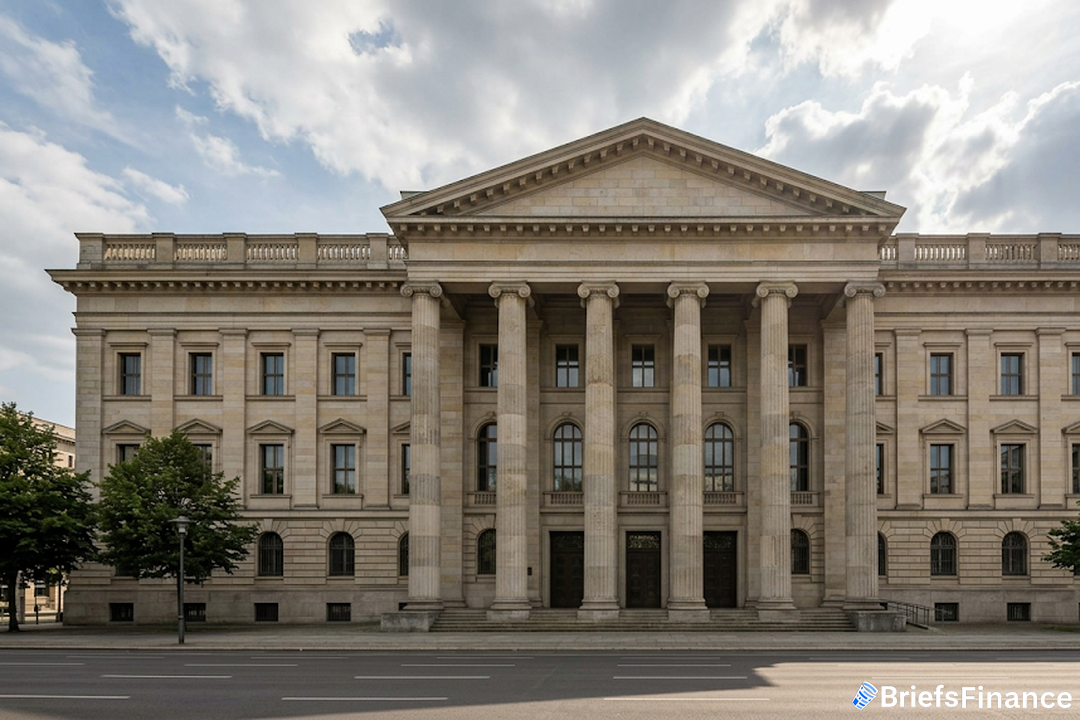
Grand German neoclassical bank building with stone columns
Summary:
  • Germany's central bank says the economy likely grew slightly in the second quarter of 2026 and should keep expanding through the third quarter.
  • Full-year growth is forecast at just 0.5%, with second-quarter GDP expected to rise only 0.1% according to a Bloomberg analyst poll.
  • The Bundesbank also found that bureaucratic red tape now costs German companies 7% of annual revenue, up from 5% in recent years.

A Modest Step Forward in a Tough Year

The German central bank, the Bundesbank, said Tuesday that output between April and June is likely to have "increased slightly." This represents an improvement from the earlier forecast of no growth, but the pace of expansion in the July-September period is expected to moderate.

The official first estimate of second-quarter GDP is due on Thursday. Bloomberg's survey of analysts anticipates a decline in growth to 0.1% compared to 0.3% in the prior quarter.

"Overall, the current set of indicators points to a slightly higher underlying economic-growth rate than anticipated," the Bundesbank stated in its monthly report, referencing its June forecast.

This projection highlights how Germany's economy has held up well against the Middle East turmoil and its impact on energy costs, although growth is slowing relative to the unexpectedly robust first quarter.

The central bank and the government both project only 0.5% growth for all of 2026, disappointing Chancellor Friedrich Merz, who had hoped for a "year of growth" after a prolonged slump.

Get the market news that matters in a five-minute read with Market Briefs, our free daily newsletter

Lately, positive developments have been observed. In July, a prominent gauge of corporate sentiment improved by more than analysts had predicted, and various polls indicate that private-sector output is once again expanding.

According to the Bundesbank, manufacturers are seeing gains from robust overseas orders and export growth, and households appear largely unconcerned about elevated energy prices. Meanwhile, increased government spending on infrastructure and defense is bolstering economic activity.

The Merz-led coalition has additionally unveiled changes to pensions, income taxes, and bureaucratic processes.

The modest 0.5% growth forecast for the full year underscores the gap between political ambitions and economic reality, with energy costs and regulatory drag continuing to mute the recovery. While the Bundesbank's assessment is more upbeat than its previous outlook, structural headwinds remain a key concern for policymakers.

The Hidden Drag on Growth

On inflation, the Bundesbank indicated a modest uptick from the current inflation rate of 2.4% is likely in the months ahead.

The Bundesbank's research further revealed that administrative burdens have risen sharply, with German firms now spending 7% of annual revenue on compliance and paperwork, compared to 5% just a few years earlier. This increase adds to the cost pressures already weighing on business investment and hiring.

What It Means for the Broader Outlook

Germany's economy has been navigating a complex landscape of high energy prices, geopolitical instability, and domestic regulatory hurdles. Chancellor Merz's coalition has introduced tax reforms and pension adjustments aimed at stimulating activity, but the impact of those measures will take time to materialize.

Meanwhile, the ongoing conflict in the Middle East continues to inject uncertainty into energy markets, even though German households have so far absorbed higher costs without major distress. Export-oriented manufacturers are benefiting from overseas demand, but domestic consumption remains tepid. The combination of these factors means that while the second quarter may show a modest gain, the overall trajectory for 2026 is still one of sluggish performance, with structural challenges like red tape and an aging workforce persisting as long-term drags.

Join Market Briefs, our free daily newsletter, for a quick daily rundown of the markets
Disclosure

Recent News

1 2 3 … 91

Get Market Briefs delivered to your inbox every morning for free!

No fluff. No noise. No politics. Just finance news you can read in 5 minutes.

Blogs

October 2, 2026
Fed Interest Rates May Rise Again in 2026 - and the Newest Culprit Is AI
  • Fed Governor Barr told a meeting our head of investing research attended that higher rates are likely in 2026, lower inflation may not come soon, and AI is now pushing prices up.
  • The same week, President Trump asked the biggest AI companies to police themselves under an accord that's morally but not legally binding, because the White House sees AI as a race with China.
  • Higher rates put downward pressure on asset prices and squeeze borrowers, but the way through hasn't changed: own investments, buy on a schedule, and treat downturns as discounts.
Read More
October 1, 2026
Housing Market 2026: Why Office Buildings Are Cracking Before Houses Do
  • Office buildings are selling for 80% to 95% off because their five-year loans are resetting at much higher rates while half-empty floors have gutted the income those buildings are valued on.
  • Housing is under pressure, not cracking: a $400,000 mortgage costs $975 more a month than at 3%, but six of every seven mortgages are still under 6% and those owners are staying put.
  • Whether pressure turns into cracks is a race between unaffordability and the economy, and either way Jaspreet's rule is to treat your house as a liability and buy only what you can afford.
Read More
September 30, 2026
Dividend Investing vs. Growth Investing: Why the Slower Portfolio Can End Up Bigger
  • "What stock should I buy?" is the wrong first question. Growth, income, or wealth preservation comes first, and the goal changes which stocks even make sense.
  • At $500 a month for 30 years, 13% growth builds about $1.75 million. 10% growth plus a reinvested 4% dividend builds a little more than $2.2 million and pays a little more than $80,000 a year.
  • Income investors have US dividend ETFs, REITs, and international dividend funds to study. Growth investors have the Nasdaq 100, AI and chip funds, and small caps. None of it is a recommendation.
Read More
September 29, 2026
Why Is Gold Going Down? A 5.2% Treasury Yield Just Took Its Job
  • President Trump rejected Iran's deal to reopen the Strait of Hormuz, oil prices jumped back up, and gold fell instead of rising.
  • Treasury yields hit their highest level in more than 20 years, so investors sold gold and bought Treasuries that pay interest.
  • Higher Treasury yields make the national debt, mortgages, car loans, and credit cards more expensive, with the Fed's next rate decision due October 28.
Read More
September 28, 2026
The Strategic Bitcoin Reserve: Why the Government Wants Bitcoin to Explode
  • The US government holds about 328,000 Bitcoin, worth roughly $25 billion, and since a 2025 executive order it keeps seized coins instead of selling them.
  • Washington wants a bigger pile of assets so its $40 trillion national debt looks smaller next to them, which lets it keep borrowing and spending.
  • Bitcoin's wild price swings, and a government holding a coin built to escape governments, are the two risks investors need to watch.
Read More
September 25, 2026
BRIEFS EXCLUSIVE: 43% Of Respondents Say Bills Outran Their Income Over Past Two Years
  • 43% of the 494 Market Briefs readers surveyed said their bills grew faster than their income over the past two years, even though 79% could cover a surprise $5,000 expense tomorrow.
  • Half of readers own gold or crypto, the two classic bets against a weaker dollar, and only 13% bought nothing at all in the last 12 months.
  • The median reader says it takes $150,000 a year to feel financially secure, about $62,000 above the U.S. median household income.
Read More
September 25, 2026
The Economy Is Booming. So Why Did Stocks and Bonds Fall Together?
  • S&P Global says the US economy is growing at its fastest rate since 2021, with corporate profits up 28.9% in a year, almost four times the historical average.
  • Stocks and bonds fell at the same time, which is not how the two markets normally behave, because Treasury yields above 5% now compete with stocks for investors' money.
  • Jaspreet Singh lays out three ways to invest through a shift like this: always be buying, buy the crash, or follow the money before it hits the headlines.
Read More
September 24, 2026
The 2026 Economic Reset Is Starting: Are We in a Recession, or Is the Pain Still Ahead?
  • The Federal Reserve has flipped from stimulating the economy to fighting inflation with higher interest rates, while the White House still wants growth at almost any cost.
  • The national debt tops $40 trillion, has outgrown the entire U.S. economy, and its interest payments are now the government's fastest-growing expense.
  • Higher rates bring pain for private equity, private credit, and speculative assets, but they open opportunities for investors holding cash, treasuries, and value assets.
Read More
September 23, 2026
Are We in a Recession? Without AI, America Might Already Be in One - and Washington Knows It
  • The White House attributes about three quarters of U.S. economic growth to AI, and many believe the economy would already be in a recession without it.
  • Washington has three reasons it cannot let the AI boom slow down: staying the world's superpower, outgrowing $40 trillion in national debt, and protecting a government stock portfolio worth billions.
  • Every market goes through booms and busts, and investors who understand the cycle get to buy the downturn instead of panic-selling with the crowd.
Read More
September 22, 2026
Will Interest Rates Go Down in 2026? Where the Money Moves Either Way
  • The Fed is leaning toward higher rates to fight 4% inflation, while the White House and a cracking job market push the other way.
  • If rates rise, money has tended to move toward short-term Treasuries, floating-rate loans, energy, banks and dividend payers.
  • If rates fall, it has tended to move toward gold, silver and Bitcoin, real estate, small caps, the S&P 500 and speculative bets.
Read More
1 2 3 … 28
Share via
Copy link











