Free NewsletterPro Login
S&P 500 6,287 +0.42%
DOW 44,521 -0.18%
NASDAQ 21,103 +0.71%
S&P 500 +12.4%
Briefs Finance Fund +24.8%
JOIN THE FUND →

Ukrainian Drone Attack Disrupts Russia's Top E-Commerce Firm, Hurting War Economy

Published Jul 29, 2026
[tts_player]
Share:
Summary:
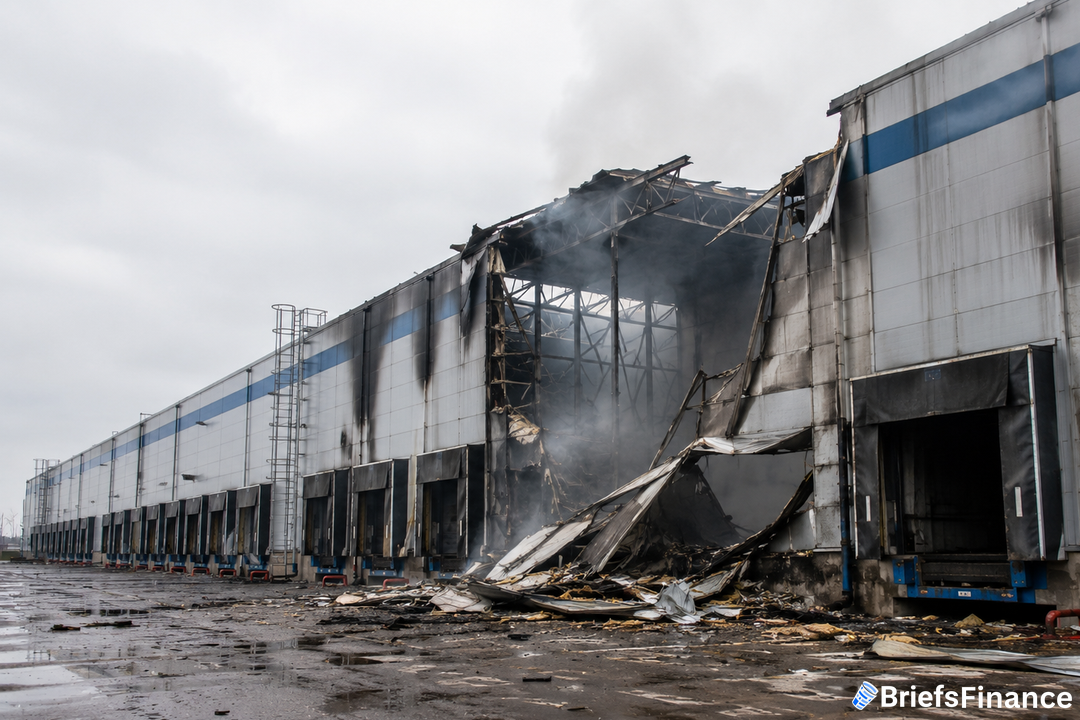
  • Ukraine attacked the logistics facilities of Wildberries, Russia's largest online retailer, in a drone strike on July 24, 2026.
  • The strike is part of a strategy to increase economic pressure on Russia and force President Putin toward negotiations.
  • Russia's economy is stalling with zero percent growth expected this year and industrial output already contracting.

A New Target in Russia's Economy

For nearly four and a half years, Ukraine has fought Russia's invasion with soldiers and weapons. Now Ukraine is targeting a different realm: the civilian economy that Russians rely on daily.

Wildberries, which employs roughly 48,000 people, is a household name across Russia. The drone strike hit its logistics hubs, aiming to disrupt the supply chain for a wide range of consumer goods - from electronics to clothing - that millions of ordinary Russians purchase regularly. The message is clear.

Natalya Kovaleva, an expert on Russia and Eurasia at Chatham House, outlined the mounting difficulties: "Western sanctions fractured supply chains. Tax increases squeezed margins. Internet blackouts disrupted operations. And recent fuel shortages drove up costs while adding to inflationary pressures."

Get the market news that matters in a five-minute read with Market Briefs, our free daily newsletter

She noted that although Russian entrepreneurs have mostly managed to cope with these difficulties, "Ukrainian strikes on Wildberries present a significant new development, reflecting Kyiv's broader effort to ratchet up economic pressure on business and ordinary Russians."

The Russian Economy Is Running Out of Steam

Even before the drone strike, Russia's economy was showing cracks. Elina Ribakova, senior fellow at the Peterson Institute for International Economics, laid out the numbers: "The Russian economy has stalled. It will have growth of zero percent this year - at best, we have seen contraction of the economy in the first quarter and industrial output contraction as well."

"That last part matters more than it sounds. Industrial output contraction means that also the defense sector has decelerated meaningfully," Ribakova said. "So, Russia is vulnerable." This stagnation marks a notable departure from the early war years, when heavy state spending on defense temporarily propped up growth, but now persistent inflation and weakening demand are taking a toll.

For much of the war, Russia seemed to defy Western sanctions thanks to energy revenues and wartime spending. But now the cracks are widening. The state-controlled bank VTB is expected to help prop up Wildberries, and Sberbank is said to have created a plan to restructure loans for the retailer's vendors.

She added: "It remains to be seen if this strategy will have the desired effect. Even as it becomes even harder to do business in Russia, the country's elites appear more dependent on - and wary of - the Kremlin [than] ever before."

Ribakova also pointed to another factor: the connection with Iran. "The fact that Iran is able to close the Strait of Hormuz is boosting oil prices and, of course, giving Russia another way to continue fighting in Ukraine."

Meanwhile, U.S. lawmakers are again moving to impose stricter sanctions on Russia; a bill backed by the late Senator Lindsey Graham has cleared an initial Senate vote. Ribakova stated that this kind of energy sanctions bill could prove "extremely impactful" to Putin's wartime economy.

Join Market Briefs, our free daily newsletter, for a quick daily rundown of the markets
Disclosure

Recent News

1 2 3 45

Get Market Briefs delivered to your inbox every morning for free!

No fluff. No noise. No politics. Just finance news you can read in 5 minutes.

Blogs

June 29, 2026
Portfolio Diversification: Why Putting All Your Eggs in One Basket Destroys Wealth
  • Real diversification means spreading investments across all 11 economic sectors plus bonds, alternatives, and cash so no single bet can sink the portfolio.
  • Different sectors perform at different times, so a diversified portfolio captures upswings while smoothing the brutal drawdowns that wipe out concentrated bets.
  • Total market index funds offer the simplest path to diversification, and annual rebalancing is what keeps the structure working over time.
Read More
June 29, 2026
Non Taxable Income: What It Is and Why It Matters
  • Non taxable income is money you receive that you don't owe income tax on.
  • The tax code treats workers, investors, and business owners very differently, and investors often come out ahead.
  • Learning how income is taxed is a quiet superpower for keeping more of what you earn.
Read More
June 29, 2026
Semiconductor Stocks: A Simple Guide for Investors
  • Semiconductor stocks are companies that design and make computer chips, the brains inside nearly every modern device.
  • The AI boom has turned chips into one of the market's most important and most watched groups.
  • They offer big growth potential, but come with high valuations and a notoriously cyclical history.
Read More
June 25, 2026
How Stocks Work: A Simple Guide for Beginners
  • A stock is a slice of ownership in a company - buy one, and you own a piece of the business.
  • You make money two ways: the share price rising over time, and dividends paid to shareholders.
  • The simplest path for most beginners is buying into the whole market through a low-cost index fund.
Read More
June 25, 2026
Stop Loss vs Stop Limit: What's the Difference?
  • A stop loss order sells your stock once it hits a trigger price, prioritizing getting you out.
  • A stop limit order only sells within a price range you set, prioritizing price over a guaranteed exit.
  • The trade-off: a stop loss almost always executes; a stop limit might not if the price moves too fast.
Read More
June 25, 2026
Energy Stocks: A Simple Guide for Investors
  • Energy stocks are companies that produce and supply the power the world runs on, from oil and gas to newer sources.
  • They make up one of the 11 sectors of the market and tend to move with energy prices and big-picture shifts.
  • Like any sector, the key is diversification and understanding the forces driving demand.
Read More
June 18, 2026
What Is a Stop Loss Order? A Simple Guide
  • A stop loss order automatically sells a stock once it falls to a price you set.
  • It's a tool to cap losses or lock in gains without watching the market all day.
  • It works best for active strategies, and can backfire if used carelessly on long-term holdings.
Read More
June 18, 2026
Best S&P 500 Index Fund: How to Choose One
  • The best S&P 500 index fund for most investors is simply the cheapest, most established one that tracks the index well.
  • Funds like VOO, IVV, and SPY all hold the same 500 companies, so the biggest difference is the fee.
  • Pick one, automate your buys, and let time do the heavy lifting.
Read More
June 17, 2026
What Are Penny Stocks? Risks and Rewards Explained
  • Penny stocks are very low-priced shares of very small companies, often trading for just a few dollars or less.
  • They promise huge gains but carry huge risks: low liquidity, high failure rates, and wild price swings.
  • Most investors are better served by quality companies and funds than by chasing cheap shares.
Read More
June 17, 2026
Best Stocks for Beginners With Little Money
  • The best stocks for beginners with little money usually aren't individual stocks at all - they're low-cost index funds.
  • You can start with $100 or less and use small, regular investments to build wealth over time.
  • Focus on diversification and consistency, not on picking the next big winner.
Read More
1 2 3 24
Share via
Copy link












