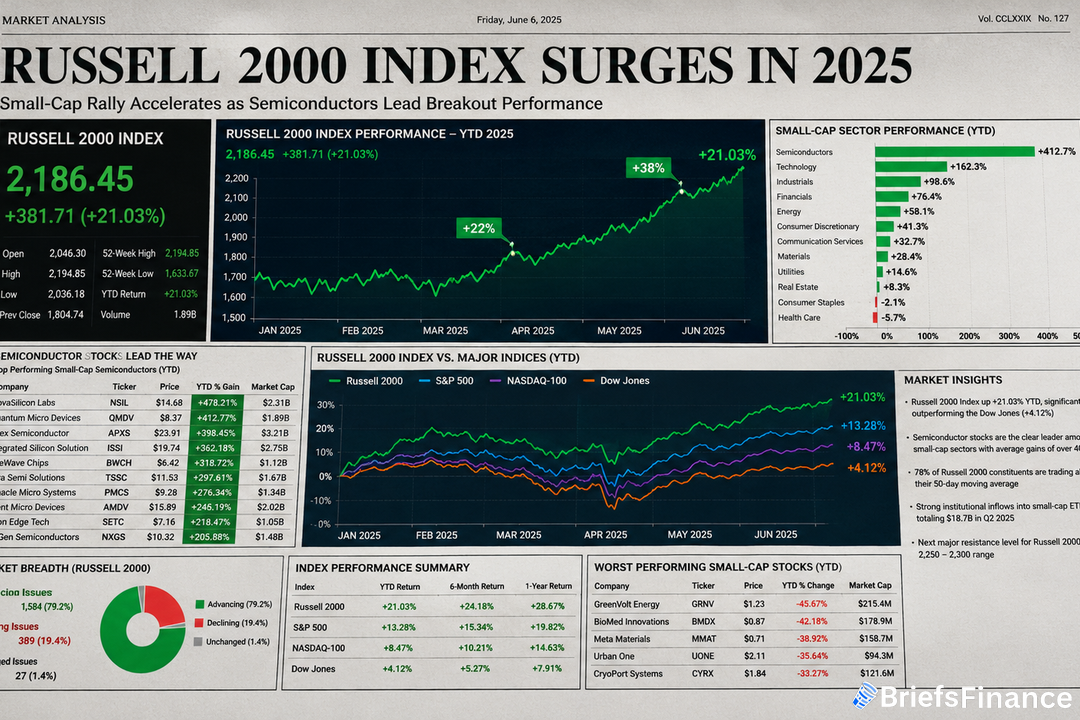
The Russell 2000 just posted its strongest first half in 35 years. But the same force that drove the rally - rapid investment in artificial intelligence infrastructure - also creates a big risk.
Small companies are now betting that interest rates stay in check. If the Federal Reserve raises rates again, their profits could take a hit.
AI Spending Fuels Small-Cap Surge
The rally started with big tech companies spending on AI infrastructure. That money has flowed to smaller suppliers, including chipmakers and equipment firms.
Amy Zhang, portfolio manager at Alger, said the move is more than just a valuation story. "It's both a valuation catch-up story and a fundamental story," she said. "The valuation gap was so wide that a truck can drive through it. At the same time, fundamentals are improving in small-caps and I think that's why it's causing the broadening trade."
Get your free investing masterclass bonus when you join Market Briefs, our free daily newsletter
LPL Financial's chief technical strategist, Adam Turnquist, said, "Small caps have meaningful exposure to semiconductors and technology hardware." "Small-cap leadership has been notable amid the mega-cap-driven bull market," he added.
The results speak for themselves. In the first half of 2026, each of three small-cap chip companies - MaxLinear, Ichor Holdings, and Aehr Test Systems - surged more than 400 percent. Analysts now expect Russell 2000 companies' earnings to grow 38 percent this year, up from a forecast of about 23 percent at the start of the year.
Interest Rate Hikes Pose Threat
Small companies carry more floating-rate debt than big firms. They also need to refinance more often. That makes them extra sensitive to higher interest rates.
Traders now see a 30 percent chance the Fed raises rates at its July 28-29 meeting. The market puts the odds of at least a quarter-point increase by September 2026 above 60 percent. Bank of America estimates that each additional quarter-point rate hike would cut Russell 2000 operating earnings by about 2 percent.
For context, the Fed raised rates by a cumulative 500 basis points between March 2022 and mid-2023. Bank of America strategists warned that further hikes "could challenge the expected 4Q profits acceleration (and sentiment) in small caps, which have the most refi risk."
Zhang believes the rate cycle may be near its peak. "We're probably close to peak inflation and peak rates," she said.
What to Watch
The small-cap rally could broaden beyond technology if rates stay put. But if the Fed hikes again, the gains may stall.
Subscribe to Market Briefs, our free daily newsletter, and claim your bonus investing masterclass