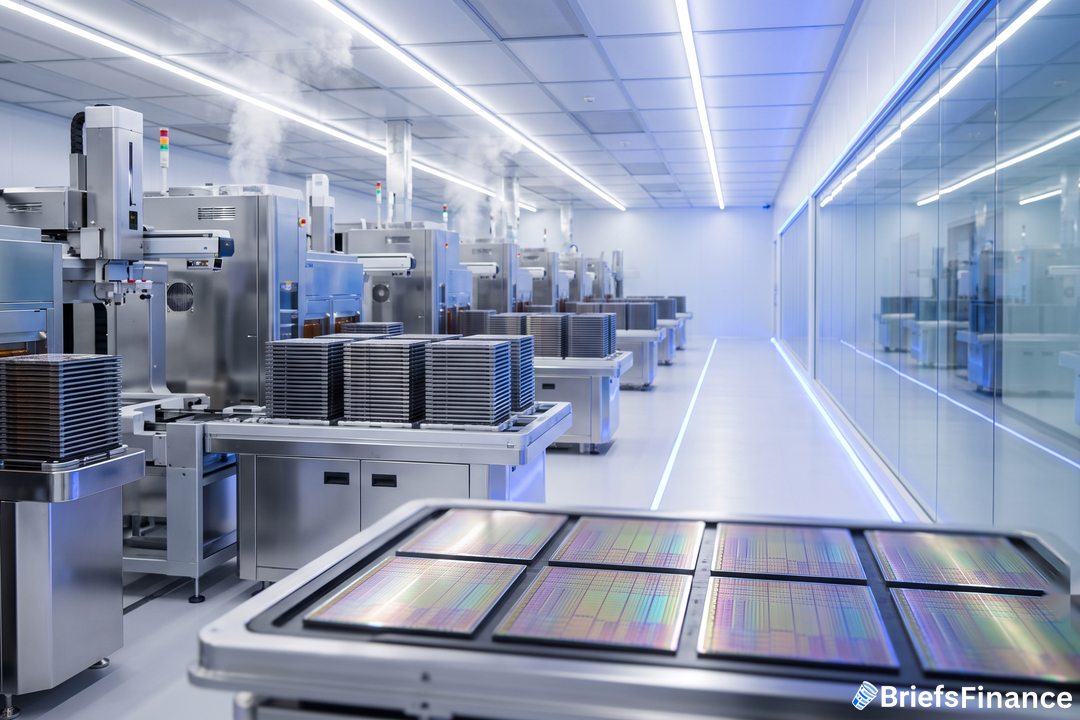
On its first Nasdaq trading session, SK Hynix saw a 13% gain, ending the day at $168.01, driven by U.S. investor enthusiasm to own a piece of South Korea's second-largest company. Shares began at $170 before easing off during Friday's market activity. These ADRs were initially sold at $149 each, generating $26.5 billion that SK Hynix plans to use for building new facilities and purchasing equipment.
"It's a kind of dream, and now it's a dream come true," SK Hynix Chairman Chey Tae-won told CNBC's Kristina Partsinevelos on Friday.
Why Investors Rushed In
The stock jumped because U.S. investors wanted to buy into the leading maker of high-bandwidth memory used in AI chips. Strong demand for AI infrastructure resulted in a memory shortage, which pushed prices sharply higher. The company dominates the market for the high-performance memory found in Nvidia's AI processors, the world's most valuable firm. Unlike standard RAM used in mobile devices and computers, AI chips need HBM - manufactured by stacking multiple conventional memory layers in an intricate procedure.
Over the last twelve months, SK Hynix's market value increased more than seven times, fueled by the AI infrastructure boom that depleted memory supplies. Among its clients are tech giants like Nvidia and Apple.
What the Chairman Says
Chey Tae-won, who also leads parent company SK Group, told CNBC, "When I meet with customers and partners, everybody expects more chips." He added, "Even when we announced doubling capacity in five years, customers said they still need more."
Get the market news that matters in a five-minute read with Market Briefs, our free daily newsletter
"All my customers said that, 'Well, that's not enough, man, and, well, we need more,'" Tae-won said Friday.
He dismissed worries that HBM demand might shrink. "The demand is enormous, exponentially, so I don't really see" signs that demand is shrinking, he told CNBC.
Chey pointed to new uses beyond data centers. "The AI agent, physical AI robot, actually that needs a lot of memory chips," he said. He believes demand has permanently changed because of AI agents and robots.
Expansion Plans
The company revealed plans for a $4 billion advanced packaging facility in Indiana. Most of the firm's future expansion will occur in its home country, featuring a $390 billion chip fab cluster in Yongin.
Some investors worry that the memory market's boom-bust cycles could lead to oversupply. But Chey argues the current boom is different because AI needs a constant stream of faster, denser chips.
Worth Noting
For context, SpaceX - led by Elon Musk - went public roughly a month earlier, achieving the biggest IPO ever recorded. SK Hynix's $26.5 billion raise is still massive.
Background on the Boom
The chipmaker's rapid rise reflects a broader shift in the semiconductor industry, where demand from artificial intelligence has outpaced traditional computing needs. SK Hynix specializes in high-bandwidth memory (HBM), a critical component for AI accelerators like Nvidia's H100 and Blackwell chips. The company's dominant position - holding roughly 50% of the HBM market - has allowed it to command premium pricing. Future growth hinges on expanding production capacity and developing next-generation HBM4 technology, which is expected to further widen its lead over rivals such as Samsung and Micron.
Join Market Briefs, our free daily newsletter, for a quick daily rundown of the markets