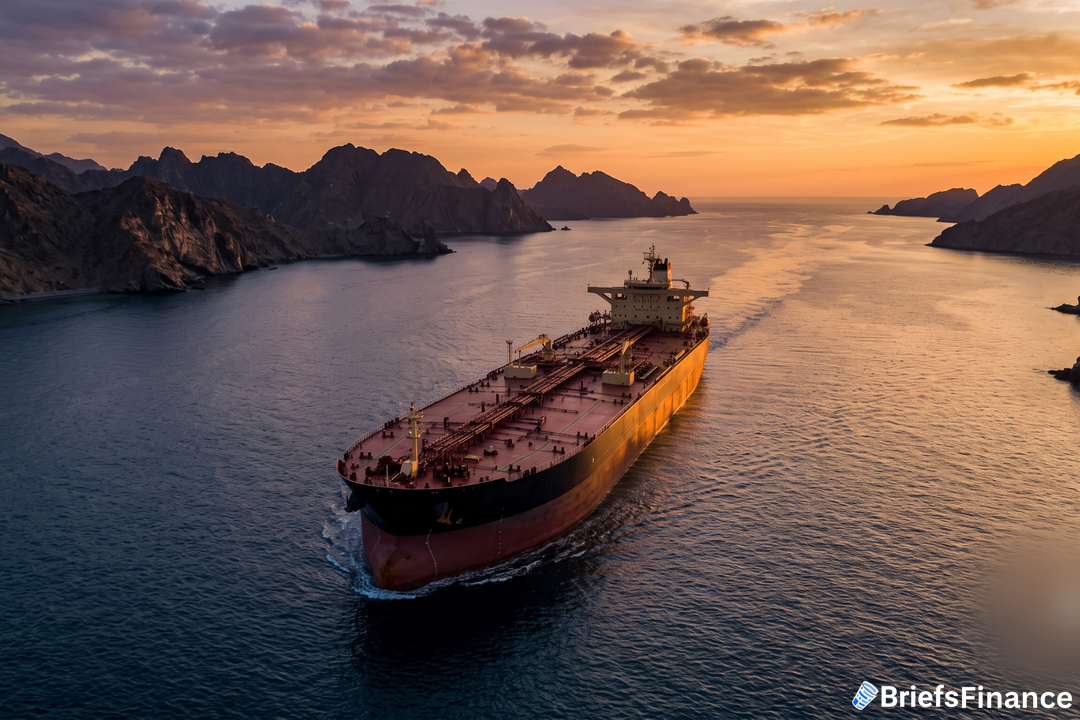
Saudi Arabia's oil exports are roaring back to near pre-war levels. Yet the Strait of Hormuz, the world's most important oil chokepoint, remains under the shadow of Iran's Islamic Revolutionary Guard Corps. Two vessels have already been attacked despite the June 2026 US-Iran interim peace deal that reopened the waterway.
The Recovery in Numbers It is also roughly the same as Saudi Arabia's average daily exports for all of 2025.
The United Arab Emirates also saw its oil exports snap back to 3.9 million barrels per day in June 2026, a full recovery to pre-war volumes. A US official estimates that total oil supply flowing through the Strait of Hormuz now exceeds 10 million barrels per day.
Get your free investing masterclass bonus when you join Market Briefs, our free daily newsletter
Why the Peace Deal Matters The surge was triggered by an interim peace deal between the United States and Iran, agreed in June 2026. The deal included terms that allowed oil tankers to again transit the Strait of Hormuz. Saudi Arabia's main export terminal at Ras Tanura, located on the Persian Gulf, could finally send ships out without the threat of Iranian seizure.
Saudi state oil company Aramco took advantage of the opening. It conducted spot transactions, selling at least 6 million barrels to customers in Asia. Tanker-tracking data from Bloomberg confirmed the passage of four supertankers owned by the Saudi shipping firm Bahri.
Each vessel is at least 300 meters long, roughly the length of three football fields. A total of eight million barrels of capacity crossed the Strait of Hormuz aboard those four ships.
Despite the deal, the Islamic Revolutionary Guard Corps still claims control over the Strait of Hormuz. Two ships have been attacked since the interim peace was signed. The IRGC said, "We will not allow foreign powers to dictate movement through the strait."
Lingering Threats and Market Implications
The Strait of Hormuz is a critical artery for global energy security, carrying about a fifth of the world's oil consumption. Even with the interim peace deal, the risk of further attacks remains high, keeping oil markets on edge. Traders are closely watching for any signs of renewed hostilities that could disrupt the fragile recovery.
This uncertainty means that while export volumes have rebounded, the underlying risk premium in oil prices is unlikely to fade quickly. Analysts suggest that a full return to pre-war stability would require a more comprehensive agreement addressing Iran's naval posture and the IRGC's role.
The conflict that preceded the interim deal began in early 2026 when Iran attacked several Saudi tankers, prompting a months-long closure of the strait. During that period, global oil prices spiked and shipping insurance costs soared. The reopening in June brought immediate relief, but the IRGC's continued presence keeps the waterway in a state of heightened alert.
Subscribe to Market Briefs, our free daily newsletter, and claim your bonus investing masterclass