Free NewsletterPro Login

Warning: Undefined variable $stocks in /var/www/briefs.co/htdocs/wp-content/plugins/oxygen/component-framework/components/classes/code-block.class.php(133) : eval()'d code on line 448

Warning: foreach() argument must be of type array|object, null given in /var/www/briefs.co/htdocs/wp-content/plugins/oxygen/component-framework/components/classes/code-block.class.php(133) : eval()'d code on line 448

Warning: Undefined variable $funds in /var/www/briefs.co/htdocs/wp-content/plugins/oxygen/component-framework/components/classes/code-block.class.php(133) : eval()'d code on line 472

Warning: foreach() argument must be of type array|object, null given in /var/www/briefs.co/htdocs/wp-content/plugins/oxygen/component-framework/components/classes/code-block.class.php(133) : eval()'d code on line 472
/* the link was here */

African Union Chief Demands Donors Pay Out $1.5 Billion in Ebola Aid

Published Jul 2, 2026
Share:
Summary:
  • South African President Cyril Ramaphosa, leading the African Union's pandemic response, is pressing donors to actually pay the $1.5 billion pledged last month.
  • The Ebola outbreak in the Democratic Republic of Congo has killed at least 440 people, with 770 confirmed cases since mid-May.
  • The rare Bundibugyo strain has no approved vaccine or treatment, and ongoing conflict in Ituri province keeps health workers from reaching many patients.

Last month, world leaders promised $1.5 billion to fight Ebola in the Democratic Republic of Congo. That money has not arrived yet. Now South African President Cyril Ramaphosa is demanding that those pledges become real cash. The outbreak is growing and the death toll is climbing.

The Numbers Behind the Outbreak Data is unavailable for May 15-16 and June 26, so the true numbers could be higher. Ramaphosa warned that the delay is costing lives.

Why the Money Matters The Ebola outbreak is caused by the rare Bundibugyo strain. Unlike other strains, there is no approved vaccine or specific treatment for it. That makes containing the outbreak harder.

Get your free investing masterclass bonus when you join Market Briefs, our free daily newsletter

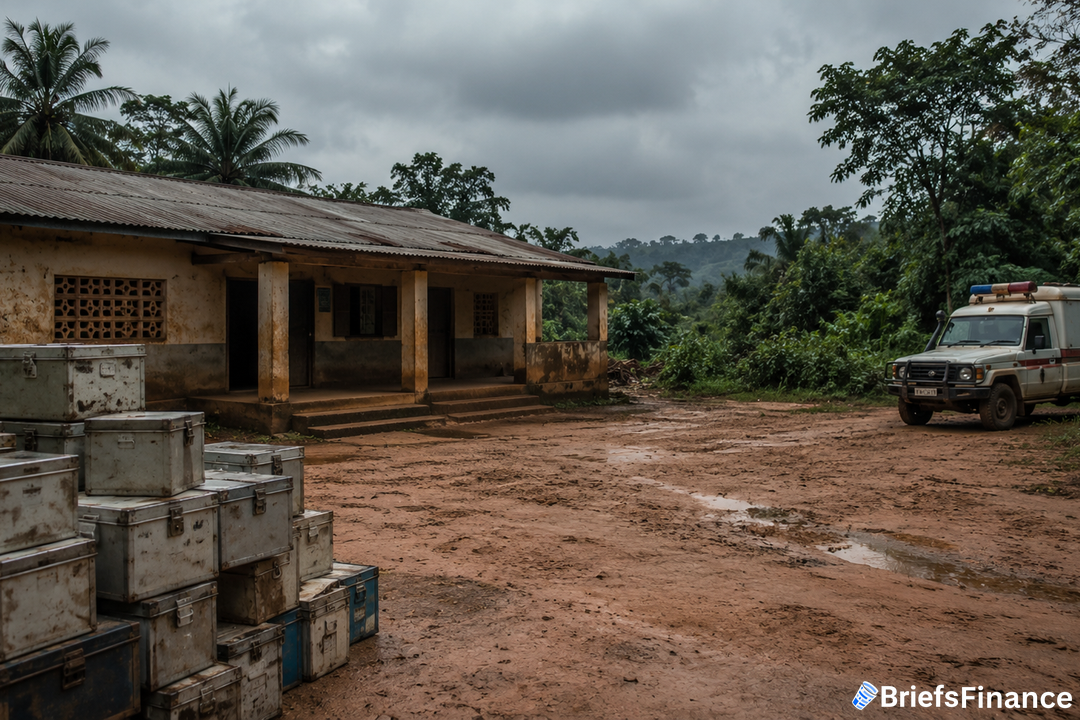
The outbreak is in the conflict-affected Ituri province. Health workers cannot reach many communities because of violence. Ramaphosa called for a ceasefire to allow aid and medical supplies to get through.

Protecting the Frontline Ramaphosa also urged communities to protect health workers and volunteers. "We appeal to every community to stand with and protect our frontline health workers and volunteers," Ramaphosa said. "They are risking their lives to save others and they must never face fear, stigma or violence while serving our people." The pledged funds are essential for sending medical supplies and expert support. "We need to rapidly convert the pledges made into financing, technical assistance and the deployment of urgently needed medical countermeasures," Ramaphosa added.

What to Watch Watch whether donors convert their pledges into actual funding soon. If the money does not arrive, the outbreak could spread further in a region already struggling with conflict. The $1.5 billion is like a promised rain that has not yet fallen on dry soil.

Broader Context of the Outbreak The Democratic Republic of Congo has weathered multiple Ebola outbreaks in the past decade, but this one is uniquely dangerous. Meanwhile, the Ituri province has been a flashpoint for armed groups for years, forcing health teams to operate under constant threat.

Previous epidemics in volatile regions have shown that funding delays can allow the virus to jump borders, especially when contact tracing and safe burials are interrupted by violence. With no medical countermeasures available, every day without resources increases the risk of a larger, uncontainable crisis.

Because no licensed vaccine exists for the Bundibugyo strain, stopping the virus depends completely on careful contact tracing, isolating patients, and conducting safe burials - every one of these methods is greatly obstructed by the ongoing violence.

Subscribe to Market Briefs, our free daily newsletter, and claim your bonus investing masterclass

Disclosure

Recent News

1 2 3 … 98

Get Market Briefs delivered to your inbox every morning for free!

No fluff. No noise. No politics. Just finance news you can read in 5 minutes.

Blogs

October 5, 2026
What Is the Briefs Connector? A Simple Guide
  • The Briefs Connector lets your favorite AI read Briefs research, like Pro reports and the Briefs Score.
  • Without it, an AI asked about investing can give answers that sound right but aren't backed by that research.
  • It explains the research, but it won't tell you what to buy or sell.
Read More
October 5, 2026
Is a Recession Coming? What the Last Five Rate Hiking Cycles Say
  • The Fed has started raising rates again, and in the last five hiking cycles going back to 1994, a recession never started while the hikes were underway.
  • The pain showed up where there was a bubble to pop - housing in 2008, dot-coms in 2000, the pandemic money-printing boom in 2022 - and usually after the hikes ended.
  • Private equity and private credit are feeling this cycle first, and how far the pain spreads depends on how high rates go and how long they stay there.
Read More
October 2, 2026
Fed Interest Rates May Rise Again in 2026 - and the Newest Culprit Is AI
  • Fed Governor Barr told a meeting our head of investing research attended that higher rates are likely in 2026, lower inflation may not come soon, and AI is now pushing prices up.
  • The same week, President Trump asked the biggest AI companies to police themselves under an accord that's morally but not legally binding, because the White House sees AI as a race with China.
  • Higher rates put downward pressure on asset prices and squeeze borrowers, but the way through hasn't changed: own investments, buy on a schedule, and treat downturns as discounts.
Read More
October 1, 2026
Housing Market 2026: Why Office Buildings Are Cracking Before Houses Do
  • Office buildings are selling for 80% to 95% off because their five-year loans are resetting at much higher rates while half-empty floors have gutted the income those buildings are valued on.
  • Housing is under pressure, not cracking: a $400,000 mortgage costs $975 more a month than at 3%, but six of every seven mortgages are still under 6% and those owners are staying put.
  • Whether pressure turns into cracks is a race between unaffordability and the economy, and either way Jaspreet's rule is to treat your house as a liability and buy only what you can afford.
Read More
September 30, 2026
Dividend Investing vs. Growth Investing: Why the Slower Portfolio Can End Up Bigger
  • "What stock should I buy?" is the wrong first question. Growth, income, or wealth preservation comes first, and the goal changes which stocks even make sense.
  • At $500 a month for 30 years, 13% growth builds about $1.75 million. 10% growth plus a reinvested 4% dividend builds a little more than $2.2 million and pays a little more than $80,000 a year.
  • Income investors have US dividend ETFs, REITs, and international dividend funds to study. Growth investors have the Nasdaq 100, AI and chip funds, and small caps. None of it is a recommendation.
Read More
September 29, 2026
Why Is Gold Going Down? A 5.2% Treasury Yield Just Took Its Job
  • President Trump rejected Iran's deal to reopen the Strait of Hormuz, oil prices jumped back up, and gold fell instead of rising.
  • Treasury yields hit their highest level in more than 20 years, so investors sold gold and bought Treasuries that pay interest.
  • Higher Treasury yields make the national debt, mortgages, car loans, and credit cards more expensive, with the Fed's next rate decision due October 28.
Read More
September 28, 2026
The Strategic Bitcoin Reserve: Why the Government Wants Bitcoin to Explode
  • The US government holds about 328,000 Bitcoin, worth roughly $25 billion, and since a 2025 executive order it keeps seized coins instead of selling them.
  • Washington wants a bigger pile of assets so its $40 trillion national debt looks smaller next to them, which lets it keep borrowing and spending.
  • Bitcoin's wild price swings, and a government holding a coin built to escape governments, are the two risks investors need to watch.
Read More
September 25, 2026
BRIEFS EXCLUSIVE: 43% Of Respondents Say Bills Outran Their Income Over Past Two Years
  • 43% of the 494 Market Briefs readers surveyed said their bills grew faster than their income over the past two years, even though 79% could cover a surprise $5,000 expense tomorrow.
  • Half of readers own gold or crypto, the two classic bets against a weaker dollar, and only 13% bought nothing at all in the last 12 months.
  • The median reader says it takes $150,000 a year to feel financially secure, about $62,000 above the U.S. median household income.
Read More
September 25, 2026
The Economy Is Booming. So Why Did Stocks and Bonds Fall Together?
  • S&P Global says the US economy is growing at its fastest rate since 2021, with corporate profits up 28.9% in a year, almost four times the historical average.
  • Stocks and bonds fell at the same time, which is not how the two markets normally behave, because Treasury yields above 5% now compete with stocks for investors' money.
  • Jaspreet Singh lays out three ways to invest through a shift like this: always be buying, buy the crash, or follow the money before it hits the headlines.
Read More
September 24, 2026
The 2026 Economic Reset Is Starting: Are We in a Recession, or Is the Pain Still Ahead?
  • The Federal Reserve has flipped from stimulating the economy to fighting inflation with higher interest rates, while the White House still wants growth at almost any cost.
  • The national debt tops $40 trillion, has outgrown the entire U.S. economy, and its interest payments are now the government's fastest-growing expense.
  • Higher rates bring pain for private equity, private credit, and speculative assets, but they open opportunities for investors holding cash, treasuries, and value assets.
Read More
1 2 3 … 28
Share via
Copy link










