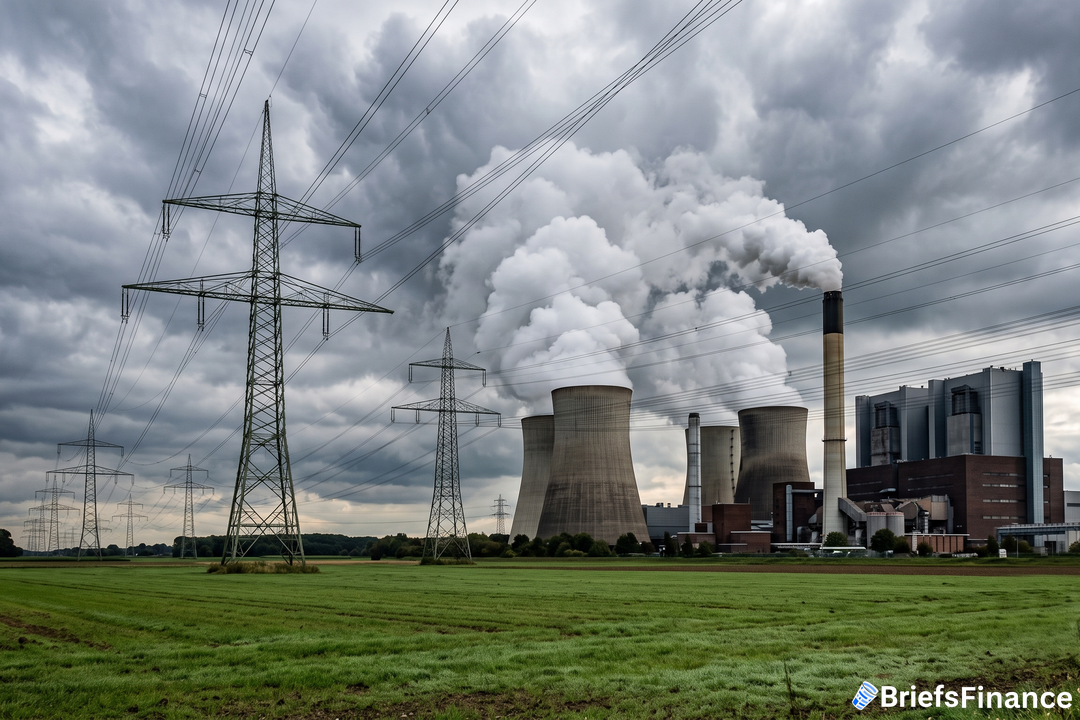
Germany wants to end coal power completely by 2038. But its grid operator now warns that rushing to close coal plants could leave the country in the dark. The operator says the power supply may become unreliable as early as the early 2030s.
This warning comes amid Germany's ongoing energy transition, the Energiewende, which has seen a rapid buildout of renewable energy sources. However, the intermittent nature of wind and solar generation necessitates reliable backup capacity. The country's emergency reserve fleet, currently dominated by coal-fired plants, provides a buffer, but its size may prove inadequate as the phase-out of coal accelerates and new gas plants are not yet online.
The Warning
Christoph Müller, CEO of Amprion GmbH, Germany's primary grid operator, proposed this during a Berlin event focused on supply security. Müller added: "No additional hard coal-fired power plants should be shut down until significant new capacity has been added."
Get your free investing masterclass bonus when you join Market Briefs, our free daily newsletter
Müller also warned that Germany's security of supply "could no longer be consistently guaranteed as early as the beginning of the 2030s without the existing reserves." All of Germany's nuclear reactors have been decommissioned. It is now closing coal plants to hit the 2038 coal-exit goal. That leaves the grid more dependent on wind and solar, which do not always produce power.
The Numbers Behind the Warning
The warning is backed by a projected gap between supply and demand. High demand periods mean the hours when people use the most power.
Germany already keeps an emergency backup fleet of power plants. That fleet has 8.8 gigawatts of capacity. Most of it - three quarters - comes from hard coal plants.
If the shortfall reaches 24 gigawatts, the backup cannot even cover one third of the gap. And if coal plants are shut down, the backup shrinks even more.
What the Government Plans to Do
Müller wants to keep existing coal plants online in the meantime.
Müller also proposed a change in how the Federal Network Agency, Germany's energy regulator, reviews coal plant closures. Currently the agency checks only for grid congestion. Müller wants it to also evaluate whether the overall generation capacity is enough before allowing more coal plants to close. He said: "The Federal Network Agency should not only assess whether grid congestion could occur, but also determine whether there is sufficient available generation capacity." If the regulator sees a shortage, it can order coal plants to stay in reserve.
Subscribe to Market Briefs, our free daily newsletter, and claim your bonus investing masterclass