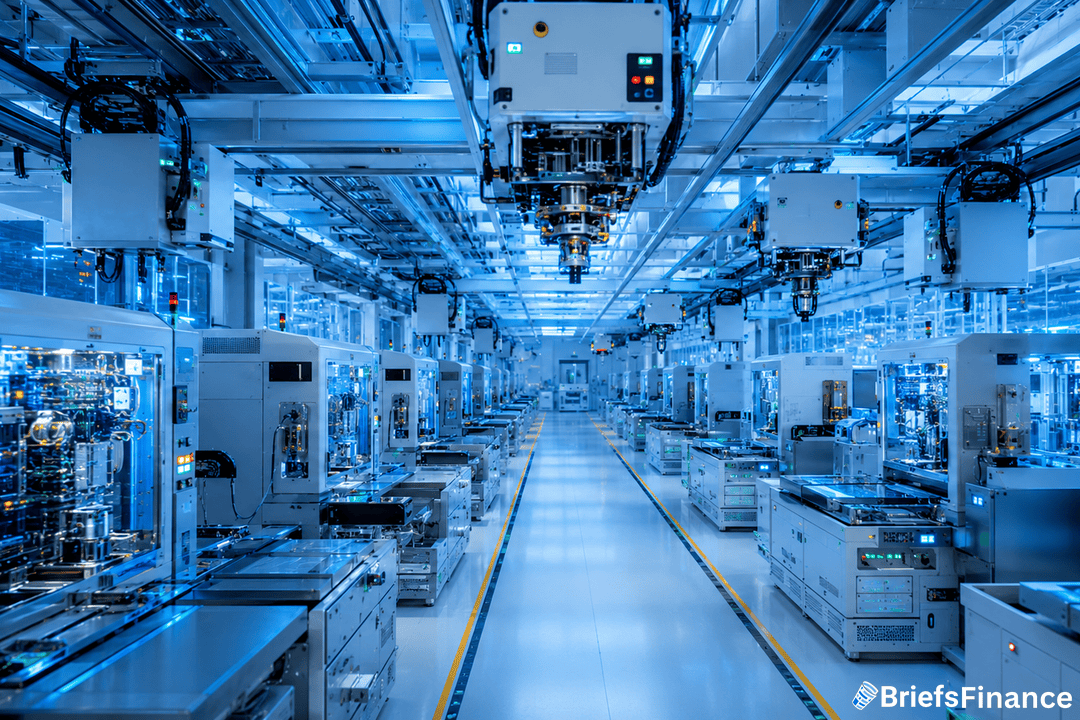
The semiconductor sector just finished its strongest quarter on record. The gains have been powered by a stampede into artificial intelligence. The biggest cloud-computing companies - Microsoft, Amazon, Alphabet, and Meta - are spending billions on AI infrastructure. That push has lifted the entire semiconductor sector.
The index is up 94% year to date, which would be its best full-year performance since 1999 if it holds. The Nasdaq 100 rose 25% in the quarter, and the S&P 500 added 14%.
The Rally's Engine: Memory and Foundry Stocks
The biggest winners are not the usual AI leaders. Sandisk Corp. rocketed 764% in the first half, making it the top S&P 500 performer. These memory and foundry companies are benefiting from what investors see as a bottleneck: demand for AI chips is so intense that it is straining the supply of memory chips and manufacturing capacity. Thornburg Investment Management portfolio manager Sean Sun described the phenomenon: "We're seeing investors follow the bottlenecks in semis, which at the moment is good for memory and good for Intel's resurgence as a foundry."
Meanwhile, Nvidia Corp. - the world's most valuable company - has lagged badly. Its year-to-date gain is just 4.5%, the weakest in the semiconductor index. Broadcom Inc. is up only 7.6%. Sun said those stocks are "running into those bottlenecks, so they're not the high-beta names the way they used to be." Investors are chasing the companies with the most upside from the AI spending wave.
Get your free investing masterclass bonus when you join Market Briefs, our free daily newsletter
Volatility Spikes as New Traders Enter and Hedge Funds Sell
The wild price swings are not normal. The Cboe Semiconductor ETF Volatility Index is up 83% year to date, on pace for its largest annual increase ever. In June, the Philadelphia semiconductor index had only one day where it moved less than 1%. It saw a single-day gain of 7.9% and a single-day loss of more than 10%.
CJ Muse, senior managing director at Cantor Fitzgerald, pointed to two causes: "There's a newness to the investor base that's exacerbating the swings, and meanwhile white papers seem to come out every week that point to new AI capabilities." Retail investors are piling in, and hedge funds are selling. Data from Goldman Sachs' prime desk shows hedge funds have been cutting their chip exposure. "We're going to be in this hyper-volatile market for a while," Muse said.
Valuations Are High but Not Crazy - Except for Some Stocks
The semiconductor index trades at 26 times forecast earnings, above its 10-year average of 19. The Nasdaq 100 is at 23 times, and the S&P 500 at 20 times. Yet a few stocks stand out: ARM Holdings Plc trades at 140 times forward earnings, and Intel at 100 times.
Nvidia, by contrast, is at 18 times - its cheapest since 2018, well below its 10-year average of 36. Micron is even cheaper at 8 times.
Sun from Thornburg said the high multiples are not alarming overall: "There are probably pockets where chips are priced for perfection and have less room for error, but overall I'd describe multiples as extended but not over-extended." Analysts expect chipmakers' earnings to grow 49% in 2027 and revenue to climb 37%, both numbers revised sharply higher since April. For context, the S&P 500 as a whole is expected to grow earnings just 17% and revenue 7.4% in 2027.
What to Watch
Investors will watch whether the big cloud companies keep spending heavily on AI infrastructure after 2026. A potential delay of OpenAI's initial public offering could be a negative signal for AI chip demand. Volatility is likely to stay high.
Subscribe to Market Briefs, our free daily newsletter, and claim your bonus investing masterclass